Successful ACL Reconstruction Surgery for Left Knee ACL Tear in a 24 Y.O. Female
PACE Hospitals
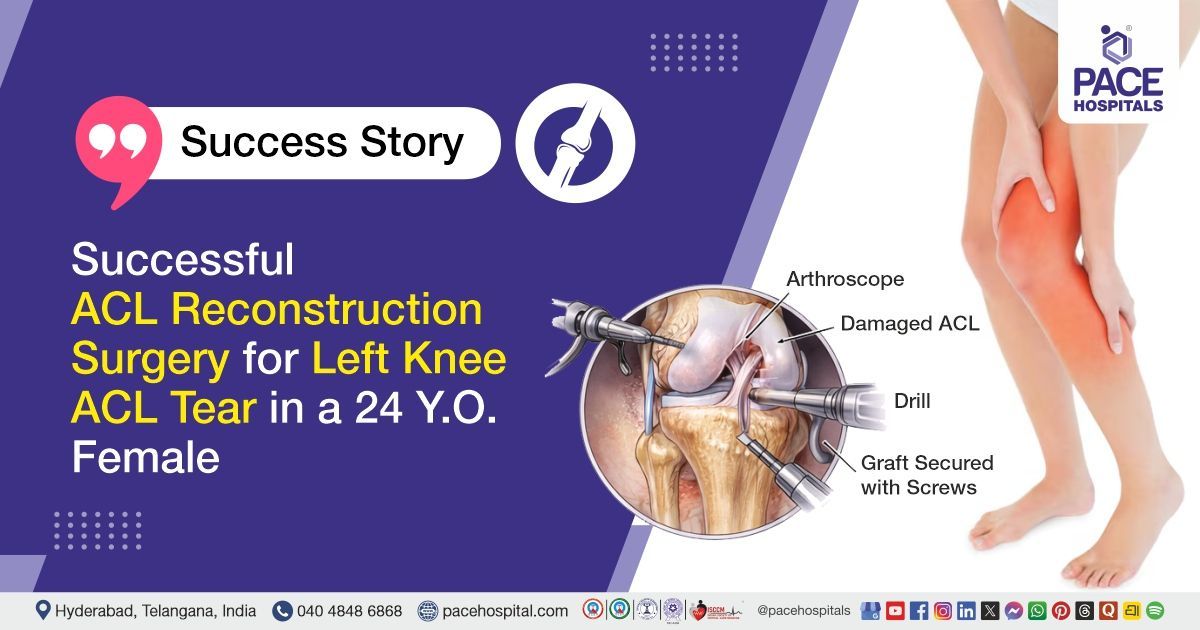
PACE Hospitals’ expert Orthopaedic team successfully performed a Left Anterior Cruciate Ligament (ACL) Reconstruction with Ipsilateral Hamstring graft in a 24-year-old female patient, who was diagnosed with a Left Anterior Cruciate Ligament (ACL) mid-substance tear. The aim of the procedure was to restore knee stability and function, allowing the patient to return safely to daily activities and sports.
Chief Complaints
A 24-year-old female patient with a body mass index (BMI) of 21 presented to the Orthopaedics Department at PACE Hospitals, Hitech City, Hyderabad, with complaints of pain, difficulty performing daily activities, and instability while climbing stairs.
Past Medical History
The patient had a history of a self-fall on the stairs at home, which resulted in the left knee injury. She had no known drug allergies or chronic illnesses, and her past medical history was otherwise normal.
On Examination
On examination, the patient was conscious, coherent and oriented with stable vitals. Systemic examination was normal. Local examination of the left knee showed tenderness over the anterior joint line, positive Anterior Drawer, Lachman, Pivot shift, and McMurray tests, negative Valgus, Varus, and Posterior Drawer tests, and grossly restricted and painful terminal flexion. No distal neurovascular deficit was noted.
Diagnosis
Following the clinical examination, the Orthopaedics team at PACE Hospitals conducted a comprehensive assessment, including a detailed review of the patient’s medical history and a focused evaluation of the left knee.
To confirm the diagnosis and evaluate the extent of the injury, a thorough clinical and systemic examination was performed. The patient exhibited tenderness over the anterior joint line of the left knee, positive Anterior Drawer, Lachman, Pivot shift, and McMurray tests, and grossly restricted and painful terminal flexion, while distal neurovascular status remained intact. Systemic examination revealed no significant abnormalities.
Initial imaging and arthroscopic evaluation of the left knee were performed to assess the extent of the injury. Findings confirmed a near total tear of the anterior cruciate ligament (ACL) with medial meniscus fraying, while the lateral meniscus appeared normal. These clinical and radiological findings established the diagnosis and guided the treatment plan.
Based on the confirmed diagnosis, the patient was advised to undergo Anterior Cruciate Ligament Tear Treatment in Hyderabad, India, under the care of the Orthopaedic Department, ensuring effective stabilization of the knee and optimal functional recovery.
Medical Decision Making (MDM)
After a detailed consultation with Dr. Anand Agroya, Senior Orthopaedic Consultant, a comprehensive evaluation was performed to determine the most appropriate diagnostic and therapeutic approach. Considering the patient’s history of a fall on stairs, clinical presentation of pain, instability, and restricted movements of the left knee, a focused local examination and radiological assessment, including arthroscopy, were undertaken to formulate an optimal treatment strategy.
Based on the clinical findings and imaging, which confirmed a near total tear of the left Anterior Cruciate Ligament (ACL) with fraying of the medial meniscus, it was determined that Left ACL Reconstruction with Ipsilateral Hamstring Graft (Semitendinosus) was identified as the most suitable surgical intervention to achieve anatomical restoration of the ligament, ensure knee stability, relieve pain, and prevent long-term complications such as chronic instability, recurrent injury, or meniscal degeneration.
The patient and her family members were thoroughly counselled regarding the severity of the injury, the necessity of surgery, the surgical procedure, associated risks, and the expected recovery process, including postoperative care and physiotherapy for optimal functional recovery.
Surgical Procedure
Following the diagnosis, the patient was scheduled to undergo Left ACL (anterior cruciate ligament) reconstruction Surgery in Hyderabad at PACE Hospitals, using an ipsilateral hamstring graft, under the supervision of the expert orthopaedic Department.
The procedure involved the following steps:
- Anesthesia and Patient Preparation: The patient was placed supine on the operating table and spinal anesthesia was administered. The surgical site was prepped and draped in a sterile fashion over a non-sterile tourniquet, with all bony prominences padded. A time-out was performed to confirm the correct surgical site, and the antibiotic dose was repeated before proceeding.
- Arthroscopic Assessment: Arthroscopy of the left knee was performed through medial and lateral parapatellar portals. The lateral meniscus was found to be normal, while fraying of the medial meniscus was noted and subsequently debrided and balanced. A near total tear of the anterior cruciate ligament (ACL) was confirmed.
- Graft Harvesting and Tunnel Preparation: The ipsilateral semitendinosus hamstring graft was harvested. The anatomic footprints of the femoral and tibial ACL insertion points were delineated and marked. Guide pins were inserted, and the knee was hyperflexed to 135 degrees to facilitate accurate placement of the tunnels.
- Graft Passage and Fixation: Reaming of the femoral and tibial tunnels was performed using appropriate drill bits. The hamstring graft was passed through the tunnels and secured using Sironix implants. The knee was assessed arthroscopically, showing a well-tensioned graft, a negative Lachman test, full range of motion, and no impingement on the PCL or intercondylar notch.
- Closure and Final Inspection: The surgical site was irrigated copiously to remove bony debris. The graft and portal sites were reapproximated using sutures and staples, and a sterile dressing was applied. The patient was then shifted to Surgical Intensive Care Unit (SICU) with no distal vascular deficit.
Postoperative Care
The operation was uneventful, and postoperatively, the patient was monitored in the Surgical Intensive Care Unit (SICU) for a few hours. On the first postoperative day, the surgical dressing was checked, and partial weight-bearing mobilization was initiated with the assistance of a walker and knee brace. By the second postoperative day, no soakage of the dressing was noted. During her hospital stay, she was managed with medications for infection prevention, pain relief, and general supportive care. She was discharged in a hemodynamically stable condition with appropriate medications and instructions.
Discharge Medications
The patient was discharged with medications for infection prevention, pain relief, and gastric protection, to be taken as advised.
Advice on Discharge
The patient was advised to mobilize with partial weight bearing, using a walker and brace, strictly until further notice. The dressing was not to be wet. Ice packs were to be applied every four hours for 10 minutes each. Physiotherapy exercises were continued as previously advised, including knee extension, quadriceps strengthening, calf pump exercises, and the ACLR and meniscus rehabilitation protocol.
Emergency Care
The patient was informed to contact the emergency ward at PACE Hospitals in case of any emergency or development of symptoms such as:
- Severe pain at the operated site.
- Discoloration or swelling of the operated site/limb.
- Excessive bleeding or discharge from the operated site.
- Chest pain.
- Acute shortness of breath.
- Altered sensorium.
- Low urine output in the last 24 hours.
- Nausea, vomiting, allergy, or drug intolerance.
- High-grade fever.
Review and Follow-up Notes
The patient was advised to return for a follow-up visit with the Orthopaedic Doctor in Hyderabad at PACE Hospitals after 5 days for dressing in OPD with prior appointment and further course of action pertaining to physiotherapy.
Conclusion
This case highlights a near-complete anterior cruciate ligament tear with medial meniscus fraying, which was successfully treated with arthroscopic ACL reconstruction using a hamstring graft. The procedure was uneventful, and the patient remained stable postoperatively. Early mobilization with partial weight bearing and physiotherapy was initiated. Clear instructions for wound care, pain management, and emergency signs were provided, with follow-up planned.
Comprehensive Management of ACL Tears with Meniscus Injury
High-grade anterior cruciate ligament (ACL) tears, particularly those associated with medial meniscus fraying, require careful surgical planning to restore knee stability and ensure durable graft fixation. Arthroscopic reconstruction using an ipsilateral hamstring graft provides precise anatomical placement, minimal soft tissue disruption, and strong fixation, supporting early mobilization. Multidisciplinary care, including evaluation and surgical management by an orthopaedic doctor / orthopaedic surgeon, is essential for optimal perioperative outcomes.
Proper postoperative monitoring, pain management, and structured physiotherapy help prevent complications and promote functional recovery. Early follow-up and patient education on exercises, wound care, and recognition of emergency signs are crucial for safe rehabilitation. Integrating surgical expertise, supportive care, and rehabilitation protocols ensures the best long-term knee function and stability.
Share on
Request an appointment
Fill in the appointment form or call us instantly to book a confirmed appointment with our super specialist at 04048486868
Appointment request - health articles
Recent Articles