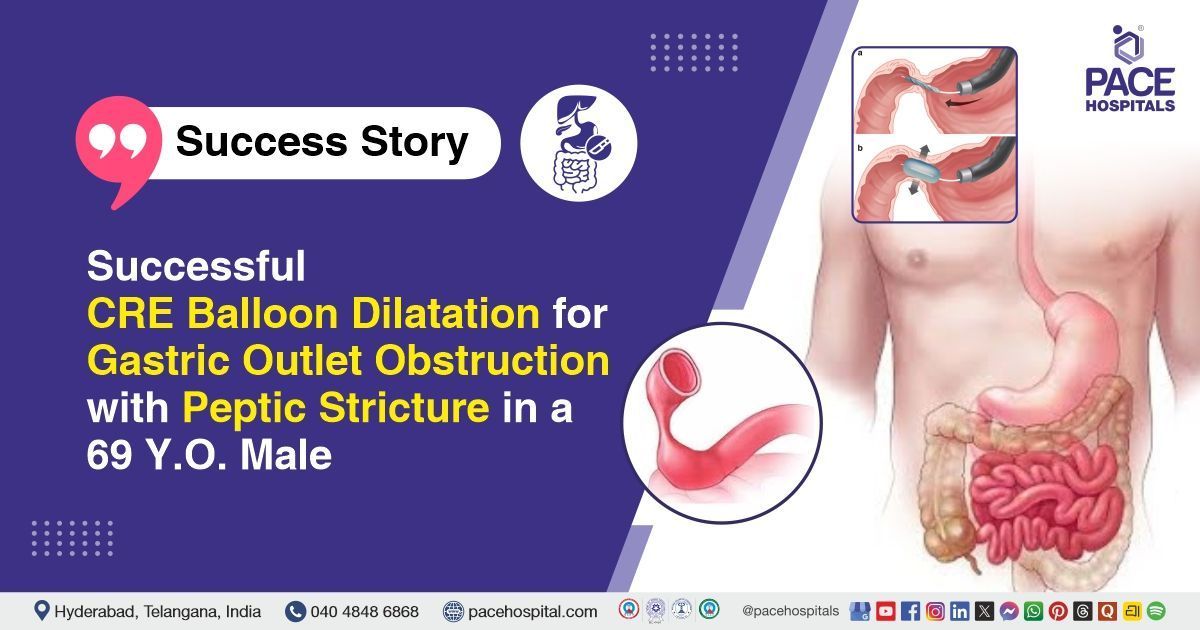
Successful CRE Balloon Dilatation for Gastric Outlet Obstruction with Peptic Stricture in a 69 Y.O. Male
PACE Hospitals
PACE Hospitals’ expert Gastroenterology team successfully performed Controlled Radial Expansion (CRE) Balloon Dilatation on a 69-year-old male patient who had been diagnosed with Gastric outlet obstruction secondary to a D1 duodenal peptic stricture, associated with Helicobacter pylori gastritis, with hypertension as a comorbid condition. The staged endoscopic dilatation sessions were aimed at relieving duodenal narrowing, improving gastric emptying, and restoring oral intake.
Chief Complaints
A 69-year-old male with a body mass index (BMI) of 22 presented to the Gastroenterology Department at PACE Hospitals, Hitech City, Hyderabad, with chief complaints of long-standing epigastric pain for nearly 15 years, described as intermittent pricking pain, associated with indigestion. The symptoms were partially relieved with medications. He was later admitted for evaluation and management of suspected gastric outlet obstruction.
Past Medical History
The patient had a known history of hypertension and was on regular antihypertensive medications. There was no documented history of abdominal surgery or malignancy.
On Examination
On general examination, the patient was conscious, coherent and oriented, and hemodynamically stable. Vital signs were normal. Abdominal examination showed a soft, non-tender abdomen with no palpable organomegaly. There were no signs of guarding or rigidity. Examination of the cardiovascular, respiratory, and other systemic systems was normal.
Diagnosis
Upon admission to PACE Hospitals, the patient was thoroughly evaluated by the Gastroenterology team, which included a clinical examination and a history of long-standing epigastric pain for nearly 15 years. There was a strong clinical suspicion of a gastric outlet obstruction.
The patient underwent necessary investigations. Upper gastrointestinal endoscopy revealed a hiatus hernia with congestive gastropathy and narrowing at the D1 portion of the duodenum, suggestive of gastric outlet obstruction. The rapid urease test was positive. CT abdomen with oral and intravenous contrast showed mild focal narrowing of the D1 portion of the duodenum with mild gastric distension and no evidence of mass lesion or extrinsic compression. Routine laboratory investigations, including complete blood picture, renal function tests, liver function tests, electrolytes, coagulation profile, thyroid function tests, viral markers, and cardiac evaluation, were within normal limits. Imaging also revealed grade I fatty liver.
Based on the confirmed diagnosis, the patient was advised to undergo Gastric Outlet Obstruction Treatment in Hyderabad, India, under the expert care of the Gastroenterology Department, to effectively address and relieve his symptoms.
Medical Decision Making
After a detailed consultation with consultant gastroenterologists, Dr. Govind Verma, Dr. M Sudhir, Dr. Padma Priya and cross consultation with surgical gastroenterologist, Dr. Suresh Kumar S, a thorough evaluation was conducted considering the patient’s complaints of epigastric pain, an optimal treatment strategy was formulated.
Based on these clinical and imaging findings, it was determined that Controlled Radial Expansion (CRE) balloon dilatation was identified as the most appropriate intervention to relieve his symptoms, restore bowel continuity, and prevent further complications.
The patient and his family members were counselled regarding the diagnosis, the planned procedure, its associated risks, including bleeding or perforation, and its potential to relieve symptoms and improve quality of life.
Surgical Procedure
Following the decision, the patient was scheduled to undergo Controlled Radial Expansion (CRE) Balloon Dilatation in Hyderabad at PACE Hospitals under the expert supervision of the Gastroenterology Department.
The following steps were carried out during the procedure:
- Upper Gastrointestinal Endoscope Passage and Assessment: An upper gastrointestinal endoscope was carefully inserted through the oral cavity and advanced into the stomach. On evaluation, a narrowing was identified at the D1 portion of the duodenum, consistent with a peptic stricture causing gastric outlet obstruction (GOO).
- CRE Balloon Dilatation: Controlled radial expansion (CRE) balloon dilatation was performed in a graded manner. During the first session, the stricture was dilated up to 15 mm. In the subsequent session, further dilatation was achieved up to 18 mm under endoscopic guidance.
- Assessment of Luminal Patency: After the balloon dilatation procedure, the endoscope was gently negotiated across the old narrowed duodenal segment, indicating adequate widening of the lumen.
- Post-Procedure Evaluation: Post-dilatation evaluation indicated satisfactory luminal patency with no evidence of bleeding, perforation, or immediate complications. A post-procedure contrast study showed no leak.
Postoperative Care
The procedure was uneventful, and the patient’s postoperative recovery was satisfactory. During the hospital stay, he received necessary medications. He was discharged in a stable hemodynamic condition with appropriate postoperative instructions and follow-up advice.
Discharge Medications
Upon discharge, the patient was prescribed medications for acid suppression, eradication of gastric infection, symptomatic relief of gastric motility, and continuation of treatment for blood pressure control.
Advice on Discharge
The patient was advised to follow a low-residue soft diet and to adhere strictly to prescribed medications. Dietary modifications and avoidance of irritant foods were emphasized.
Emergency Care
The patient was informed to contact the emergency ward at PACE Hospitals in case of any emergency or development of symptoms such as fever, abdominal pain and vomiting.
Review and Follow-up Notes
The patient was advised to return for a follow-up visit with the Gastroenterologist in Hyderabad at PACE Hospitals after 3 weeks for further evaluation.
Conclusion
This case demonstrates the successful endoscopic management of gastric outlet obstruction caused by a benign D1 peptic stricture in an elderly male patient. Staged CRE balloon dilatation effectively relieved the obstruction, allowing the patient to resume oral intake and achieve symptomatic improvement. The patient was discharged in stable condition with appropriate medical therapy and follow-up advice.
Integrated Endoscopic and Diagnostic Approach in Benign Duodenal Stricture
Accurate endoscopic assessment combined with cross-sectional imaging plays an important role in differentiating benign (non-cancerous) from malignant (cancerous) causes of gastric outlet obstruction. Timely evaluation and intervention by an experienced gastroenterologist / gastroenterology doctor are important for correct diagnosis and treatment planning. CRE balloon dilatation provides a minimally invasive and effective treatment option for benign duodenal strictures. Careful post-procedure monitoring, dietary modification, eradication of H. pylori, and planned follow-up help ensure sustained clinical improvement and decrease the risk of recurrence.
Share on
Request an appointment
Fill in the appointment form or call us instantly to book a confirmed appointment with our super specialist at 04048486868
Appointment request - health articles
Recent Articles