Successful Fistulectomy for Perianal Fistula in a 67 Y.O. Male with Multiple Comorbidities
PACE Hospitals
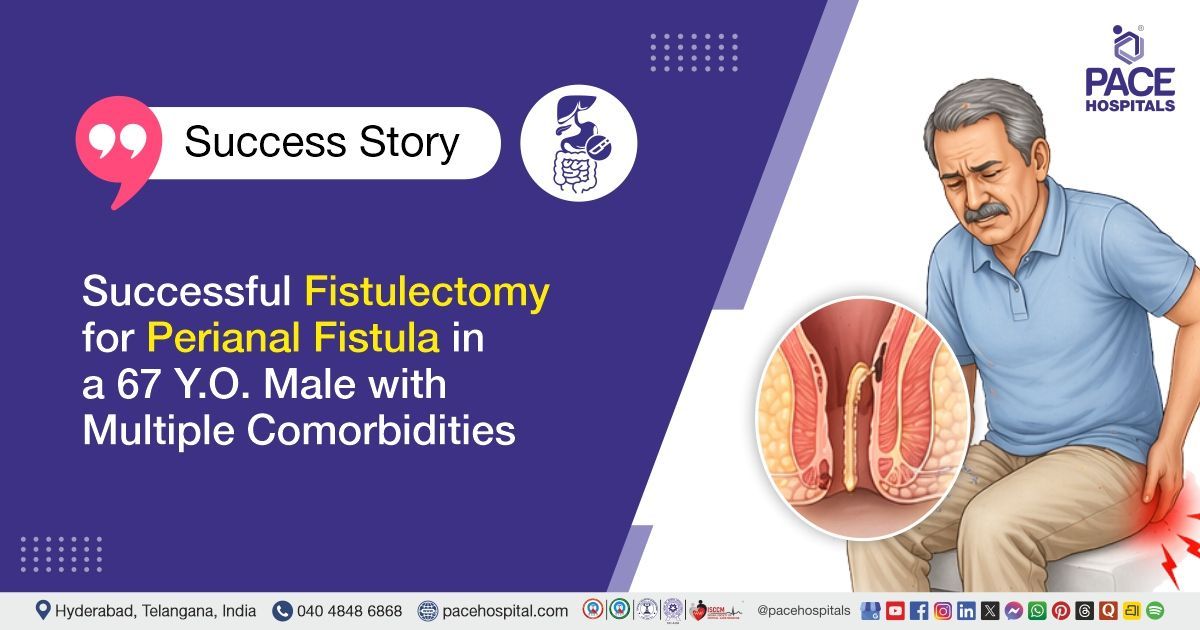
PACE Hospitals’ expert Surgical Gastroenterology team successfully performed a Fistulectomy on a 67-year-old male patient diagnosed with Fistula in Ano, Hypertension, Meralgia Paresthetica, and Dyslipidemia. The aim of the procedure was to completely remove the fistulous tract, eliminate infection, relieve symptoms such as pain and discharge, and prevent recurrence, thereby improving the patient’s overall quality of life.
Chief Complaints
A 67-year-old male patient with a body mass index (BMI) of 20 presented to the Surgical Gastroenterology Department at PACE Hospitals, Hitech City, Hyderabad, with complaints of intermittent pus and bloody discharge from the perianal region for the past six months. He also reported pain following defecation. The symptoms were recurrent in nature and were not associated with fever or abdominal pain.
Past Medical History
The patient was a known case of Hypertension and was on regular treatment. He also had associated comorbidities, including Dyslipidemia and Meralgia Paresthetica (burning thigh pain), for which he was under medical management. There was no documented history of diabetes mellitus, major abdominal illnesses, or prior similar anorectal surgeries.
On Examination
On examination, the patient was conscious, coherent, oriented, and with stable vitals. Systemic examination revealed normal cardiovascular findings with normal heart sounds. Respiratory system examination showed adequate bilateral air entry. Abdominal examination was soft with no tenderness. Central nervous system examination did not reveal any focal neurological deficits.
Diagnosis
Upon admission to PACE Hospitals, the patient was thoroughly evaluated by the Surgical Gastroenterology team. He presented with complaints of intermittent pus and bloody discharge from the perianal region for six months, associated with pain following defecation. There was no history of fever or abdominal pain. Clinical assessment and history were suggestive of a fistula in Ano.
The patient underwent further diagnostic evaluation. MRI fistulogram revealed a long, complex fistulous tract in the left perineal region with intersphincteric extension and associated branching tracts with a small collection. Histopathological examination of the excised tissue showed granulation tissue consistent with a fistulous tract and was negative for granulomas. Routine laboratory investigations, including complete blood picture, liver function tests, renal function tests, blood sugar levels, lipid profile, thyroid profile, and urine examination, were performed. Most parameters were within normal limits, with notable findings including low vitamin D levels, borderline glycemic status, mild eosinophilia, and low HDL cholesterol. Imaging of the abdomen revealed grade I fatty liver changes. Cardiac evaluation showed preserved cardiac function with mild diastolic dysfunction.
Based on the confirmed diagnosis, the patient was advised to undergo
Anal Fistula Treatment in Hyderabad, India, under the expert care of the Surgical Gastroenterology Department, to remove the fistulous tract, control infection, relieve symptoms, and prevent recurrence, thereby improving overall quality of life.
Medical Decision Making (MDM)
After a detailed consultation with the surgical gastroenterologist Dr. Suresh Kumar S, along with the General physician Dr. Mounika Jetti, a comprehensive clinical and radiological evaluation was carried out to determine the most appropriate management plan for the patient.
Based on the patient’s presenting complaints of chronic intermittent pus and bloody discharge from the perianal region associated with pain during defecation, along with MRI fistulogram findings confirming a complex fistulous tract with branching, a diagnosis of fistula-in-ano was established. Considering the chronicity of symptoms, anatomical extent of the tract, and risk of recurrent infection, surgical intervention was deemed necessary.
It was determined that fistulectomy was identified as the most appropriate treatment to completely excise the fistulous tract, promote healing, and prevent recurrence. The patient was also evaluated for associated comorbidities including hypertension, dyslipidemia, and meralgia paresthetica, and was optimized medically prior to surgery.
The patient and his family members were counselled in detail regarding the diagnosis, the need for surgical management, the procedure involved, potential risks and complications such as recurrence, infection, and delayed wound healing, as well as the expected postoperative recovery and wound care, including sitz bath.
Surgical Procedure
Following the decision, the patient was scheduled for Fistulectomy Surgery in Hyderabad at PACE Hospitals under the expert care of the Surgical Gastroenterology Department.
The procedure involved the following steps:
- Anesthesia and Positioning: The patient was administered appropriate anesthesia (spinal or general) and positioned in lithotomy or prone jackknife position to allow adequate exposure of the perianal region. The operative field was cleaned and draped under sterile conditions.
- Identification of Fistulous Tract: The external opening of the fistula was identified in the left perineal region, and the tract was assessed using gentle probing and/or dye injection to delineate its course and internal opening.
- Exposure and Incision: An elliptical incision was made around the external opening, and dissection was carried out carefully along the fistulous tract, exposing its full extent through the subcutaneous and intersphincteric planes.
- Excision of Fistulous Tract: The entire fistulous tract, including all branches and extensions as identified on imaging, was completely excised up to the internal opening, ensuring removal of all infected and granulation tissue.
- Hemostasis and Wound Care: Meticulous hemostasis was achieved, and the surgical cavity was left open or partially dressed to allow healing by secondary intention. A sterile dressing was applied, and the patient was shifted to recovery for post-operative care.
Postoperative Care
The procedure was uneventful, and the patient was closely monitored during the postoperative period. During the hospital stay, he was managed with appropriate medications for pain control, wound healing, neurological symptoms, and prevention of infection. Regular sitz baths were given along with wound care.
In view of bilateral lower limb paresthesia, a neurologist's opinion was obtained, and their advice was duly followed. Histopathological examination of the excised tissue showed granulation tissue consistent with a fistulous tract and was negative for granulomatous disease. The patient remained hemodynamically stable throughout the post-operative period without any complications and showed satisfactory clinical improvement. He was subsequently discharged in stable condition.
Discharge Medications
Upon discharge, the patient was prescribed medications for gastric protection and for infection prevention and wound healing. He was also given treatment for post-operative pain control, inflammation reduction, and to support recovery. The patient was continued on regular therapy for blood pressure control and management of dyslipidemia. In view of bilateral lower limb paresthesia, medications were prescribed for neuropathic pain management.
Advice on Discharge
The patient was advised to continue sitz baths regularly, maintain adequate oral fluid intake, and follow a soft diet as part of post-operative care and recovery.
Emergency Care
The patient was informed to contact the emergency ward at PACE Hospitals in case of any emergency or development of symptoms such as fever, abdominal pain, vomiting, or any bleeding manifestations.
Review and Follow-up Notes
The patient was advised to follow up with the surgical gastroenterologist in Hyderabad at PACE Hospitals and also to review with the General Physician after 30 days, along with CBP, LFT, and RFT reports, with prior appointment.
Conclusion
This case highlights a diagnosis of fistula in ano managed with MRI evaluation followed by surgical fistulectomy. The postoperative course remained uneventful with good clinical recovery and no complications. Associated comorbid conditions were managed appropriately during the hospital stay. The case concluded with the patient being discharged in a stable and satisfactory condition.
Complex Fistula in Ano Surgical Management and Multidisciplinary Care
Management of fistula in ano requires careful clinical assessment and appropriate evaluation to determine the extent and complexity of the disease. Imaging modalities such as MRI fistulogram are commonly used to accurately delineate the fistulous tract and guide surgical planning. Definitive treatment is primarily surgical, performed by a surgical gastroenterologist / surgical gastroenterology doctor, aiming for complete eradication of the tract while preserving anal sphincter function and minimizing recurrence.
Preoperative optimization and perioperative care are important, especially in patients with associated comorbid conditions. Histopathological examination is performed to exclude specific infections or granulomatous diseases and to confirm a benign inflammatory process. Postoperative management includes wound care, sitz baths, medications as required, and regular follow up to ensure proper healing. With timely intervention and structured follow up, most patients achieve good clinical outcomes and symptom relief.
Frequently Asked Questions (FAQs)
What makes fistulectomy the preferred treatment for fistula-in-ano?
Fistulectomy is considered when the fistula tract can be clearly identified and completely removed. It directly eliminates the source of infection rather than only treating symptoms. This helps reduce the risk of recurrence. It also helps provide long-term relief from discharge and discomfort.
How does MRI fistulogram help in planning fistula surgery?
MRI fistulogram provides a detailed view of the fistula pathway within the surrounding tissues. It shows the exact path, any side branches, and where the tract begins and ends. With this information, the surgical plan becomes more accurate. It also reduces the risk of leaving behind hidden portions of the tract.
Why is early surgical intervention important in fistula-in-ano?
Early treatment of a fistula can help prevent it from becoming more complex. Over time, new branches may form, making the condition harder to manage. Persistent infection can also lead to repeated pain and swelling. Addressing it at the right time helps keep the treatment simpler and recovery smoother.
What is the recovery time after fistulectomy?
Recovery after a fistulectomy usually takes a few weeks, but it can vary from person to person. Most people can slowly return to normal daily activities as they start feeling better. The wound heals from the inside out, so it may take time to fully close. Regular follow-up visits are important to make sure healing is going well and to address any problems early.
What post-operative care is required after fistula surgery?
Simple care measures play a big role in recovery. Warm sitz baths help keep the area clean and reduce discomfort. A soft, fiber-rich diet along with good fluid intake helps avoid strain during bowel movements. Medications may be advised for pain and infection control. Keeping the area clean supports steady healing.
Can fistula-in-ano recur after fistulectomy?
Recurrence is less common when the fistula tract has been completely removed. However, there remains a possibility of recurrence if small extensions of the fistulous tract are not identified during evaluation or surgery, which may result in persistent disease. Following care instructions and attending follow-ups helps in early detection if anything changes. Proper healing reduces the likelihood of recurrence.
How do other health conditions affect fistula surgery recovery?
Existing health conditions can affect the body’s healing process. Conditions like diabetes or hypertension may slow recovery if not well controlled. Proper management of these illnesses during treatment helps improve healing. A well-controlled overall health status supports better surgical outcomes.
Why is histopathology done after fistulectomy?
The removed tissue is examined under a microscope to confirm the exact nature of the condition. This step helps rule out uncommon causes such as infections or abnormal cell changes. It adds an extra layer of clarity to the diagnosis. The results guide any further care if needed.
What medications are given after fistula surgery and why?
Medications are given to support proper recovery after surgery. They help prevent or control infection and reduce pain and discomfort. Some medicines also help decrease swelling and support the healing process. Taking these medications as prescribed helps ensure a smooth recovery.
When should medical attention be sought after fistulectomy?
Medical attention should be sought if there is fever, increasing pain, unusual bleeding, or persistent discharge. These symptoms may indicate a possible complication. Early consultation helps in timely management and prevents worsening. Regular follow-up is also important to ensure proper healing.
Share on
Request an appointment
Fill in the appointment form or call us instantly to book a confirmed appointment with our super specialist at 04048486868
Appointment request - health articles
Recent Articles