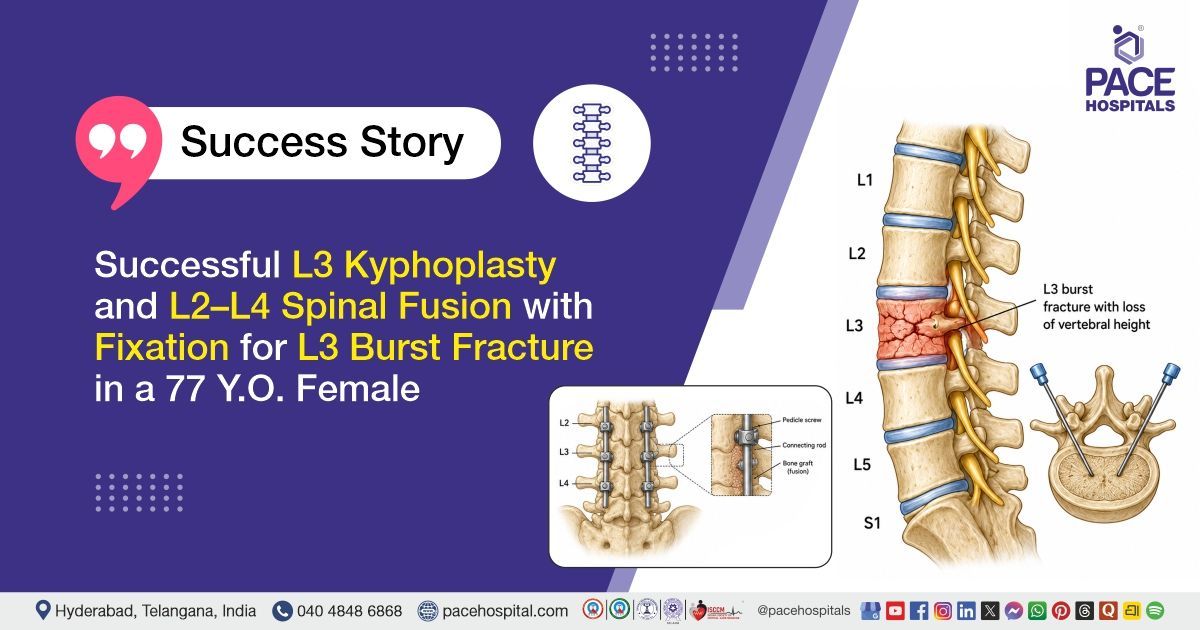
Successful L3 Kyphoplasty & L2–L4 Spinal Fusion with Fixation for L3 Burst Fracture
PACE Hospitals
PACE Hospitals’ expert Neurosurgery team successfully performed an L3 Kyphoplasty, L2–L4 Posterolateral Spinal Fusion and Fixation, along with L2 Laminectomy and L2–L3 Discectomy on a 77-year-old female patient diagnosed with L3 burst fracture with L2–L3 disc prolapse causing canal stenosis. The aim of the procedure was to stabilize the lumbar spine, decompress the spinal canal, relieve nerve compression, alleviate back pain, improve mobility, and enhance the patient’s overall quality of life through a comprehensive surgical approach.
Chief Complaints
A 77-year-old female patient with a body mass index (BMI) of 21 presented to the Neurosurgery Department at PACE Hospitals, Hitech City, Hyderabad, with complaints of severe back pain following a fall at home 2 months prior. She reported difficulty in walking and pain present even at rest. There was no associated history of paresthesias, bowel or bladder disturbances. Prior to the fall, she had no significant neurological deficits.
Past Medical History
The patient had no known history of diabetes mellitus, hypertension, cardiac illness, renal disease, thyroid disorders, tuberculosis, or any major previous surgical interventions. There was no history of bowel or bladder dysfunction or other significant comorbidities.
On Examination
On general examination, the patient was moderately built and nourished, conscious, coherent, oriented and hemodynamically stable. Neurological examination revealed power 4/4 in both lower limbs with normal sensation, intact cranial nerves, and absent cerebellar signs. Reflexes were normal, and there were no signs of meningitis. Cardiovascular and respiratory system examination was normal, with normal heart sounds and bilateral air entry. There were no focal neurological deficits, bowel or bladder involvement, or other systemic abnormalities noted.
Diagnosis
Upon admission to PACE Hospitals, the patient underwent a comprehensive clinical evaluation along with a detailed review of her medical history and preoperative investigations conducted by the Neurosurgery team.
Laboratory investigations revealed microcytic hypochromic anemia with normal leukocyte counts, while renal and liver function tests, serum electrolytes, coagulation profile, and blood sugar levels were within normal limits. Chest X-ray showed normal heart size and clear lung fields.
Neuroimaging, including X-ray of the lumbar spine, demonstrated L3 burst fracture with L2–L3 disc prolapse causing canal stenosis. Findings included multilevel degenerative changes, vertebral body collapse at L3, and posterior element compression contributing to spinal canal narrowing and nerve root impingement, correlating with the patient’s severe back pain and difficulty walking.
Based on the confirmed diagnosis, the patient was advised to undergo
L3 burst fracture with L2–L3 disc prolapse and
lumbar canal stenosis treatment in Hyderabad, India under the expert care of the Neurosurgery Department.
Medical Decision-Making (MDM)
After a detailed consultation with Dr. U. L. Sandeep Varma (Consultant Neurosurgeon), and cross-consultation with Dr Seshi Vardhan Janjirala (Consultant Cardiologist), a comprehensive evaluation was conducted focusing on the patient’s presentation of severe back pain and difficulty walking following a fall.
Clinical examination, laboratory investigations including complete blood picture, renal and liver function tests, serum electrolytes, coagulation profile, viral markers, urine analysis, chest X-ray, and 2D echocardiography were reviewed. Findings confirmed an L3 burst fracture with L2–L3 disc prolapse causing canal stenosis, with multilevel degenerative changes and posterior element compression, while no major cardiopulmonary contraindications were noted for surgery.
It was determined that L3 Kyphoplasty, L2–L4 Posterolateral Spinal Fusion and Fixation, and L2 Laminectomy with L2–L3 Discectomy under general anesthesia were the most appropriate interventions to stabilize the spine, decompress the spinal canal, relieve nerve compression, alleviate pain, restore mobility, and prevent further neurological deterioration.
The patient and family were counseled in detail regarding the diagnosis, surgical procedure, postoperative care,
physiotherapy, medication adherence, and the importance of regular follow-up to optimize recovery and functional outcomes.
Surgical Procedure
Following the decision, the patient was scheduled to undergo an L3 Kyphoplasty, L2–L4 Posterolateral Spinal Fusion and Fixation, L2 Laminectomy, and L2–L3 Discectomy Surgery in Hyderabad at PACE Hospitals under the expert supervision of the Neurosurgery Department.
The procedure involved the following steps:
- Patient Positioning and Anaesthesia: The patient was placed in a prone position on the operating table after the administration of general anaesthesia. The surgical site was prepared and draped under strict aseptic precautions to ensure a sterile operating environment.
- Exposure and Pedicle Screw Fixation: A vertical midline incision was made over the lumbar spine. The incision was deepened, and the paraspinal muscles were carefully separated to expose the lamina, spinous processes, and transverse processes. Bilateral pedicle screw fixation was performed from L2 to L4 using cannulated pedicle screws under fluoroscopic guidance.
- L3 Kyphoplasty and Vertebral Stabilisation: Kyphoplasty of the fractured L3 vertebral body was performed bilaterally under X-ray guidance. Bone cement was injected through the pedicle screw system to strengthen the vertebral body and enhance spinal stability. The fixation construct was completed using titanium rods bilaterally.
- Laminectomy, Discectomy, and Neural Decompression: An L2 laminectomy was performed, and the ligamentum flavum was excised to decompress the spinal canal. Subsequently, an L2–L3 discectomy was carried out to remove the prolapsed disc material causing canal stenosis. Adequate decompression of the neural elements was confirmed, and the dura was noted to be freely pulsatile at the end of the procedure.
- Posterolateral Fusion and Wound Closure: Posterolateral spinal fusion from L2 to L4 was performed using autologous bone graft to promote long-term spinal stability and fusion. Hemostasis was secured, and the wound was closed in layers over a surgical drain and epidural catheter. The patient tolerated the procedure well and was transferred to the intensive care unit for postoperative monitoring.
Postoperative Care
Postoperatively, the patient was monitored in the Intensive Care Unit (ICU) overnight and later shifted to the room after stabilization. The drain and urinary catheter were removed on the second postoperative day, and supervised ambulation was initiated. Postoperative X-rays showed satisfactory implant alignment, the surgical wound remained healthy, and physiotherapy was continued during recovery. The patient was discharged in stable condition with improved mobility and neurological status.
Discharge Medications
Upon discharge, the patient was discharged with treatment aimed at postoperative pain control, prevention of infection, management of nerve-related symptoms, gastric protection, bowel regulation, nutritional supplementation, and enhancement of bone healing and recovery following spinal surgery. Continued osteoporosis treatment was advised to promote vertebral healing and improve bone strength.
Advice on Discharge
The patient was advised to continue prescribed medications, comply with physiotherapy and rehabilitation exercises, and gradually increase walking as tolerated. She was instructed to avoid strenuous activities, lifting heavy weights, and sitting on the floor during the recovery period. Wound care was advised, and she was permitted to take a bath while ensuring proper wound hygiene.
Emergency Care
The patient was instructed to contact the emergency ward at PACE Hospitals if she develops fever, worsening weakness, discharge from the surgical wound, severe back pain, difficulty walking, or any new neurological symptoms.
Review and Follow-up Notes
The patient was advised to return for follow-up with the Neurosurgeon in Hyderabad at PACE Hospitals after 10 days for postoperative review, wound inspection, and staple removal. Further follow-up visits were advised to assess neurological recovery, spinal stability, wound healing, and progress with physiotherapy. Compliance with rehabilitation measures and prescribed medications was strongly recommended.
Conclusion
This case highlights an L3 burst fracture with associated L2–L3 disc prolapse causing spinal canal stenosis, resulting in severe back pain and difficulty walking following a fall. The patient underwent successful L3 kyphoplasty, L2–L4 posterolateral spinal fusion and fixation, L2 laminectomy, and L2–L3 discectomy. She had an uneventful postoperative recovery with satisfactory implant alignment, healthy wound healing, and improved ambulation. The patient was discharged in stable condition with planned follow-up and continuation of physiotherapy for functional recovery.
L3 Burst Fracture with Lumbar Canal Stenosis – Post Surgical Recovery
An L3 burst fracture can result in vertebral collapse, spinal instability, and narrowing of the spinal canal, leading to persistent back pain, difficulty walking, and potential neurological compromise. When associated with disc prolapse and canal stenosis, surgical intervention by a neurosurgeon/neurosurgery doctor may be required to decompress the neural elements, restore spinal stability, and prevent further functional deterioration.
Management typically involves a combination of vertebral stabilization, spinal fusion, and decompression procedures tailored to the extent of fracture and neural compression. In this case, surgical treatment successfully addressed both the vertebral injury and canal stenosis, allowing restoration of spinal alignment and stability.
Postoperative recovery was marked by improvement in mobility, preservation of neurological function, and satisfactory wound healing. Early ambulation and physiotherapy played an important role in enhancing recovery and reducing the risk of postoperative complications. Continued rehabilitation, adherence to activity precautions, and regular follow-up are essential for achieving optimal long-term functional outcomes and maintaining spinal stability.
Frequently Asked Questions (FAQS)
What is an L3 burst fracture?
An L3 burst fracture is a serious injury in which the third lumbar vertebra (L3) breaks and collapses, usually after a fall or trauma. Unlike a simple fracture, the bone can break into multiple pieces and may narrow the spinal canal. This can put pressure on nearby nerves and affect movement.
What symptoms can an L3 burst fracture cause?
An L3 burst fracture commonly causes severe lower back pain that worsens with movement. Some patients may experience difficulty standing, walking, or performing daily activities. If nerves are compressed, symptoms such as leg pain, numbness, tingling, or weakness may occur. In severe cases, bowel or bladder problems can develop.
Why was surgery required in this case?
Surgery was required because the fracture was associated with disc prolapse and narrowing of the spinal canal, causing persistent pain and difficulty walking. The goal was to stabilize the fractured vertebra, relieve pressure on the nerves, and prevent further deterioration. Surgical treatment also helps improve mobility and restore spinal stability.
Can an L3 burst fracture lead to paralysis?
In some cases, yes. If the fractured bone fragments severely compress the nerves within the spinal canal, significant neurological problems can occur. However, early diagnosis and timely treatment greatly reduce the risk of permanent nerve damage. Not all burst fractures result in paralysis.
Is physiotherapy necessary after spinal surgery?
Yes. Physiotherapy is an important part of recovery after spinal surgery. It helps improve strength, flexibility, balance, and walking ability. A structured rehabilitation program can also reduce stiffness and support a safe return to daily activities. Following the recommended exercises can improve long-term outcomes.
What are the warning signs that require urgent medical attention after surgery?
Patients should seek immediate medical attention if they develop fever, increasing back pain, wound redness or discharge, worsening leg weakness, or difficulty walking. Sudden loss of bladder or bowel control is also an emergency. Early medical evaluation can help prevent serious complications.
Can a simple fall cause a burst fracture in older adults?
Yes. Older adults often have weaker bones due to osteoporosis or age-related bone loss. As a result, even a relatively minor fall can sometimes cause a vertebral fracture. Maintaining bone health and preventing falls are important measures to reduce this risk.
What is the difference between a compression fracture and a burst fracture?
A compression fracture usually involves the collapse of the front part of a vertebra and is often more stable. A burst fracture is more severe because the vertebra breaks in multiple directions and may send fragments into the spinal canal. This increases the risk of nerve compression and neurological symptoms.
What are the benefits of early ambulation after spine surgery?
Early walking helps improve blood circulation, reduce the risk of blood clots, and prevent muscle weakness. It also promotes faster recovery and improves confidence in movement. Under medical supervision, early ambulation is considered an important part of postoperative rehabilitation.
When can patients return to normal daily activities after spinal stabilization surgery?
The timing varies depending on the patient's recovery and the type of surgery performed. Light daily activities can often be resumed within a few weeks, while more demanding activities may require several months. Patients should follow their surgeon’s advice regarding lifting, bending, and physical activity. Regular follow-up helps ensure a safe return to normal routines.
Share on
Request an appointment
Fill in the appointment form or call us instantly to book a confirmed appointment with our super specialist at 04048486868
Appointment request - health articles
Recent Articles