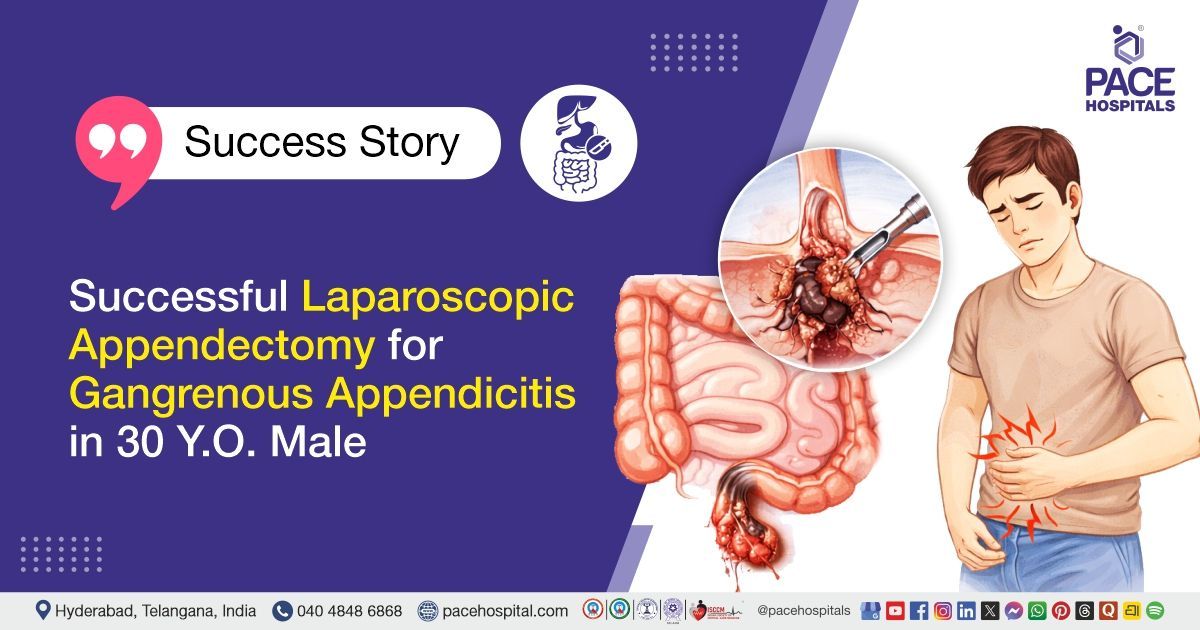
Successful Laparoscopic Appendectomy for Gangrenous Appendicitis in 30 Y.O. Male
PACE Hospitals
PACE Hospitals’ expert Surgical Gastroenterology team successfully performed a Laparoscopic Appendectomy on a 30-year-old male patient diagnosed with acute appendicitis, with the aim of safely removing the inflamed appendix, relieving pain, preventing complications such as rupture or infection, and ensuring a faster recovery with minimal surgical trauma.
Chief Complaints
A 30-year-old male patient with a body mass index (BMI) of 20 presented to the Surgical Gastroenterology Department at PACE Hospitals, Hitech City, Hyderabad, with complaints of abdominal pain that initially began in the umbilical region and later migrated to the right iliac fossa over the past one day. The pain was associated with 4–5 episodes of vomiting since the previous night, along with a history of fever for the past 6 hours.
Past Medical History
The patient had no significant past medical history and no known comorbidities. He had not undergone any prior abdominal surgeries and had no history of similar complaints in the past.
On Examination
On examination, the patient was conscious, coherent, and oriented, with vitals within normal limits. Abdominal examination revealed tenderness in the right iliac fossa with features suggestive of localized inflammation, while the rest of the abdomen was soft with no abnormal masses. Systemic examination of the cardiovascular, respiratory, and central nervous systems was within normal limits.
Diagnosis
Upon admission to PACE Hospitals, the patient was thoroughly evaluated by the Surgical Gastroenterology team, including a detailed clinical history and comprehensive physical examination. Based on the presenting complaints of abdominal pain initially in the umbilical region migrating to the right iliac fossa, along with vomiting and fever, there was a strong clinical suspicion of acute appendicitis.
An ultrasound of the abdomen and pelvis was performed, which was suggestive of acute appendicitis. Laboratory investigations revealed relative neutrophilia, indicating an ongoing inflammatory process.
Based on the confirmed findings, the patient was advised to undergo
acute appendicitis Treatment in Hyderabad, India, under the expert care of the Surgical Gastroenterology Department.
Medical Decision Making (MDM)
After a detailed consultation with Dr. Suresh Kumar S, a Surgical Gastroenterologist, a comprehensive evaluation of the patient was undertaken. Considering his history of abdominal pain migrating from the umbilical region to the right iliac fossa, associated vomiting, and recent fever, the surgeon reviewed his clinical findings, including tenderness in the right iliac fossa and supportive laboratory investigations, along with ultrasound findings suggestive of acute appendicitis.
Further evaluation, including preoperative blood tests and imaging, confirmed the presence of an inflamed appendix with a gangrenous tip and a healthy base, with no evidence of other intra-abdominal pathology. Based on these findings, it was determined that laparoscopic appendectomy was identified as the most appropriate intervention to remove the diseased appendix, relieve symptoms, prevent complications such as perforation or peritonitis, and ensure faster recovery.
The patient and his family members were counselled in detail regarding the diagnosis, the planned procedure, associated risks, expected benefits, and anticipated recovery, following which informed consent was obtained.
Surgical Procedure
Following the decision, the patient was scheduled to undergo a Laparoscopic Appendectomy Surgery in Hyderabad at PACE Hospitals under the expert care of the Surgical Gastroenterology Department.
The following steps were carried out during the procedure:
- Anesthesia and Patient Positioning: The patient was placed under general anesthesia. He was positioned supine on the operating table, and the abdomen was prepared and draped under sterile conditions. Pneumoperitoneum was established using a Veress needle, and intra-abdominal pressure was maintained at a safe level.
- Port Placement and Exploration: A 10 mm camera port was inserted at the umbilicus, and two additional 5 mm working ports were placed in the lower abdomen under direct vision. A thorough laparoscopic exploration of the abdominal cavity was performed to assess the appendix, surrounding bowel, and any signs of inflammation or perforation.
- Identification and Mobilization of Appendix: The appendix was identified, showing a gangrenous tip with inflammation, while the base appeared healthy. The mesoappendix was carefully dissected and controlled using the Ligasure energy device. Small vessels were coagulated to minimize bleeding.
- Ligation and Division of Appendix: The base of the appendix was secured with endoloops. After confirming hemostasis, the appendix was divided between the ligatures. The specimen was placed in an endoscopic retrieval bag and removed through the umbilical port.
- Final Inspection and Closure: The operative site was inspected for hemostasis and any spillage of contents. The peritoneal cavity was irrigated with normal saline. Ports were removed under vision, pneumoperitoneum was released, and the port sites were closed with absorbable sutures. Sterile dressings were applied.
Postoperative Care
Post-procedure recovery had been satisfactory. During the hospital stay, the patient had received medications to prevent and treat infection, relieve pain, protect the stomach lining, and provide general supportive care. Histopathological examination confirmed acute appendicitis with fecolith. He was discharged in a hemodynamically stable condition.
Discharge Medications
Upon discharge, the patient was prescribed medications to prevent and treat infection, relieve pain and inflammation, protect the stomach lining, and support normal bowel function, to be taken as directed for five days.
Advice on Discharge
The patient was advised to follow a normal diet.
Emergency Care
The patient was informed to contact the emergency ward at PACE Hospitals in case of any emergency or development of symptoms such as fever, abdominal pain, vomiting, or chest pain.
Review and Follow-up Notes
The patient was advised to return for a follow-up visit with the Surgical Gastroenterologist in Hyderabad at PACE Hospitals, after 5 days.
Conclusion
This case highlights a patient with acute appendicitis complicated by a fecolith, which was successfully managed with a laparoscopic appendectomy. The postoperative period was uneventful, and the patient recovered well with appropriate supportive care. Early surgical intervention and proper perioperative management ensured a favourable outcome.
Role of Laparoscopic Appendectomy in Acute Appendicitis
In clinical practice, laparoscopic appendectomy is a widely used surgical procedure performed by Surgical gastroenterologist / Surgical gastroenterology doctor to manage acute appendicitis, including cases complicated by fecoliths. This minimally invasive approach allows the surgical gastroenterology doctor to remove the inflamed appendix precisely while preserving surrounding healthy tissue, thereby reducing the risk of perforation and peritonitis. Patients often present with right lower abdominal pain, nausea, vomiting, and fever, and timely intervention ensures rapid symptom relief and prevents serious complications.
Postoperative histopathological evaluation confirms the diagnosis and identifies complicating factors such as gangrenous changes or fecoliths. Laparoscopic appendectomy provides faster recovery, shorter hospital stay, and lower postoperative morbidity. Postoperative care, guided by intraoperative findings and histopathology, focuses on infection prevention, pain management, supportive therapy, and maintaining hemodynamic stability for optimal outcomes.
Share on
Request an appointment
Fill in the appointment form or call us instantly to book a confirmed appointment with our super specialist at 04048486868
Appointment request - health articles
Recent Articles