Successful ORIF with K-Wire Fixation for Right Little Finger Fractures
PACE Hospitals
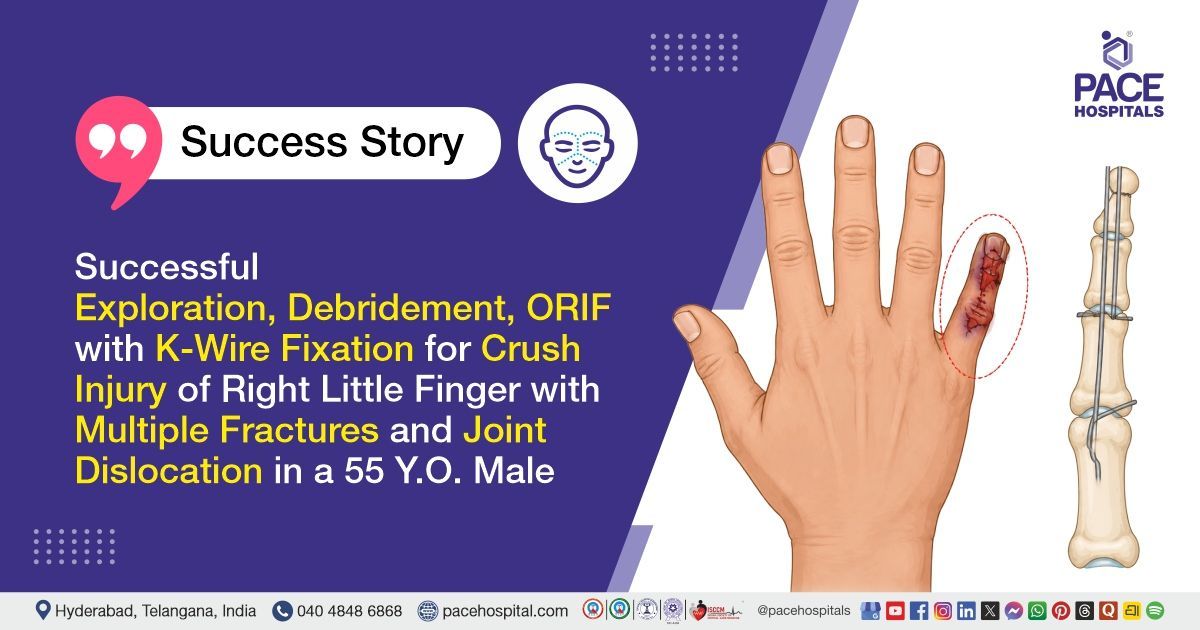
PACE Hospitals’ expert Plastic and Reconstructive Surgery team successfully performed Exploration, Open Reduction and Internal Fixation (ORIF) with K-wire Fixation, Debridement, and Suturing under right axillary block on a 55-year-old male patient diagnosed with crush injury of the right little finger with fractures of the proximal phalanx (PPX), middle phalanx (MPX), and dislocation of the proximal interphalangeal joint (PIPJ). The procedure was aimed at restoring proper bone and joint alignment, stabilizing the fractures, removing damaged tissue, preventing infection, and preserving optimal finger function and mobility.
Chief Complaints
A 55-year-old male patient with a
body mass index (BMI) of 20 presented to the Plastic and Reconstructive Surgery Department at
PACE Hospitals, Hitech City, Hyderabad, with a history of crush injury to the right little finger sustained two days earlier. The patient had initially received primary treatment at another hospital. There was no history of associated head, chest, or abdominal injury.
Past Medical History
The patient was a known case of epilepsy and has been on regular treatment with antiepileptic medication. There was no history of hypertension, diabetes mellitus, thyroid disorders, tuberculosis, or asthma. The patient was a non-smoker and non-alcoholic and had no known drug allergies.
On Examination
On examination, the patient was conscious, coherent, and cooperative. There was no pallor, icterus, cyanosis, clubbing, lymphadenopathy, or pedal edema. Local examination of the right little finger revealed a crush injury with soft tissue damage, tenderness, swelling, and deformity associated with fractures of the proximal and middle phalanges, along with dislocation of the proximal interphalangeal joint. Vital parameters were stable.
Diagnosis
Upon admission to the PACE Hospitals, the patient underwent a comprehensive evaluation, including a detailed review of his medical history and a thorough physical examination by the Plastic, Orthopaedic, and Neurology teams. The patient presented with a history of crush injury to the right little finger following trauma, associated with pain, swelling, and functional impairment of the affected digit. Clinical examination and radiological assessment revealed a crush injury of the right little finger with fractures of the proximal phalanx (PPX) and middle phalanx (MPX), along with dislocation of the proximal interphalangeal joint (PIPJ).
A complete diagnostic workup was carried out, including routine laboratory investigations, viral screening, and imaging studies, which were within normal limits and did not reveal any contraindications for surgical management. The patient was also noted to have a known history of epilepsy, for which he was on regular treatment. His general systemic condition was stable, with no significant medical comorbidities contributing to the current presentation.
Based on the clinical and radiological findings, the patient was advised to undergo
Crush Injury of the Right Little Finger with Fractures of PPX and MPX Treatment in Hyderabad, India,
along with PIPJ dislocation
under the expert care of the Plastic and Reconstructive Surgery team.
Medical Decision Making (MDM)
After a thorough evaluation by Dr. Kantamneni Lakshmi, Senior Consultant Plastic, Reconstructive & Aesthetic Surgeon, and in coordination with cross-consultations from Dr. Raghuram (Consultant Orthopaedic Surgeon) and Dr. S Pramod Kumar (Consultant Neurologist), a comprehensive assessment was carried out to determine the most appropriate management plan for the patient diagnosed with a crush injury of the right little finger.
Based on the clinical findings of crush injury to the right little finger with fracture of the proximal phalanx (PPX), middle phalanx (MPX), and dislocation of the proximal interphalangeal joint (PIPJ), along with associated soft tissue damage and vascular assessment of the digit, it was determined that surgical management with exploration, open reduction and internal fixation (ORIF) using K-wire stabilization, along with debridement and suturing, was the most appropriate treatment approach. This decision was made after careful evaluation of the injury severity, requirement for anatomical alignment, preservation of vascularity, prevention of infection, and restoration of hand function.
The patient and his family were counselled regarding the condition, the need for surgery, associated risks and benefits, and the importance of postoperative care, including wound care, limb elevation, medication adherence, and follow-up for optimal recovery.
Surgical Procedure
Following the diagnosis, the patient was scheduled to undergo Exploration with Open Reduction and Internal Fixation (ORIF) using K-Wire Stabilization Procedure in Hyderabad at PACE Hospitals, along with debridement and suturing under right axillary block under the supervision of the expert Plastic and Reconstructive Surgery team.
The surgical procedure involved the following steps:
- Anesthesia and Preparation: The patient was taken up for surgery under right axillary block anesthesia. The operative site was prepared under strict aseptic precautions. The right upper limb was painted and draped in a sterile manner to maintain a sterile surgical field.
- Wound Exploration and Debridement: A thorough exploration of the wound over the right little finger was performed. Devitalized and contaminated tissues were carefully debrided to reduce infection risk and prepare a healthy wound bed for fixation.
- Fracture Assessment and Stabilization: Intraoperative assessment confirmed fractures of the proximal and middle phalanges with dislocation of the proximal interphalangeal joint. Open reduction was performed, and K-wire fixation was used to stabilize the MPX and PIPJ fractures by the orthopaedic team.
- Intraoperative Findings and Tissue Preservation: The proximal phalanx fracture was not addressed due to associated vascular compromise. The wound was reassessed, and vascularity of the digit was confirmed to be adequate. Intact flexor and extensor tendons were identified and preserved.
- Closure and Completion of Procedure: Hemostasis was secured, and the wound was closed with 3-0 Ethilon sutures. Aseptic dressing was applied, and the procedure was completed uneventfully with stable intraoperative condition.
Postoperative Care
During the postoperative period, the patient was managed with intravenous fluids and intravenous therapy for infection control and prevention of postoperative infection. Supportive treatment was given for pain relief and fever control. Gastric protection therapy was provided to prevent acidity related to medications and stress. Regular sterile dressings were done for the operated finger to maintain wound hygiene and promote healing. The blood flow to the injured finger was checked regularly and remained normal throughout the hospital stay. The limb was kept elevated to reduce swelling, and the patient remained stable with satisfactory recovery prior to discharge.
Discharge Medications
Upon discharge, the patient was advised oral medications to prevent and treat postoperative infection, support wound healing, reduce pain and inflammation, and protect the stomach from medication-related acidity. Additional supportive therapy was prescribed to reduce swelling in the operated finger and promote soft tissue and bone healing. Nutritional support was also advised to aid overall recovery and improve healing strength. Long-term seizure control therapy was continued as part of ongoing neurological management, with a short-term medication given for temporary seizure prevention and then stopped.
Advice on Discharge
The patient was advised to elevate the right upper limb to reduce swelling and improve recovery. Proper wound care with regular cleaning and sterile dressings was instructed to promote healing and prevent infection. A high-protein diet was recommended to support tissue repair and overall recovery.
Emergency Care
The patient was informed to contact the emergency ward at PACE Hospitals in case of any emergency or development of symptoms such as fever, increasing pain or swelling in the operated finger, wound discharge, bleeding, discoloration of the digit, or any signs of infection or impaired healing.
Review and Follow-up Notes
The patient was advised to return for a follow-up consultation with the Consultant Plastic, Reconstructive & Aesthetic Surgeon in Hyderabad at PACE Hospitals after 2 days.
Conclusion
This case highlights a crush injury of the right little finger with fractures of the proximal and middle phalanges and dislocation of the proximal interphalangeal joint requiring surgical management. The patient underwent exploration with open reduction and internal fixation using K-wire along with debridement and suturing, resulting in stable postoperative recovery with preserved blood flow to the finger. The patient was discharged in stable condition with appropriate advice and follow-up care.
Multidisciplinary Surgical Management and Tissue Preservation in Complex Hand Injuries
Complex hand injuries involving fractures, joint dislocations, and soft tissue damage require timely and coordinated multidisciplinary care involving a Plastic Surgeon / Plastic Surgery Doctor along with other surgical specialties. Early exploration and appropriate fixation techniques are essential to restore anatomical alignment and preserve hand function. Intraoperative assessment of vascular status and soft tissue viability plays a crucial role in guiding the extent of fixation and preventing ischemic complications. Thorough debridement is important in reducing infection risk, especially in open injuries.
Preservation of tendons and neurovascular structures significantly influences functional outcomes and recovery potential. Postoperative monitoring of circulation, wound condition, and structured rehabilitation are key to achieving optimal healing. Overall, early intervention, surgical precision, and careful tissue handling are fundamental to successful outcomes in complex hand trauma.
Frequently Asked Questions (FAQs)
What should be expected in terms of recovery after finger surgery?
Post-operative care is important for proper recovery after surgery for a crush injury. This includes taking pain relief medicines as advised by the doctor, keeping the hand raised (elevated) to reduce swelling, and maintaining proper wound care to prevent infection. Regular follow-up visits are needed for dressing changes and to monitor the healing process.
How long is medication necessary after discharge?
After discharge from the hospital, it is important to follow the prescribed medication schedule carefully to ensure proper recovery. This usually includes medicines to prevent infection, relieve pain, and support the healing process. In some cases, additional medications may be prescribed to manage neurological conditions and promote recovery of the affected area.
Can the hand be used after surgery?
During the early stages of recovery, it is important to avoid using the injured hand for heavy tasks. The hand should remain elevated to reduce swelling, and pressure or weight should be kept off the injured finger. Normal activities can be resumed once the treating surgeon provides clearance, usually following a scheduled follow-up visit.
How should the wound be cared for at home?
Wound care at home involves applying the prescribed ointment as directed and keeping the area clean and dry. Dressing changes should be done as advised by the healthcare team to reduce the risk of infection. Any signs of infection such as increased redness, swelling, or discharge should be closely monitored.
Is it normal to experience pain or swelling after this type of injury?
Some pain, swelling, and stiffness are to be expected following a crush injury and surgery. Pain can generally be managed with the prescribed medications, and swelling may be reduced by keeping the hand elevated. If these symptoms worsen or fail to improve, medical consultation is advised.
When should follow-up care be scheduled?
Follow-up care is important to check wound healing and to do dressing changes if needed. Attending the scheduled follow-up appointment is necessary for proper recovery. If symptoms such as fever or severe pain occur before the visit, immediate medical attention should be taken.
What is the significance of K-wire fixation in the surgery?
K-wire fixation is used to hold the broken bone fragments in the finger in a stable position after a fracture. It helps maintain proper alignment and supports healing by keeping the bones fixed during recovery. This allows the bones to heal in the correct position, and the wire is removed later once adequate healing has occurred.
What signs of complications should be monitored after surgery?
After surgery, it is important to monitor for signs of infection, including increased pain, swelling, or discharge from the wound. Other concerning signs include changes in sensation, such as numbness, or if the finger becomes pale, cold, or difficult to move. In such cases, immediate medical attention should be sought.
Can a regular diet be resumed after surgery?
A high-protein diet is advised after surgery because protein helps in wound healing and recovery. Alcohol and smoking should be avoided, as they can delay healing and affect recovery. Any food restrictions or diet-related concerns should be discussed with the healthcare provider to make sure proper nutrition is maintained during the recovery period.
Is it safe to drive after finger surgery?
Driving should be avoided until full use and mobility of the injured hand is restored. Healing involves the recovery of bones, tendons, and ligaments, which may take several weeks. Medical advice should be sought before resuming activities like driving to ensure it is safe to do so.
Share on
Request an appointment
Fill in the appointment form or call us instantly to book a confirmed appointment with our super specialist at 04048486868
Appointment request - health articles
Recent Articles