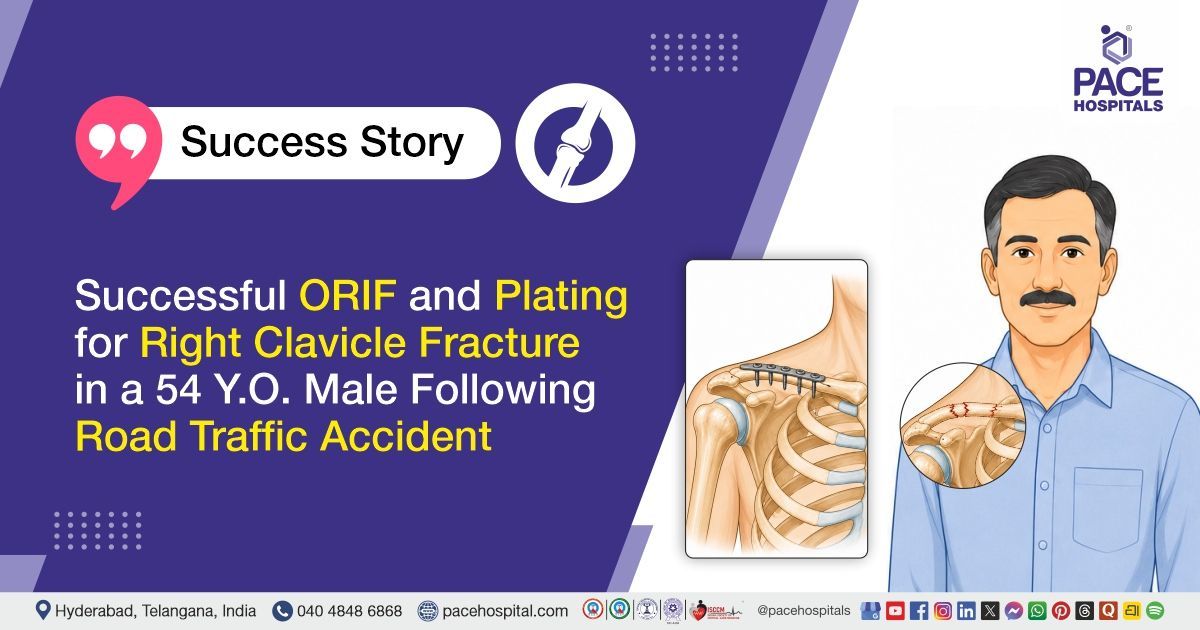
Successful ORIF & Plating for Right Clavicle Fracture in a 54 Y.O. Male
PACE Hospitals
PACE Hospitals’ expert Orthopaedic team successfully performed an Open Reduction and Internal Fixation (ORIF) with Plating of the right clavicle on a 54-year-old male patient diagnosed with a fracture of the right clavicle associated with fractures of the right 5th and 6th ribs following a road traffic accident. The aim of the procedure was to accurately realign the fractured clavicle, restore shoulder girdle anatomy, provide stable fixation to promote proper bone healing, relieve pain, and facilitate early recovery of shoulder function and daily activities.
Chief Complaints
A 54-year-old male patient with a body mass index (BMI) of 21 presented to the Orthopaedic Department at PACE Hospitals, Hitech City, Hyderabad, with complaints of severe pain in the right shoulder associated with difficulty in performing activities using the right upper limb. He also complained of right-sided chest pain and difficulty in breathing due to pain following an alleged history of a road traffic accident (bike vs dog). The patient sustained multiple abrasions on the right elbow. There was no history of loss of consciousness, seizures, ear, nose, or throat (ENT) bleeding following the injury.
Past Medical History
The patient had no known history of major medical comorbidities such as diabetes mellitus, hypertension, or other chronic illnesses, and had no history of previous surgeries or significant past medical conditions.
On Examination
The patient was conscious, coherent, and oriented. Chest examination revealed tenderness over the axillary border of the right 5th and 6th ribs. Local examination of the right shoulder showed swelling, tenderness, and crepitus over the middle one-third region of the clavicle, with painful restriction of shoulder movements. Examination of the right elbow revealed multiple abrasions over the posterolateral aspect, while elbow movements were normal. No distal neurovascular deficit was noted.
Diagnosis
Following the clinical evaluation, the Orthopaedic team at PACE Hospitals conducted a detailed assessment of the patient’s complaints of right shoulder pain, right-sided chest pain, and difficulty in performing daily activities involving the right upper limb following a road traffic accident (bike versus dog).
A comprehensive clinical and systemic examination was performed. The examination of the right shoulder revealed swelling, tenderness, deformity, and palpable crepitus over the middle one-third region of the right clavicle. The range of movements of the right shoulder was painfully restricted. Chest examination demonstrated tenderness over the axillary border corresponding to the right 5th and 6th ribs. Multiple abrasions were also observed over the posterolateral aspect of the right elbow. No distal neurovascular deficit was noted.
Investigations and radiological assessment confirmed the diagnosis of fracture of the right clavicle along with fractures of the right 5th and 6th ribs. Laboratory investigations were within acceptable limits for surgical intervention.
Based on these findings, the patient was advised to undergo Right Clavicle (Collarbone) Fracture Treatment in Hyderabad, India, alongside management for fractures of the Right 5th and 6th Ribs and Multiple Abrasions Over the Right Elbow, under the care of the Orthopaedic Department, to achieve anatomical reduction, stable fixation, pain relief, restoration of shoulder function, and early mobilization while preventing long-term functional disability.
Medical Decision Making (MDM)
After a detailed consultation with Dr. Raghuram, Consultant Orthopaedic Surgeon, in coordination with cross consultation from Dr. Pradeep Kiran Panchadi, Consultant Interventional Pulmonologist, a comprehensive evaluation was conducted focusing on the patient’s presentation of severe right shoulder pain and right-sided chest pain following a road traffic accident, associated with significant difficulty in performing daily activities involving the right upper limb. Clinical examination revealed swelling, tenderness, deformity, and palpable crepitus over the middle one-third of the right clavicle, along with painful restriction of right shoulder movements. Tenderness was also present over the right 5th and 6th ribs, and multiple abrasions were noted over the right elbow.
Further assessment and radiological evaluation confirmed a displaced fracture of the right clavicle associated with fractures of the right 5th and 6th ribs.
Based on the above findings, it was determined that Open Reduction and Internal Fixation (ORIF) with plating of the right clavicle was the most appropriate surgical intervention. This decision was made with the aim of restoring clavicular alignment, providing stable fixation, relieving pain, improving shoulder function, facilitating early mobilization, and preventing long-term functional impairment or malunion.
The patient and family members were counselled regarding the diagnosis, planned surgical procedure, possible risks and benefits, postoperative rehabilitation, use of arm sling, chest physiotherapy, breathing exercises, and the importance of regular follow-up to ensure optimal recovery and functional outcome.
Surgical Procedure
Following the diagnosis, the patient was scheduled for Open Reduction and Internal Fixation (ORIF) with plating of the right clavicle Surgery in Hyderabad at PACE Hospitals, under the expert supervision of the Orthopaedic Department.
The surgical procedure involved the following steps:
- Preoperative Preparation and Anaesthesia: After proper preoperative work-up and fitness assessment, the patient was taken up for surgery under general anaesthesia. Standard aseptic precautions and surgical draping were performed prior to the procedure.
- Surgical Exposure: The patient was positioned supine, and an incision was made over the borders of the right clavicle. Soft tissues were carefully dissected to expose the fracture site while preserving surrounding anatomical structures.
- Fracture Identification and Reduction: Intraoperatively, the fracture of the middle one-third of the right clavicle was identified. The fracture fragments were carefully reduced into anatomical position to restore proper clavicular alignment and shoulder contour.
- Fixation with Implant: Stable internal fixation was achieved using a 7-hole titanium SMPL locking plate along with an interfragmentary screw. Intraoperative image guidance using C-arm fluoroscopy confirmed satisfactory reduction and implant positioning. The fixation provided adequate stability and alignment of the fracture fragments.
- Wound Closure and Postoperative Care: Haemostasis was secured following fixation, and the wound was closed in layers using Vicryl 2-0 sutures and skin staples. A sterile dressing was applied after closure.
Postoperative Care
The postoperative period was uneventful, and the patient remained hemodynamically stable throughout the hospital stay. The patient received adequate pain control, infection prevention, and supportive care for pain management and recovery. Supportive care, such as chest physiotherapy and incentive spirometry, was advised to improve respiratory function and prevent pulmonary complications. Regular wound dressings were performed during the postoperative period and were found to be clean and healthy.
Discharge Medications
Upon discharge, the patient was prescribed medications for the prevention of postoperative infection, pain relief, gastric protection, nutritional supplementation, and enhancement of wound healing and recovery.
Advice on Discharge
The patient was advised to continue using the arm sling as instructed for support and immobilization of the right upper limb. He was instructed to perform elbow and wrist range-of-motion exercises regularly to maintain joint mobility and aid rehabilitation. Chest physiotherapy and incentive spirometry were advised as part of the recovery protocol to improve respiratory function and facilitate healing of the associated rib fractures. The patient was also advised to attend regular follow-up visits for postoperative evaluation and monitoring of fracture healing.
Emergency Care
The patient was advised to report immediately to the emergency ward at PACE Hospitals in case of fever, increasing pain over the surgical site or chest region, difficulty in breathing, swelling, redness, wound discharge, vomiting, or any unusual worsening symptoms.
Review and Follow-up Notes
The patient was advised to return for follow-up with the Orthopaedic Doctor in Hyderabad at PACE Hospitals, after 3 days for postoperative review and assessment of the surgical wound and dressing status. Further periodic follow-up visits were advised for clinical and radiological evaluation of fracture healing, monitoring of implant position, assessment of shoulder function, and progression of rehabilitation exercises.
Conclusion
This case highlights a traumatic fracture of the right clavicle associated with fractures of the right 5th and 6th ribs following a road traffic accident, which was successfully managed with Open Reduction and Internal Fixation (ORIF) using a 7-hole titanium locking plate and interfragmentary screw. The patient underwent successful surgical stabilization after appropriate preoperative evaluation and pulmonary clearance.
The postoperative recovery was uneventful, with satisfactory fracture fixation, adequate pain control, and gradual improvement in shoulder function. Chest physiotherapy, incentive spirometry, arm sling support, and rehabilitation exercises aided recovery. The patient was discharged in stable condition with postoperative instructions and scheduled follow-up.
Role of Surgical Fixation in Clavicle Fractures with Associated Rib Injuries
Operative management is often recommended in displaced clavicle fractures associated with functional limitation and chest injuries to restore anatomical alignment, provide stable fixation, and promote early recovery, as determined by the Orthopaedic Doctor/ Orthopaedic Surgeon. In this case, Open Reduction and Internal Fixation (ORIF) with plating of the right clavicle provided stable fixation, restored shoulder alignment, relieved pain, and improved upper limb function.
Surgical fixation helps maintain clavicular biomechanics, allows early mobilization, and reduces the risk of malunion, persistent pain, and long-term shoulder dysfunction. Supportive postoperative measures such as chest physiotherapy, incentive spirometry, and rehabilitation exercises further aided recovery and contributed to satisfactory functional outcomes.
Frequently Asked Questions (FAQs)
Why was surgery advised for the clavicle fracture?
Surgery was advised because the clavicle fracture was displaced and caused significant functional limitation. Conservative treatment in such cases may result in malunion, persistent pain, or deformity. Surgical fixation helps restore proper alignment and shoulder function.
What is ORIF with plating?
ORIF is a surgical procedure used to align and stabilise fractured bones. Open Reduction refers to surgically exposing and aligning the fracture, while internal fixation involves securing the bone with implants such as plates and screws.
What are the benefits of clavicle plating?
Clavicle plating provides rigid stabilization of the fracture and helps maintain normal shoulder alignment. It promotes early pain relief, faster recovery, and improved shoulder movements. It also reduces the risk of non-union and deformity.
How do rib fractures affect recovery?
Fractures of the ribs can cause severe chest pain and difficulty in breathing or coughing. Proper pain control and breathing exercises are important to prevent respiratory complications. Recovery may take several weeks, depending on the severity of the injury.
Why was chest physiotherapy advised?
Chest physiotherapy helps improve lung expansion and breathing after rib fractures. It reduces the risk of complications such as lung infections and collapse of lung segments. It also improves respiratory comfort during recovery.
How long does recovery take after clavicle fixation surgery?
Bone healing generally occurs within 6–8 weeks, although complete functional recovery may take a few months. Physiotherapy and gradual mobilization play an important role in regaining strength and mobility. Recovery time may vary between individuals.
When can shoulder movements be started after surgery?
Gentle shoulder, elbow, and wrist exercises are usually started early under medical supervision. Early mobilization helps prevent stiffness and improves circulation. However, strenuous activities and heavy lifting should be avoided for the initial period.
What precautions should be followed after clavicle surgery?
Patients are advised to wear an arm sling as instructed and avoid sudden shoulder movements or heavy lifting. Proper wound care and regular follow-up visits are essential. Adhering to rehabilitation advice helps ensure better recovery outcomes.
What complications can occur if displaced clavicle fractures are untreated?
Untreated displaced fractures may lead to malunion, chronic pain, visible deformity, and restricted shoulder function. Some patients may also develop weakness and difficulty performing overhead activities. Timely treatment reduces these risks.
What factors contribute to successful recovery after clavicle fixation?
Successful recovery depends on timely surgery, stable fixation, adequate pain control, and proper rehabilitation. Physiotherapy, breathing exercises, and compliance with medical advice are equally important. Regular follow-up helps monitor fracture healing and functional improvement.
Share on
Request an appointment
Fill in the appointment form or call us instantly to book a confirmed appointment with our super specialist at 04048486868
Appointment request - health articles
Recent Articles