Successful Bilateral Blepharoplasty, Mastopexy & Right Arm Lift Surgery Following Massive Weight Loss
PACE Hospitals
PACE Hospitals’ expert Plastic and Reconstructive Surgery team successfully performed
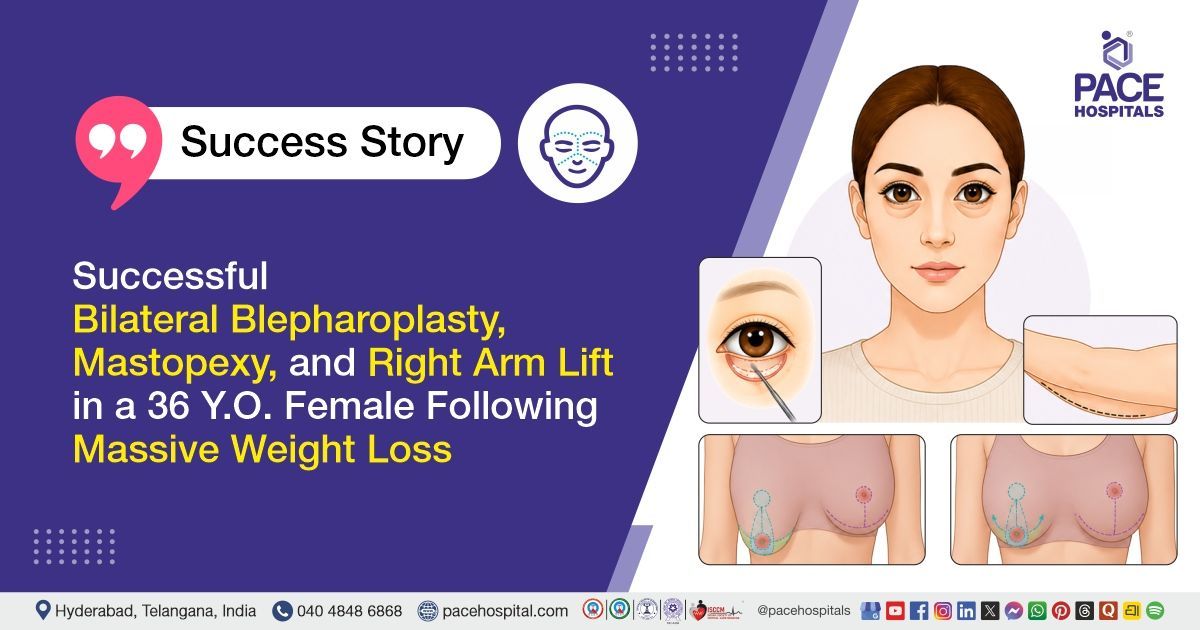
Bilateral Transconjunctival Blepharoplasty with Fat Grafting, Bilateral Autoaugmentation Mastopexy, and a Right Arm Short-scar Lift
on a 36-year-old female with bilateral under-eye bags, Grade 3 breast ptosis (severe breast sagging), and sagging skin of the right upper arm. The procedures were aimed at rejuvenating the under-eye area, restoring breast shape and position, and improving arm contour by removing excess loose skin, resulting in a more youthful and proportionate appearance.
Chief Complaints
A 36-year-old female patient with a body mass index (BMI) of 17 presented to the Plastic and Reconstructive Surgery Department at PACE Hospitals, Hitech City, Hyderabad, with complaints of bilateral under-eye bags, Grade 3 breast ptosis (severe breast sagging), and excess loose skin of the right upper arm. The patient had experienced a significant weight loss of approximately 20 kg over the previous two years, following which she developed noticeable breast sagging, arm skin laxity, and prominent under-eye bags, prompting her to seek surgical correction.
Past Medical History
The patient had no known medical illnesses or significant chronic health conditions. Her past surgical history was notable for a lower segment cesarean section (LSCS), bariatric surgery resulting in substantial weight loss, and bilateral arm liposuction performed. She reported a weight loss of approximately 20 kg over the preceding two years, which contributed to the development of breast ptosis and excess skin laxity. No other significant medical or surgical history was documented.
On Examination
On physical examination, the patient was conscious, coherent, and cooperative. Local examination showed prominent bilateral under-eye bags with tear trough hollowing, Grade III bilateral breast ptosis, and marked laxity with excess redundant skin over the right upper arm. The patient was clinically stable, and no other significant abnormalities were noted on systemic examination.
Diagnosis
Upon admission to PACE Hospitals, the patient underwent a comprehensive evaluation, including a detailed history taking and thorough clinical examination by the Plastic and Reconstructive Surgery team. The patient presented with complaints of bilateral under-eye bags, sagging of both breasts, and excess loose skin over the right upper arm, following a history of significant weight loss of approximately 20 kg over the past two years.
The diagnosis was primarily established on the basis of clinical history and physical examination findings. Clinical evaluation revealed bilateral lower eyelid fat prolapse with tear trough deformity, Grade III bilateral breast ptosis, and marked skin laxity with excess redundant tissue over the right upper arm. These findings, along with the patient’s post-weight loss changes, formed the basis for the final diagnosis.
A complete preoperative workup was also performed, including routine laboratory investigations and viral screening as part of the anesthetic fitness assessment. All investigations were within normal limits, and no contraindications to surgery were identified.
Based on the clinical and radiological findings, the patient was advised to undergo
Bilateral Under-Eye Bags and Bilateral Grade III Breast Ptosis Treatment in Hyderabad, India, along with correction of the Sagging skin of the right arm under the expert care of the Plastic and Reconstructive Surgery team.
Medical Decision Making (MDM)
After a thorough evaluation by Dr. Kantamneni Lakshmi, Senior Consultant Plastic, Reconstructive & Aesthetic Surgeon, a comprehensive assessment was carried out to determine the most appropriate management plan for the patient presenting with bilateral under-eye bags, bilateral Grade III breast ptosis, and right arm skin laxity following significant post-weight loss changes.
Based on the clinical findings of bilateral lower eyelid fat prolapse with tear trough deformity, severe breast sagging (Grade III ptosis), and excess redundant skin of the right upper arm, it was determined that surgical correction would provide the most effective functional and aesthetic improvement. Accordingly, a combined surgical approach was planned, including bilateral transconjunctival blepharoplasty with fat grafting to the tear trough region, bilateral autoaugmentation mastopexy, and right arm short-scar lift. This decision was made after careful evaluation of tissue laxity, volume loss, contour deformities, and the patient’s overall fitness for surgery.
The patient was also evaluated with routine preoperative investigations and viral screening as part of the anesthetic fitness workup, which revealed no contraindications for surgery. Based on these findings, the patient was deemed fit for surgery under general anesthesia.
The patient and her family were counselled regarding the nature of the procedures, expected outcomes, potential risks and benefits, and the importance of postoperative care, including wound care, use of ice packs, activity restriction, medication adherence, and scheduled follow-up to ensure optimal healing and recovery.
Surgical Procedure
Following the diagnosis, the patient was scheduled to undergo Bilateral Transconjunctival Blepharoplasty with fat grafting, Bilateral Autoaugmentation Mastopexy Procedure in Hyderabad at PACE Hospitals, along with right arm lift to address under-eye bags, breast ptosis and upper arm skin laxity, respectively, under the supervision of the expert Plastic and Reconstructive Surgery team.
The surgical procedure involved the following steps:
- Anaesthesia and Preparation: The patient was taken up for surgery under general anaesthesia. The operative sites were prepared under strict aseptic precautions, including painting and draping of all planned surgical areas to ensure a sterile operative field.
- Bilateral Transconjunctival Lower Blepharoplasty: A transconjunctival approach was used to access the lower eyelids through the inner conjunctival surface. The central and medial fat pads responsible for under-eye bulging were identified and carefully excised to correct the lower eyelid fullness without creating any external visible scar.
- Fat Harvesting and Fat Grafting (Tear Trough Correction): Fat was harvested from the lower abdominal region using standard liposuction techniques. The harvested fat was then processed and purified before being injected into the tear trough area beneath both eyes. This was done to correct under-eye hollowness and improve the smooth transition between the lower eyelid and cheek.
- Bilateral Autoaugmentation Mastopexy (Breast Lift): Both breasts were addressed for severe Grade III ptosis. The patient’s own breast tissue was reshaped and repositioned to achieve an uplifted and more natural contour. Excess skin was adjusted to improve breast shape, projection, and symmetry without the use of implants.
- Right Arm Short Scar Lift and Closure: The right upper arm was treated for significant skin laxity by excising excess redundant skin using a short scar brachioplasty technique. The remaining tissues were tightened and contoured to improve arm shape. All surgical wounds were closed in layers using appropriate sutures, hemostasis was secured, and sterile dressings were applied.
Postoperative Care
Postoperatively, the patient had an uneventful recovery and was managed with medications to prevent infection, reduce gastric acidity and stress-related gastric irritation, and provide pain relief and comfort after surgery. Eye lubricating drops were used to protect the ocular surface and prevent dryness following eyelid surgery, along with antibiotic eye drops to prevent local eye infection. Strict wound care with sterile (aseptic) dressings was maintained, and the surgical sites were regularly monitored for any signs of infection, redness, or discharge. Ice packs were applied to reduce swelling and bruising and to improve postoperative comfort.
Discharge Medications
Upon discharge, the patient was advised to take medications to prevent infection and support overall recovery. Medicines were given to reduce the risk of infection, control stomach acidity, prevent stress-related gastric irritation and manage post-operative pain and inflammation. Treatment was also provided to prevent nausea and vomiting after surgery.
Additional medications were prescribed to reduce swelling and support healing during the recovery period. Multivitamin supplements were recommended to aid tissue repair and improve overall recovery. For eye-related procedures, lubricating eye drops were advised to prevent dryness and protect the ocular surface after surgery, along with antibiotic eye drops to prevent local eye infection.
Dietary Advice
The patient was advised to follow a high-protein diet to support wound healing, tissue repair, and overall postoperative recovery.
Advice on Discharge
She was instructed to maintain proper wound care with regular dressing and hygiene measures to prevent infection. Application of ice packs over the periorbital region was recommended to reduce swelling and bruising. She was also advised to avoid strenuous physical activities and heavy exertion to promote optimal healing and prevent strain on the surgical sites.
Emergency Care
The patient was informed to contact the emergency ward at PACE Hospitals in case of any emergency or development of symptoms such as fever, increasing pain, swelling, redness, wound discharge, or any signs of infection at the surgical sites.
Review and Follow-up Notes
The patient was advised to return for a follow-up consultation with the Consultant Plastic, Reconstructive & Aesthetic Surgeon in Hyderabad at PACE Hospitals after 2 days.
Conclusion
This case highlights a comprehensive post–massive weight loss deformity presenting as bilateral under-eye bags, Grade III breast ptosis, and right arm skin laxity. The patient was successfully managed with a combined aesthetic surgical approach, including transconjunctival blepharoplasty with fat grafting, autoaugmentation mastopexy, and right arm short-scar lift. The outcome was an uncomplicated postoperative course with stable recovery and satisfactory contour improvement.
Post–Massive Weight Loss Body Contouring Surgery Overview
Post–massive weight loss patients commonly present with multi-region soft tissue laxity due to significant loss of skin elasticity and subcutaneous volume. These changes can involve the face, breasts, abdomen, and upper limbs, leading to functional and aesthetic concerns. Management generally requires a comprehensive and individualized surgical plan tailored to the extent of deformity. A Plastic Surgeon / Plastic Surgery Doctor evaluates the patient holistically and decides the appropriate combination of procedures such as tissue excision, lifting, and volume restoration to achieve optimal contour. Both single-stage and staged approaches may be considered depending on patient condition and surgical extent. The primary goal is to restore balanced body proportions with a natural appearance and minimal visible scarring. Careful evaluation and planning are essential to ensure safe outcomes and long-term patient satisfaction.
Frequently Asked Questions (FAQs)
What is the purpose of transconjunctival blepharoplasty for under-eye bags?
This surgery is done to reduce under-eye puffiness by removing or repositioning excess fat and tightening the area under the eyes. In some cases, fat grafting is used to fill hollow areas like the tear trough. This helps smooth the under-eye region and reduce a tired appearance. The aim is to improve facial balance while maintaining a natural look.
Why is autoaugmentation mastopexy done for sagging breasts?
Autoaugmentation mastopexy is a breast lift procedure that uses the patient’s own breast tissue instead of implants. It is used to correct breast ptosis (sagging), improve shape, restore fullness, and enhance symmetry. The breasts appear lifted and more youthful. It can also improve overall body proportion and patient confidence.
What does a short scar arm lift achieve?
A short scar arm lift removes excess skin and tightens loose tissue in the upper arms. It improves arm contour and firmness while keeping scars as minimal as possible. This procedure helps create a more toned and balanced appearance. After healing, the arms look smoother and better shaped.
What is the role of general anesthesia in these procedures?
General anesthesia is used to keep the patient fully asleep and pain-free during surgery. It allows the surgeon to perform procedures safely on multiple areas such as the eyes, breasts, and arms. The patient does not feel discomfort or movement during the operation. This helps improve surgical precision and patient comfort.
Why are post-operative dressings and compression garments important?
Post-operative dressings and compression garments are used to support the healing process after surgery. They help hold the tissues in the correct position, reduce swelling (edema), and prevent fluid accumulation (seroma). These garments also support proper skin reattachment and improve wound healing. When worn as advised by the surgeon, they help achieve better and more stable final results. They are an important part of a safe and effective recovery.
How soon should follow-up appointments be scheduled?
Follow-up visits are usually planned a few days after surgery. During these visits, the doctor examines the surgical wounds, checks how the healing is progressing, and may remove sutures (stitches) if required. The doctor also looks for any early signs of infection or other post-operative complications. Regular follow-up is important to ensure proper wound healing and safe recovery. It also allows the surgeon to advise on further care and the next steps in treatment.
When should a patient seek urgent medical attention after surgery?
Medical help should be sought immediately if there is fever, increasing pain, unusual swelling, discharge, or redness at the surgical site. These may be signs of infection or other complications. Early treatment helps prevent worsening of the condition. Quick response is important for safe recovery.
What dietary measures support recovery after surgery?
A diet rich in protein helps the body repair tissues and heal faster. Good nutrition also supports immunity and reduces swelling. Drinking enough water is also important for recovery. Following the surgeon’s dietary advice helps ensure smoother healing.
Why is activity restriction necessary post-surgery?
After surgery, patients are advised to avoid heavy lifting and strenuous activities. This helps prevent unnecessary strain on healing tissues and supports proper wound healing. It also reduces the risk of complications such as swelling, bleeding, or wound dehiscence (opening of the surgical wound). Patients are encouraged to return to normal activities gradually, based on the surgeon’s advice. Adequate rest and following post-operative instructions are important for a safe and smooth recovery.
What are the long-term benefits of combined procedures for multiple body areas?
Doing multiple procedures together, such as on the eyes, breasts, and arms, can reduce overall recovery time. It also helps achieve more balanced and harmonious body results. Fewer surgeries mean less exposure to anesthesia and fewer hospital visits. Many patients find this approach more convenient and satisfactory in the long term.
Share on
Request an appointment
Fill in the appointment form or call us instantly to book a confirmed appointment with our super specialist at 04048486868
Appointment request - health articles
Recent Articles