Benzonatate Capsule: Uses, Side effects & Dosage Guide
PACE Hospitals
Manufactured by: Lupin, Macsen Laboratories, Gelnova Laboratories, Ami Life Sciences Pvt. Ltd.
Class: Non-narcotic antitussive (cough suppressant).
Overview
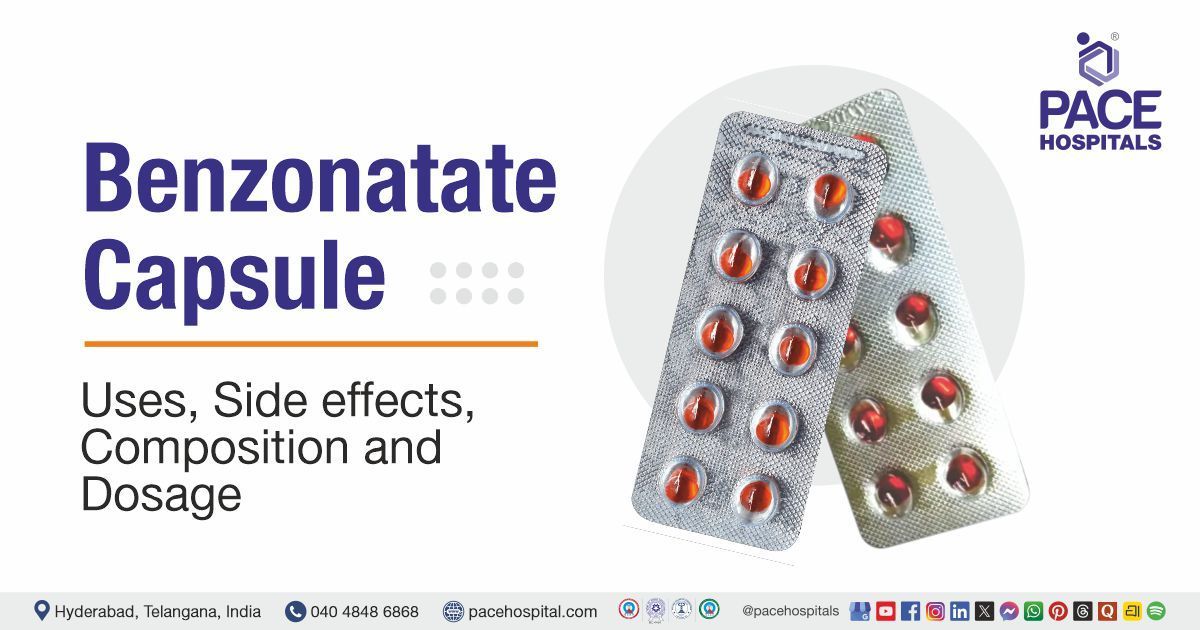
Benzonatate is an oral non-narcotic antitussive medication approved by the Food and Drug Administration (FDA). It is used for the symptomatic relief and suppression of cough in patients over ten years of age. Benzonatate works by numbing the stretch receptors located in the lungs, respiratory passages, and pleura, thereby calming the cough reflex in the brain.
It is chemically related to local anesthetics such as procaine and tetracaine and acts as a potent voltage-gated sodium channel blocker. The onset of action is within 15 to 20 minutes, and its effect typically lasts between 3 and 8 hours. Benzonatate is available in 100 mg, 150 mg, and 200 mg oral capsule forms. It is not suitable for children under 10 years of age and must be swallowed whole to avoid serious side effects such as choking or laryngospasm.
Benzonatate is primarily indicated for the relief of cough associated with various respiratory conditions, but does not treat the underlying causes of cough. Serious overdose can be fatal, especially in children, and misuse, such as chewing the capsules, can cause life-threatening adverse effects.
Benzonatate Composition
- Benzonatate 100 mg Capsule: Each capsule contains Benzonatate 100 mg (immediate-release). Packaging: Bottle of 100 capsules or Bottle of 500 capsules.
- Benzonatate 200 mg Capsule: Each capsule contains Benzonatate 200 mg (immediate-release). Packaging: Bottle of 100 capsules or Bottle of 500 capsules.
Inactive Ingredients: D&C Yellow No. 10, Gelatin, Glycerin, Methylparaben Sodium, Propylparaben Sodium
Benzonatate Uses
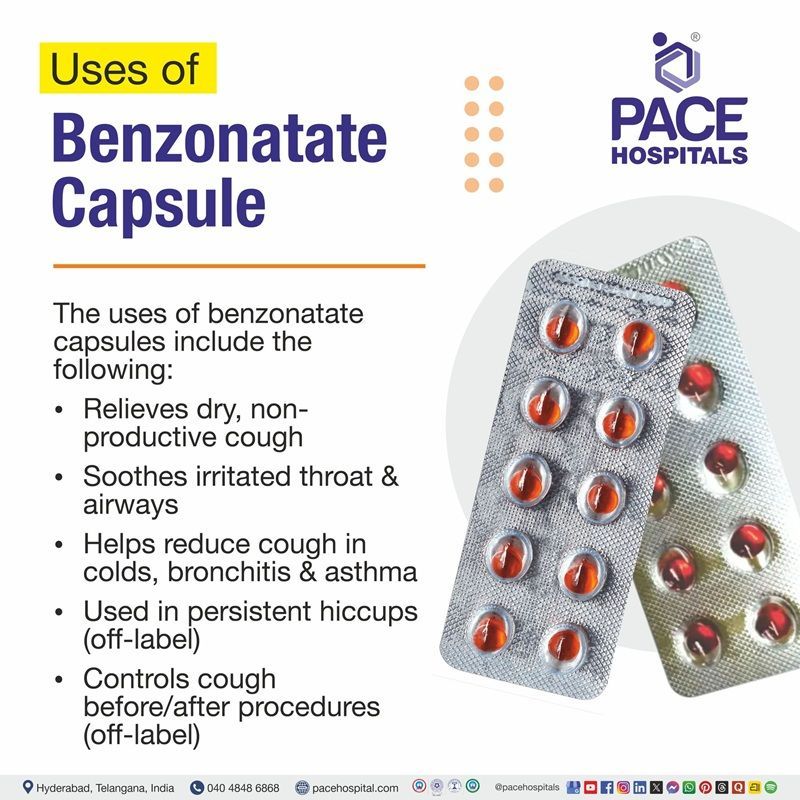
The uses of benzonatate capsules include the following:
- Symptomatic relief of cough: Benzonatate is primarily used to relieve dry, non-productive cough in adults and children over 10 years of age. It helps reduce cough caused by respiratory conditions such as the common cold, bronchitis, pneumonia, asthma, emphysema, and chronic bronchitis. And it numbs stretch receptors in the lungs, bronchi, and pleura to suppress the cough reflex.
- Soothing of irritated throat and lungs: Benzonatate capsule is used to reduce irritation and inflammation in the throat and airways, especially when persistent coughing causes discomfort. It provides a local anesthetic effect to sensory nerves in the throat, trachea, and bronchi, reducing the urge to cough.
Benzonatate off-label uses
- For persistent hiccups: It is used off-label in some cases to treat intractable or persistent hiccups when conventional treatments fail and may suppress the hiccup reflex by numbing vagal afferent pathways involved in diaphragmatic stimulation.
- Adjunct use in pre-/postoperative respiratory management: Sometimes it is used off-label to control coughing during or after surgical procedures, such as thoracic or abdominal surgery, or during bronchoscopic procedures, as it suppresses cough by anaesthetizing respiratory tract receptors, reducing airway sensitivity during recovery or medical interventions.
- As Oropharyngeal anesthesia: It is rarely used for local anesthesia of the mouth and throat during procedures like awake intubation or ENT interventions. This method is high-risk and not generally recommended, and acts as a topical anaesthetic when applied locally, but carries the risk of mouth numbness, choking, and systemic toxicity.
Guidelines to follow while taking Benzonatate Capsule
- Benzonatate is taken by mouth, and the capsule must be swallowed whole with a full glass of water.
- It is advised not to be chewed, cut, crushed, sucked, or dissolved in the mouth. Chewing the capsule can rapidly release the medication, numbing the mouth and throat, which may lead to choking or even more severe toxic reactions.
- Benzonatate may be taken at any time of the day, with or without food, but regular timing helps maintain consistent cough relief throughout the day.
- This medication is not to be used in children under 10 years due to the risk of fatal overdose and severe side effects if the capsule is accidentally chewed or broken.
- If numbness or tingling of the mouth, throat, tongue, or face occurs after taking the capsule, do not eat or drink until the numbness fully resolves.
- Do not mix benzonatate with other cough suppressants without consulting a healthcare provider. It does not interact with the absorption of other drugs, but it is always advised to inform the physician about all medications in use.
- It is recommended always to follow the exact instructions provided by the doctor and the prescription label when taking benzonatate capsules.
Benzonatate Mechanism of Action
Benzonatate acts mainly as a peripheral local anesthetic to suppress cough. Its mechanism of action involves anaesthetizing and reducing the activity of vagal sensory nerve fibres and stretch receptors located on the lungs and pleura, which are key components in triggering the cough reflex.
By numbing these stretch receptors, benzonatate diminishes the cough reflex at its source, preventing the transmission of signals to the cough centre in the brainstem (medulla). Additionally, it may inhibit transmission of cough impulses at the level of the medullary cough centre. Benzonatate is also a potent inhibitor of voltage-gated sodium channels, similar to other local anesthetics like procaine and tetracaine, which contributes to its anesthetic and cough-suppressing effects.
Benzonatate Side Effects
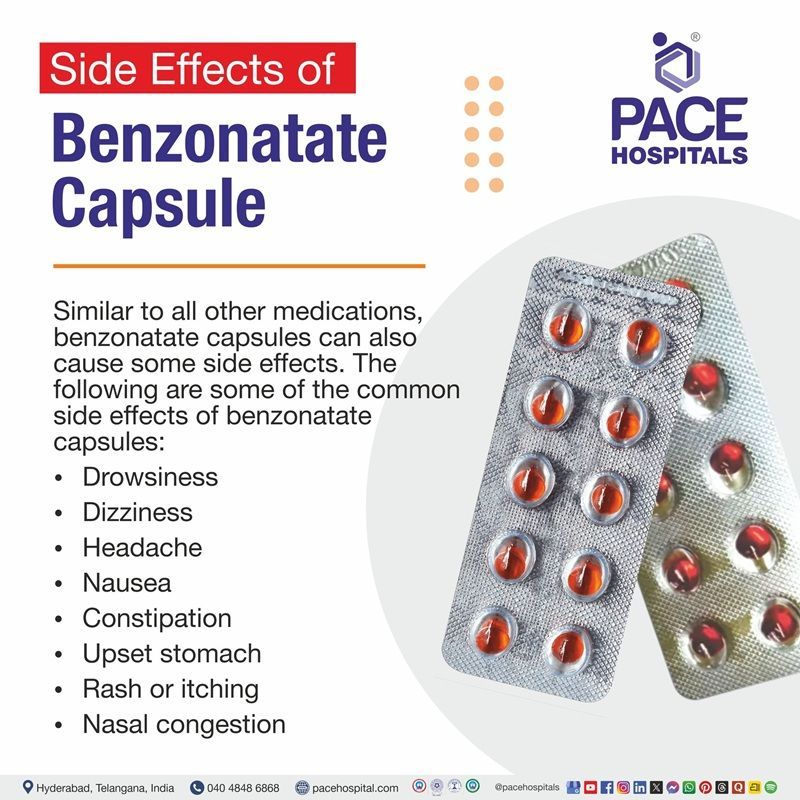
Similar to all other medications, benzonatate capsules can also cause some side effects. However, mentioning side effects as common in the patient information leaflet doesn't mean that everyone taking the medication will experience them. These side effects are generally mild and may resolve without treatment. The following are some of the common side effects of benzonatate capsules:
- Drowsiness
- Dizziness
- Headache
- Nausea
- Constipation
- Upset stomach
- Rash or itching
- Nasal congestion
The following are some of the serious potential side effects of benzonatate capsules:
- Severe allergic reactions like swelling of the lips, tongue, face, or throat.
- Difficulty breathing or swallowing
- Confusion
- Hallucinations
- Numbness in the mouth, throat, or chest
- Choking sensation
NOTE: If a patient experiences any of the symptoms mentioned above, the patient is recommended to consult a
physicianwithout delay.
Benzonatate Capsules Dosage
Benzonatate is administered orally in the form of liquid-filled capsules that must be swallowed whole. It is not available in injectable or other forms. Benzonatate capsules are available in the following strengths:
- 100 mg
- 150 mg
- 200 mg
The physician typically initiates benzonatate treatment with a low dose of 100 mg orally, which can be increased to 200 mg based on patient response and tolerability. The usual adult dosage is 100–200 mg taken three times daily as needed for cough relief. Dosage adjustments need to be made cautiously and not more frequently than every few days, maintaining a maximum total daily dose of 600 mg.
Benzonatate dosage for adults
In adults and children over 10 years, the standard dose is 100 mg to 200 mg taken orally three times daily as needed for cough relief. It is advised that the maximum daily dose need not exceed 600 mg. Capsules must be swallowed whole and never chewed, crushed, dissolved, or broken to avoid numbness and choking risks.
Benzonatate dosage for child
Benzonatate is not recommended for children under 10 years old due to safety concerns and lack of established efficacy. Children aged 10 and above follow the adult dosing schedule.
Benzonatate dosage for older patients
The safety and efficacy of benzonatate in older adults are comparable to those of younger patients, but they may be more sensitive to its effects.
Missed dose
If a dose is missed, take it as soon as possible, unless it is near the time of the next scheduled dose. Do not double doses to make up for the missed one, and then continue with the regular dosing schedule.
Benzonatate Dosage for Specific Patient Populations
- Hepatic Impairment: According to available data and product information, there are no specific dosage adjustments recommended for patients with hepatic impairment. As clinical experience is limited in patients with mild, moderate, or severe liver impairment, benzonatate needs to be used cautiously in these patients.
- Renal Impairment: No established dosage adjustments exist for patients with renal impairment. Use with caution, as benzonatate’s safety profile in patients with kidney disease is not well studied, and adverse reactions such as dizziness or sedation may be exacerbated.
Effects of Capsule Benzonatate in Pregnancy and Breastfeeding
Benzonatate in pregnancy
No well-controlled clinical trials have been conducted for benzonatate in pregnant women. Clinical studies have not shown direct harm to the fetus, but safety in human pregnancy is not established. Benzonatate is classified as a pregnancy category C drug, which means it may be used during pregnancy only when potential benefits justify the potential risk to the fetus. It is advised that Patients who are pregnant or planning to become pregnant need to consult the doctor before use.
Benzonatate during breastfeeding
It is unknown whether benzonatate passes into breast milk or what effects it might have on a breastfed infant. Due to limited data, benzonatate capsules need to be used with caution while breastfeeding. The decision to use benzonatate during breastfeeding needed to be focused on weighing the benefits of breastfeeding against the potential risks of the medication to the infant. Alternate medications may be preferred, especially while nursing newborn or preterm infants.
Benzonatate Overdose
From a benzonatate overdose, symptoms usually appear within 15 to 20 minutes and may include restlessness, tremors, seizures, loss of consciousness, abnormal heart rhythms, respiratory depression, and possibly cardiac arrest. Chewing or dissolving the benzonatate capsules in the mouth can quickly numb the throat and mouth, thereby increasing the risk of choking.
Overdose treatment involves immediate supportive care, including seizure management, monitoring of cardiovascular and neurological functions, airway protection, and stabilisation of heart rhythms. Activated charcoal may be utilised if the patient appears early and airway protection is maintained. Intravenous lipid emulsion therapy may be considered for severe cardiovascular toxicity. Due to the rapid onset and potential severity of benzonatate overdose symptoms, immediate emergency medical attention and prolonged observation are essential.
Benzonatate Contraindications
Benzonatate capsule is contraindicated in the following conditions:
- Benzonatate capsules are contraindicated in patients who are hypersensitive or allergic to benzonatate or related compounds, including tetracaine-type topical anesthetics such as procaine and tetracaine. Hypersensitivity reactions may include bronchospasm, laryngospasm, and severe cardiovascular collapse.
- Benzonatate is not recommended for use in children younger than 10 years due to the risk of severe adverse effects and potentially fatal overdose from accidental ingestion.
- Use of benzonatate during pregnancy and breastfeeding has not been established as safe; therefore, it may be taken during these periods only if the potential benefits outweigh the risks.
- Patients with chronic cough associated with excessive secretions should avoid benzonatate, as suppressing cough can worsen these conditions.
- Always inform the healthcare provider of any allergies or medical conditions before starting benzonatate treatment to avoid serious adverse effects.
Benzonatate Warnings and Precautions
- General: Benzonatate capsules must be swallowed whole and not chewed, crushed, or dissolved, as this can cause immediate numbness of the mouth and throat, leading to choking or hypersensitivity reactions.
- Hypersensitivity: Severe allergic reactions, including laryngospasm, bronchospasm, and cardiovascular collapse, especially if the capsule is chewed or dissolved. Discontinue benzonatate immediately and seek emergency help if signs occur.
- Neurologic and Psychiatric: Benzonatate can cause mental confusion, hallucinations, dizziness, drowsiness, and, rarely, seizures. Use caution when driving or operating machinery. Monitor for unusual behaviour or mood changes.
- Pediatric Use: Studies suggested that the Safety and effectiveness have not been established in children under 10 years. Accidental ingestion in children has caused serious adverse effects and fatalities.
- Respiratory: Use cautiously in patients with chronic cough due to excessive secretions; suppressing cough may worsen the underlying condition.
- Pregnancy and Lactation: Use only if clearly needed and after consulting a healthcare provider, given limited data on safety.
Patients should report any severe or persistent adverse effects promptly. Regular monitoring may be necessary during treatment.
Benzonatate Interactions
When two or more pharmaceuticals react, it's termed a drug interaction; when the drug and food interact, it's called a food interaction. An interaction between a medication and a disease is called a disease-drug interaction.
Drug interactions
- Benzonatate drug interactions can increase sedation when taken with central nervous system (CNS) depressants such as opioids like oxycodone, hydrocodone, benzodiazepines like diazepam, lorazepam, muscle relaxants, sedative-hypnotics, and certain antihistamines like diphenhydramine, chlorpheniramine.
- Combining benzonatate with other cough suppressants like dextromethorphan may increase adverse effects such as dizziness and confusion.
- Use caution when combined with antipsychotics and antidepressants, particularly monoamine oxidase inhibitors (MAOIs) and tricyclic antidepressants (TCAs), due to increased risk of neurological side effects.
- Benzonatate capsule may interact with local anaesthetics like procaine and tetracaine, potentially enhancing numbing and toxicity.
Disease interactions
- Caution is advised in patients with emotional or psychiatric conditions due to possible hallucinations, confusion, or changes in mental status.
- Benzonatate should be used cautiously in patients with chronic cough related to excessive secretions, as suppressing cough may worsen the condition.
- It is advised to use it with caution in patients with respiratory disorders, as numbing effects might impair protective airway reflexes.
Food Interactions
- Avoid alcohol while taking benzonatate, as it may increase drowsiness, dizziness, and impair cognitive function.
- No significant food interactions reported; benzonatate can be taken with or without food.
- It is recommended to inform the physician about all medications, health conditions, and substances being taken to prevent side effects and harmful interactions. Dose adjustments of the drug or alternative treatments may be necessary.
Benzonatate Storage
- Store benzonatate capsules at room temperature between 59°F and 86°F (15°C and 30°C), ideally close to 77°F (25°C).
- Keep the medication in its tightly closed original container, protected from light and moisture.
- Do not store benzonatate in damp or humid places, such as bathrooms.
- Keep benzonatate out of reach and sight of children and pets, preferably in a child-resistant container.
- Avoid freezing the medication.
- Dispose of unused or expired benzonatate properly, following local guidelines or pharmacy take-back programs.
- Proper storage helps maintain the medication's effectiveness and safety.
Frequently asked questions (FAQs) on Benzonatate Capsule
What is benzonatate used for?
Benzonatate is mainly used to relieve coughing, especially a dry cough that irritates or keeps a person awake. It works by numbing the nerves in the throat and lungs that trigger the cough reflex. So, it helps control persistent coughs that are not productive and not caused by mucus or infection.
Is benzonatate an antibiotic?
No, benzonatate is not an antibiotic. It does not treat infections or kill bacteria. Instead, it is a cough suppressant, sometimes called an "antitussive," that only reduces or calms coughing.
Does benzonatate contain aspirin?
No, Benzonatate does not contain aspirin or any related ingredients. It is an entirely different type of medicine, unrelated to aspirin, and does not have pain-relieving or blood-thinning effects like aspirin.
Does benzonatate help with congestion?
Benzonatate does not directly help with chest or nasal congestion. It is meant to suppress cough by numbing the throat and lungs, but it will not clear up a stuffy nose or reduce mucus. It is suggested that treatments like decongestants are better for congestion.
What are the common side effects of benzonatate?
The most common side effects of benzonatate capsules are drowsiness, dizziness, headache, constipation, nausea, and stomach upset. Some people may feel chilly or have a stuffy nose. Rare but serious effects can include confusion, visual changes, numbness in the mouth or throat, and allergic reactions.
Does benzonatate affect heart rate?
Benzonatate does not usually change heart rate when taken as prescribed. However, in cases of overdose, it can cause fast or irregular heart rhythms and even serious heart issues like cardiac arrest. Normal doses are generally not linked to major heart problems.
How long is benzonatate effective?
Benzonatate usually begins to work within 15 to 20 minutes after the capsule is swallowed, and its effects can last for up to 8 hours to help relieve coughing. Its effects last long enough to help most people manage cough throughout the day or night.
What cannot be taken with benzonatate?
Benzonatate should not be mixed with medicines or substances that make people sleepy, such as certain anxiety drugs, sedatives, strong painkillers (opioids), or alcohol, because it may increase drowsiness or dizziness. Mixing with other numbing agents can also increase certain risks. It is always advised to check with a physician before using new medications together.
When not to use benzonatate?
It is suggested not to use benzonatate capsules for people who are allergic to it or to similar numbing agents like tetracaine or procaine. It is not safe for children under 10 years old because they are at higher risk for serious side effects or accidental overdose.
How much benzonatate is safe?
The usual safe dose for adults and children over 10 is 100–200 mg up to three times a day as needed, without chewing the capsules. Taking more than prescribed or swallowing several capsules at once, especially in children, can lead to severe or fatal reactions. Always follow healthcare instructions exactly.
Can benzonatate affect sleep?
Benzonatate may cause drowsiness in some people, making them sleepy or tired. However, it does not work as a sleep aid, and its primary use is to quiet a cough rather than help with sleep problems.
What happens if benzonatate pops in the patient’s mouth?
If a benzonatate capsule pops or is chewed in the mouth, it can quickly numb the mouth and throat, which may make swallowing or speaking difficult. This can be dangerous due to the risk of choking or allergic reactions. Capsules need to be swallowed whole.
Can I drive if I take benzonatate?
It is advised to avoid driving if an individual is feeling drowsy, dizzy, or less alert after taking benzonatate. Benzonatate can cause these effects in some individuals and using it with other sedatives can increase the risk of accidents.
How to know if allergic to benzonatate?
Signs of a benzonatate allergy may include itching, rash, swelling of the face or throat, difficulty breathing, or hives, often appearing shortly after use. Severe reactions can happen quickly and can be life-threatening, so seek emergency help if symptoms occur. It is advised that a person with a history of reactions to local anaesthetics should not take benzonatate.
Share on
Request an appointment
Fill in the appointment form or call us instantly to book a confirmed appointment with our super specialist at 04048486868
Appointment request - health articles
Recent Articles