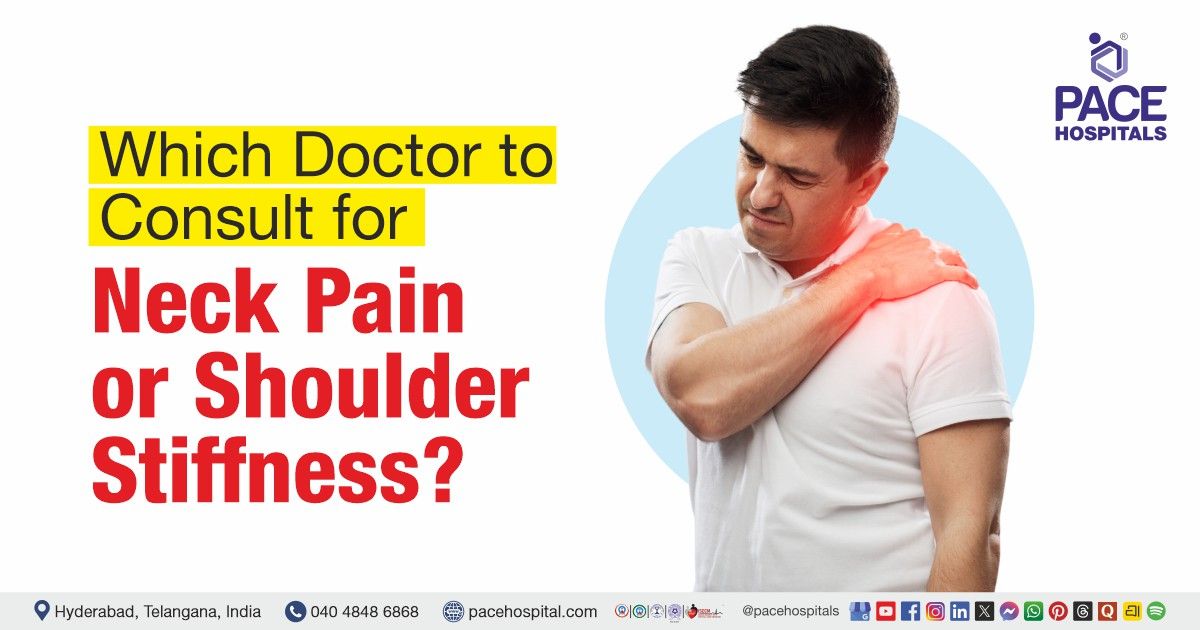
Which Doctor to Consult for Neck Pain or Shoulder Stiffness?
PACE Hospitals
Written by: Editorial Team
Medically reviewed by: Dr. Raghuram - Orthopaedic Consultant, Trauma, Shoulder and Knee Arthroscopic Surgeon, Hip and Knee Joint Replacement Specialist
Introduction
Neck pain and shoulder stiffness are common problems among persons such as office workers, drivers, older adults, athletes, and people with prolonged mobile or laptop use. Most cases are mechanical, but some are related to disc problems, nerve compression, inflammatory arthritis, injury, or emergency conditions.
The right doctor selection is based upon on conditions such as whether the pain is persistent, injury-related, radiating to the arm, associated with numbness or weakness, or accompanied by fever or neurological symptoms that are unbearable. This exclusive guide helps patients choose the correct specialist and avoid delayed care.
Causes Neck Pain and Shoulder Stiffness
Neck pain may happen from muscles, joints, discs, nerves, posture, injury, inflammation, or spine disease. Shoulder stiffness may develop from rotator cuff disease,
frozen shoulder,
arthritis, injury,
diabetes-related stiffness, or referred pain from the neck. Neck and shoulder symptoms often overlap because nerves from the cervical spine travel into the shoulder, arm, and hand.
Not all neck pain is cervical spondylosis, and not all shoulder stiffness is frozen shoulder. Diagnosis depends on symptoms, examination, and tests when needed.
Neck Pain or Shoulder Stiffness Should Not Be Ignored
Persistent, worsening, radiating, or injury-related pain needs thorough and timely evaluation. Neck pain with numbness, tingling, weakness, balance problems, hand clumsiness, or bladder/bowel symptoms may indicate nerve or spinal cord involvement that being the root cause of these issues. Fever with neck stiffness, severe headache, trauma, or stroke-like symptoms require emergency care.
Doctor Selection Guide: Which Specialist Should You Choose?
| Situation | First Doctor to Consult | Specialist Needed If |
|---|---|---|
| Mild neck pain after posture strain (cervicalgia or a cervical strain) | General Physician/Orthopaedic doctor | Pain persists, worsens, or limits normal daily activity |
| Neck pain radiating to arm | Spine specialist/Orthopaedic doctor | Cervical nerve compression suspected |
| Neck pain with numbness or tingling | Neurologist/Spine specialist | Nerve involvement suspected |
| Neck pain with weakness | Emergency Physician/Neurologist/Spine specialist | Spinal cord or nerve emergency suspected |
| Neck pain after accident or fall | Emergency Physician/Orthopaedic doctor | Fracture or spinal injury suspected |
| Shoulder stiffness with limited movement | Orthopaedic doctor | Frozen shoulder, arthritis, or rotator cuff issue suspected |
| Shoulder stiffness with diabetes | Orthopaedic doctor/Endocrinologist | Frozen shoulder or metabolic risk needs proper attention and care |
| Fever, accompanied with stiff neck or severe headache | Emergency Physician | Serious infection or neurological emergency suspected |
| Morning stiffness with multiple joint pain | Rheumatologist | Inflammatory arthritis suspected |
| Posture-related neck and shoulder pain | Orthopaedic doctor/Physiotherapist | Ergonomic rehab needed after diagnosis |
When Neck Pain or Shoulder Stiffness Is a Medical Emergency
- Neck pain after major trauma, fall, or road accident
- Severe neck pain with weakness in arms or legs
- Numbness in both arms or legs
- Loss of bladder or bowel control
- Fever with stiff neck
- Severe headache with neck stiffness or confusion
- Sudden difficulty walking or balance loss
- Stroke symptoms such as facial drooping, slurred speech, or one-sided weakness
- Chest pain with neck or shoulder pain
- Unexplained weight loss with persistent severe pain or history of cancer
Important note: If neck pain follows an accident or occurs with weakness, numbness in arms or legs, bladder/bowel problems, fever with stiff neck, severe headache, confusion, chest pain, or sudden neurological symptoms, visit an emergency department immediately without ignoring or delaying the treatment needed for it.
Specialists for neck and shoulder symptoms
Neck and shoulder symptoms may arise from muscle, joint, nerve, or spine-related conditions and may require evaluation by the appropriate specialist.
When to See an Orthopaedic Doctor or Spine Specialist?
An Orthopaedic doctor or Spine specialist is usually the main specialist for persistent neck pain, cervical spondylosis, disc prolapse, neck pain after injury, shoulder stiffness, frozen shoulder, arthritis, rotator cuff problems, mechanical spine pain, and pain radiating to the arm. They may advise X-ray, MRI, medicines, injections, physiotherapy, or surgery only when required.
When to See a Neurologist?
A Neurologist is needed when neck pain is associated with numbness, tingling, weakness, loss of coordination, balance problems, hand clumsiness, electric shock-like sensations, or suspected nerve/spinal cord involvement. Neurology evaluation may include nerve conduction studies, EMG, MRI, or other tests.
When to See a Physiotherapist?
Physiotherapy plays an important role in posture correction, mobility, strengthening, ergonomic training, frozen shoulder rehabilitation, and recovery after injury or surgery. However, physiotherapy should be diagnosis-based. Severe pain after injury, weakness, numbness, fever, or suspected fracture/spinal cord compression should be evaluated by a doctor before exercises.
When to See a Rheumatologist?
A Rheumatologist's guidance is often required essentially when neck or shoulder stiffness is linked with inflammatory arthritis, morning stiffness lasting more than 30-60 minutes, multiple joint pain, swelling, skin rash, eye inflammation, ankylosing spondylitis, rheumatoid arthritis, or polymyalgia rheumatica-like symptoms in older adults
Common Conditions and Which Doctor Treats Each
| Condition/Symptom | Common Features | Doctor/Specialist |
|---|---|---|
| Cervical spondylosis | Neck stiffness, pain, reduced movement | Orthopaedic/Spine specialist |
| Disc prolapse/cervical radiculopathy | Pain radiating to arm, tingling, numbness | Spine specialist/Neurologist |
| Frozen shoulder | Painful restriction of shoulder movement | Orthopaedic doctor/Physiotherapist |
| Rotator cuff problem | Shoulder pain with lifting arm | Orthopaedic doctor |
| Posture-related pain | Desk work, mobile use, muscle strain | Orthopaedic doctor/Physiotherapist |
| Inflammatory arthritis | Morning stiffness, multiple joints | Rheumatologist |
| Trauma-related pain | Fall, accident, severe pain | Emergency/Orthopaedic doctor |
| Nerve symptoms | Weakness, numbness, balance issues | Neurologist/Spine specialist |
Tests and treatment options
Tests and treatment options help identify the underlying cause of symptoms and guide the most appropriate medical care.
Doctors May Recommend Tests
- Physical and neurological examination
- X-ray cervical spine or shoulder
- MRI cervical spine for disc, nerve, or spinal cord problems
- MRI shoulder for rotator cuff/frozen shoulder or soft tissue concerns
- CT scan after trauma when fracture is suspected
- Nerve conduction study/EMG if nerve damage is suspected
- ESR/CRP for infection or inflammation
- Rheumatoid factor, anti-CCP, HLA-B27 when inflammatory arthritis is suspected
- Blood sugar/HbA1c for frozen shoulder risk
- Vitamin D/calcium if bone health is a concern
Treatment Options
Treatment depends on diagnosis and severity of the conditions related with patients. Options may include rest, activity modification, posture correction, medicines when prescribed, physiotherapy, ergonomic changes, heat/ice if advised, injections in selected cases, frozen shoulder rehabilitation, spine interventions in selected cases, and surgery only for severe compression, instability, progressive weakness, or selected structural conditions. Avoid long-term painkiller use without doctor supervision
Neck Pain or Shoulder Stiffness Specialists at PACE Hospitals, Hyderabad
PACE Hospitals manages neck pain through specialists in Orthopaedics, Spine Surgery, Neurology, Physiotherapy and Rehabilitation, General Medicine/Internal Medicine, and Emergency & Trauma Care. Evaluation may be required for symptoms such as neck stiffness, pain spreading to the shoulder or arm, numbness, tingling, weakness, restricted movement, or pain following an injury. Diagnostic tests and imaging studies are used when needed to identify the underlying cause and determine the most suitable treatment plan.
Frequently Asked Questions (FAQs)
Which doctor should I consult for neck pain?
For persistent neck pain, it may be required to consult an Orthopaedic doctor or Spine specialist. They can evaluate disc problems, cervical spondylosis, muscle strain, injury, and mechanical spine causes. If your neck pain is accompanied by numbness, tingling, weakness, balance issues, or hand clumsiness, an individual should consult a Neurologist.
When is neck pain an emergency?
Neck pain is an emergency after major trauma or when it occurs with weakness, numbness in both arms or legs, bladder/bowel problems, fever with stiff neck, severe headache, confusion, chest pain, or stroke-like symptoms. Do not delay emergency evaluation in these situations.
Can poor posture cause neck and shoulder pain?
Yes, poor posture is a leading cause of neck and shoulder pain. Bending over mobile phones ("text neck"), slouching over laptops, and forward head posture drastically increase the physical strain on an individual cervical spine and surrounding muscles. Ergonomic adjustments and physiotherapy can be beneficial, but persistent or radiating pain should be assessed medically.
Which is the best hospital for neck pain or shoulder stiffness treatment in Hyderabad?
For neck pain or shoulder stiffness treatment in Hyderabad, choose a hospital with Orthopaedics, Spine Surgery, Neurology, Physiotherapy, Rheumatology support, imaging, and Emergency care. PACE Hospitals offers multi-speciality evaluation and personalized treatment planning.
Which doctor treats cervical spondylosis?
Cervical spondylosis is usually treated by an Orthopaedic doctor or Spine specialist. A Neurologist may be involved if there are nerve symptoms such as numbness, tingling, weakness, or balance problems. Physiotherapy is often part of the treatment plan.
Which doctor should I consult for shoulder stiffness?
For shoulder stiffness, it may be needed to consult an Orthopaedic doctor, especially if movement is restricted, pain persists, or frozen shoulder, arthritis, or rotator cuff disease is suspected. Physiotherapy is often important after diagnosis to restore mobility and strength.
Should I see an orthopaedic doctor for neck pain?
Yes, an Orthopaedic doctor or Spine specialist is usually the main and right specialist to consult for persistent, injury-related, or radiating neck pain. They have the expertise to examine the cervical spine, assess posture and movement, and correctly advise imaging, medicines, physiotherapy, injections, or surgery only when necessary.
When should I see a neurologist for neck pain?
It is required to see a Neurologist if neck pain is associated with numbness, tingling, weakness, balance issues, hand clumsiness, electric shock-like sensations, severe headache, or suspected nerve/spinal cord involvement. Sudden neurological symptoms require emergency care.
Which doctor treats frozen shoulder?
Frozen shoulder is treated by an Orthopaedic doctor, often with Physiotherapy support. It is more common in people with diabetes and thyroid disease. Treatment may include medicines, guided exercises, injections, or procedures in selected cases.
Can neck pain cause tingling in hands?
Yes, neck problems such as cervical disc prolapse or nerve compression can cause tingling, numbness, or pain radiating into the arm or hand. These symptoms should be evaluated by a Spine specialist or Neurologist, especially if weakness is present.
What causes shoulder stiffness?
Shoulder stiffness may be caused by frozen shoulder, rotator cuff problems, arthritis, injury, diabetes, thyroid disease, poor posture, or referred pain from the neck. An Orthopaedic doctor can identify the exact cause and guide for proper treatment.
What tests are done for neck pain?
Neck Pain tests may include combination of several approaches, such as physical examination, neurological examination, X-ray cervical spine, MRI cervical spine, CT scan after trauma, nerve conduction study/EMG, and blood tests such as ESR/CRP or rheumatoid markers if inflammation is suspected.
Is physiotherapy helpful for neck pain?
Physiotherapy is helpful for many cases of posture-related neck pain, cervical spondylosis, muscle stiffness, and recovery after injury. It should start after proper evaluation, especially if there is trauma, severe pain, numbness, weakness, or suspected nerve compression.
Which doctor treats neck pain after injury?
Neck pain after an accident, fall, or sports injury should be evaluated by an Emergency Physician or Orthopaedic doctor. Do not massage or manipulate the neck after trauma until fracture or spinal injury is ruled out.
Can neck pain be treated without surgery?
Most neck pain can be treated without surgery using medicines when prescribed, physiotherapy, posture correction, activity modification, ergonomic changes, and targeted rehabilitation. Surgery is reserved for selected cases with severe compression, instability, or progressive neurological deficits.
Conclusion
Persistent neck pain, radiating pain, shoulder stiffness, injury-related pain, or nerve symptoms should be medically evaluated. An Orthopaedic doctor or Spine specialist is usually the main specialist, Neurology is needed for nerve symptoms, Rheumatology for inflammatory stiffness, and Physiotherapy for rehabilitation after diagnosis.
Emergency symptoms such as trauma, weakness, fever with stiff neck, severe headache, or bladder/bowel problems require immediate care.
Share on
Request an appointment
Fill in the appointment form or call us instantly to book a confirmed appointment with our super specialist at 04048486868
Appointment request - health articles
Recent Articles