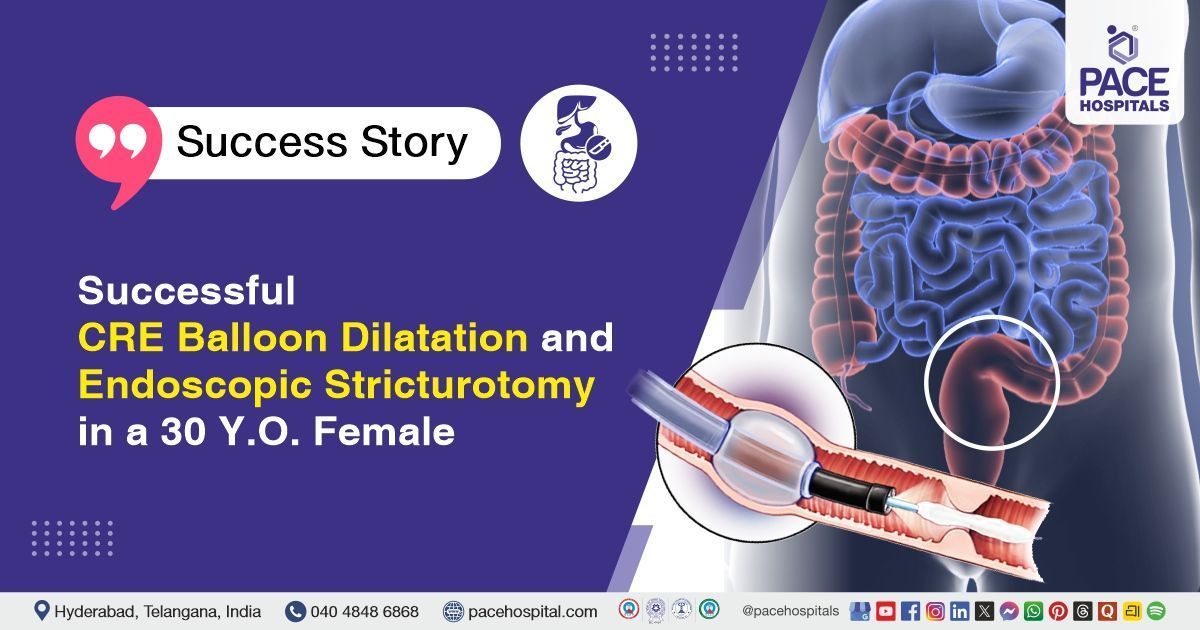
Successful CRE Balloon Dilatation and Endoscopic Stricturotomy in a 30 Y.O. Female
PACE Hospitals
PACE Hospitals’ expert Surgical Gastroenterology team successfully performed Controlled Radial Expansion (CRE) balloon dilatation and Endoscopic Stricturotomy on a 30-year-old female patient who had been diagnosed with a Rectosigmoid anastomotic stricture, and the procedure was aimed at relieving the narrowing, restoring normal bowel function, and improving her quality of life.
Chief Complaints
A 30-year-old female with a
body mass index (BMI) of 20 presented to the Surgical Gastroenterology Department at
PACE Hospitals, Hitech City, Hyderabad, with chief complaints of one-month history of abdominal discomfort and reduced stool passage.
Past Medical History
The patient had a significant surgical history, including
vesicovaginal fistula (VVF) repair, creation of a sigmoid colostomy, and later colostomy closure.
On Examination
On general examination, the patient was conscious, coherent and oriented, and hemodynamically stable. Vital signs were normal. Abdominal examination revealed a soft, non-tender abdomen with no palpable organomegaly. There were no signs of guarding or rigidity. Examination of the cardiovascular, respiratory, and other systemic systems was normal.
Diagnosis
Upon admission to PACE Hospitals, the patient was thoroughly evaluated by the Surgical Gastroenterology team, which included a clinical examination and a one-month history of abdominal discomfort with reduced evacuation of stool. There was a strong clinical suspicion of a rectosigmoid anastomotic stricture following previous sigmoid colostomy and repair of vesicovaginal fistula (VVF).
The patient underwent a comprehensive diagnostic evaluation for bowel obstruction. Colonoscopy revealed a short-segment narrowing at 15–16 cm from the anal verge. CT abdomen with rectal contrast confirmed mild proximal dilatation of the sigmoid colon at the rectosigmoid anastomotic site. Routine blood investigations, including complete blood picture, liver and renal function tests, and coagulation profile, were within normal limits. Chest X-ray and other systemic evaluations were unremarkable.
Based on the confirmed diagnosis, the patient was advised to undergo Rectosigmoid anastomotic stricture Treatment in Hyderabad, India, under the expert care of the Surgical Gastroenterology Department.
Medical Decision Making
After a detailed consultation with consultant gastroenterologists, Dr. Suresh Kumar S, Dr. Govind Verma, Dr. M Sudhir, and Dr. Padma Priya, a thorough evaluation was conducted considering the patient’s complaints of abdominal discomfort and reduced stool evacuation from the past one month, history of sigmoid colostomy for VVF repair, an optimal treatment strategy was formulated.
Based on these clinical and imaging findings, it was determined that Controlled Radial Expansion (CRE) balloon dilatation followed by endoscopic stricturotomy was identified as the most appropriate intervention to relieve the stricture, restore bowel continuity, and prevent further complications.
The patient and her family members were counselled regarding the diagnosis, the planned procedure, its associated risks including bleeding or perforation, and its potential to relieve symptoms and improve quality of life.
Surgical Procedure
Following the decision, the patient was scheduled to undergo Controlled Radial Expansion (CRE) balloon dilatation and endoscopic stricturotomy Surgery in Hyderabad at PACE Hospitals under the expert supervision of the Surgical Gastroenterology Department.
The following steps were carried out during the procedure:
- Colonoscope Passage and Assessment: The colonoscope was carefully passed through the rectum, and a narrowing was identified at approximately 15 cm from the anal verge, consistent with a rectosigmoid anastomotic stricture.
- CRE Balloon Dilatation Attempt: Controlled radial expansion (CRE) balloon dilatation was attempted twice, gradually inflating the balloon up to 18 mm. Despite dilation, the colonoscope could not be negotiated beyond the stricture.
- Endoscopic Stricturotomy: Using an electrosurgical Insulation-Tipped (IT) knife, an endoscopic stricturotomy was performed along the stricture to incise the fibrotic tissue and widen the lumen.
- Adjunctive Argon Plasma Coagulation (APC): Following the stricturotomy, APC was applied to the incised tissue to achieve hemostasis and reduce the risk of post-procedure bleeding.
- Post-Procedure Assessment: The colonoscope was successfully passed beyond the previously narrowed segment, confirming luminal patency. Hemostasis was achieved, and no immediate complications were observed.
Postoperative Care
The procedure was uneventful, and the patient’s postoperative recovery was satisfactory. During the hospital stay, she received intravenous fluids, antibiotics, and other supportive medications. She was discharged in a stable hemodynamic condition with appropriate postoperative instructions and follow-up advice.
Discharge Medications
Upon discharge, the patient was prescribed a course of antibiotics for infection prevention, a proton pump inhibitor for gastric acid suppression, and a mild laxative to facilitate soft bowel movements.
Advice on Discharge
The patient was advised to follow a liquid diet for the first 24 hours to allow the gastrointestinal tract to rest, followed by a soft diet for one week to facilitate gradual return to normal bowel function and ensure easy digestion.
Emergency Care
The patient was informed to contact the emergency ward at PACE Hospitals in case of any emergency or development of symptoms such as fever, abdominal pain and vomiting.
Review and Follow-up Notes
The patient was advised to return for a follow-up visit with the Surgical Gastroenterologist in Hyderabad at PACE Hospitals, after 1 week , for further evaluation.
Conclusion
This case highlights a patient with a rectosigmoid anastomotic stricture following sigmoid colostomy closure, who presented with abdominal discomfort and reduced stool evacuation. The patient underwent successful endoscopic CRE balloon dilatation and stricturotomy without complications. The patient was discharged in stable condition with medications, dietary instructions, and advised follow-up.
Integrated Endoscopic and Diagnostic Approach in Rectosigmoid Anastomotic Stricture
Endoscopic evaluation allows precise treatment of post-surgical rectosigmoid strictures, with CRE balloon dilatation and endoscopic stricturotomy providing minimally invasive relief. CT imaging with rectal contrast and prior colonoscopy guide procedural planning, while laboratory tests ensure systemic stability. Post-procedure care, including diet modification and scheduled follow-up, enhances recovery and reduces complications. Continuous monitoring for infection or obstruction and patient education on bowel habits support long-term outcomes. The expertise of a surgical gastroenterologist / surgical gastroenterology doctor is essential for accurate intervention and safe management. This integrated approach demonstrates how combining diagnostics, intervention, and holistic care optimizes post-surgical gastrointestinal management.
Share on
Request an appointment
Fill in the appointment form or call us instantly to book a confirmed appointment with our super specialist at 04048486868
Appointment request - health articles
Recent Articles