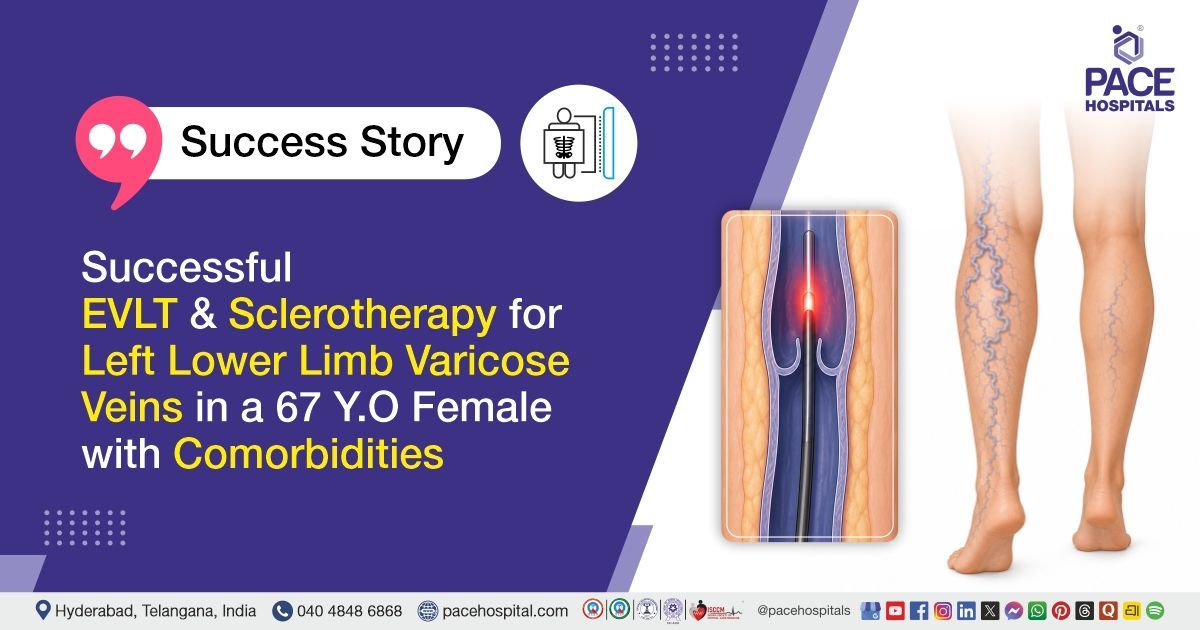
Successful EVLT & Sclerotherapy for Left Lower Limb Varicose Veins in a 67 Y.O Female
PACE Hospitals
PACE Hospitals’ expert Interventional Radiology team successfully performed Endovenous Laser Therapy (EVLT) and sclerotherapy for varicose veins of the left lower limb in a 67-year-old female patient diagnosed with bilateral lower limb varicose veins (Left > Right). The aim of the procedure was to ablate the incompetent veins, improve venous circulation, alleviate symptoms such as pain and swelling, prevent disease progression, and enhance the patient’s quality of life through a minimally invasive treatment approach.
Chief Complaints
A 67-year-old female with a body mass index (BMI) of 24 presented to the Interventional Radiology Department at PACE Hospitals, Hitech City, Hyderabad, with complaints of dilated veins, skin pigmentation, and persistent itching in the left leg.
Past Medical History
The patient had a known history of type 2 diabetes mellitus, hypothyroidism, and primary open-angle glaucoma in both eyes, for which she had been receiving regular medical treatment.
On Examination
On examination, the patient was conscious, coherent, and oriented. Local examination of the lower limbs revealed prominent dilated superficial veins with associated skin pigmentation over the left leg. The left lower limb was more severely affected than the right, consistent with chronic venous insufficiency. No other significant systemic abnormalities were noted on examination.
Diagnosis
Upon admission to PACE Hospitals, the Interventional Radiology team conducted a comprehensive assessment, which included a detailed review of the patient’s medical history and a focused clinical evaluation. A Colour Doppler ultrasound was performed to assess venous reflux, valve competence, and the extent of venous dilation in both lower limbs.
Imaging studies revealed bilateral lower limb varicosities with incompetent perforator veins, with more severe involvement of the left lower limb compared to the right. In addition, the patient had associated comorbid conditions including diabetes mellitus, hypothyroidism, and primary open-angle glaucoma affecting both eyes, along with suspected new-onset hypertension identified during evaluation.
Based on the confirmed diagnosis, the patient was advised to undergo
Varicose Veins Treatment in Hyderabad, India, under the care of the Interventional Radiology Department, to alleviate symptoms, improve venous circulation, prevent disease progression, and provide comprehensive management of her condition.
Medical Decision Making (MDM)
After consultation with Dr. Lakshmi Kumar Chalamarla (Senior Interventional Radiologist), along with cross-consultation with Dr. Mounika Jetti, (Consultant General Physician and Diabetologist), the patient underwent a thorough evaluation to determine the most appropriate diagnostic and therapeutic approach for the patient’s venous condition. This included a detailed clinical assessment along with correlation of Colour Doppler findings.
Following evaluation, it was concluded that conservative management alone would not be sufficient due to the extent of venous reflux and symptomatic varicosities of both lower limbs, with greater involvement of the left lower limb. It was determined that the patient’s varicose veins were responsible for the dilated veins, pigmentation, and itching.
Based on clinical assessment and imaging findings, it was determined that Endovenous Laser Therapy (EVLT), along with foam sclerotherapy, was the most suitable intervention to ablate the incompetent veins, alleviate symptoms, improve venous circulation, and prevent disease progression. The right lower limb varicosities were assessed and planned for conservative management with compression therapy and follow-up.
The patient and her family members were counselled in detail regarding the nature of the disease, the planned endovenous procedure, associated risks and benefits, and the importance of intervention for definitive management of the condition.
Surgical Procedure
Following the decision, the patient was scheduled to undergo Endovenous laser therapy (EVLT) and Sclerotherapy Procedure in Hyderabad at PACE Hospitals under the supervision of the expert Interventional Radiology Department.
The following steps were carried out during the procedure:
- Anesthesia and Patient Preparation: The patient was taken up for the procedure after obtaining informed consent. Under strict aseptic precautions, spinal anesthesia was administered along with tumescent anesthesia along the targeted venous segments of the left lower limb. The patient was positioned appropriately, and the left lower limb was prepared and draped in a sterile manner.
- Venous Access and Mapping: Under ultrasound guidance, the left great saphenous vein (GSV) and anterior accessory saphenous vein (AASV) were identified and mapped. Access to the GSV was obtained, and the extent of refluxing segments was confirmed from approximately 6 cm below the knee up to 6 cm proximal to the saphenofemoral junction (SFJ).
- Endovenous Laser Ablation (EVLA): A radial laser fiber was introduced into the left GSV and positioned appropriately. Endovenous laser ablation was performed in a controlled manner along the incompetent segment of the GSV as well as the left AASV in the upper thigh, resulting in thermal ablation and closure of the refluxing veins.
- Foam Sclerotherapy of Varicosities: Following laser ablation, residual superficial varicosities in the left leg were treated using ultrasound-guided foam sclerotherapy with sclerosants achieving obliteration of the residual varicose channels.
- Hemostasis and Compression Dressing: Hemostasis was achieved successfully at the access sites. A compression dressing was applied using crepe bandages to the left lower limb to support venous closure, reduce post-procedural edema, and promote healing. The procedure was completed uneventfully.
Postoperative Care
Postoperatively, the patient was managed with medications for infection prevention and for pain relief. Gastric protection was provided to prevent gastric irritation. Thromboprophylaxis was administered to reduce the risk of clot formation. Medications were also continued for blood pressure control and blood sugar management to ensure optimal systemic stability. The patient remained stable, had an uneventful recovery, and was discharged in a hemodynamically stable condition with advice for follow-up.
Discharge Medications
Upon discharge, the patient was prescribed medications for the prevention of infection, control of gastric acidity, and relief of pain. Medication was also given to prevent blood clot formation. Treatment was continued to control blood pressure and blood sugar levels as per ongoing medical requirements. The patient was also advised to continue other routine medications as prescribed by treating physicians.
Advice on discharge
The patient was advised to avoid prolonged standing or sitting for more than 30 minutes, avoid crossing the legs, and refrain from lifting heavy weights for one week. Use of above-knee compression stockings during the daytime was recommended for 2 months to support venous healing and improve recovery.
Emergency Care
The patient was informed to contact the emergency ward at PACE Hospitals in case of any emergency or development of symptoms such as fever, swelling of the operated limb, severe leg pain, chest pain, or breathlessness.
Review and Follow-up Notes
The patient was advised to return for a follow-up visit with the Interventional Radiologist in Hyderabad at PACE Hospitals, along with the General Physician, after 14 days.
Conclusion
This case highlights successful management of bilateral lower limb varicose veins (Left > Right), with endovenous laser therapy and foam sclerotherapy performed for the left side and conservative management for the right. The procedure was uneventful with a good clinical outcome. The patient recovered well and was discharged in a stable condition with follow-up advice.
Hemodynamic-Based Strategy in Varicose Vein Treatment
Modern management of varicose veins is increasingly guided by a hemodynamic approach rather than treating visible veins alone. The focus is on identifying and eliminating the primary sources of venous reflux, which drive the progression of the disease. By addressing axial reflux through endovenous techniques, the abnormal pressure transmission to superficial venous networks is effectively interrupted. This strategy allows secondary and tributary varicosities to regress naturally or be managed with adjunctive minimally invasive methods. It also emphasizes the importance of duplex mapping in tailoring individualized treatment plans rather than a one-size-fits-all approach.
A hemodynamic‑based strategy is associated with better long‑term control of symptoms and may help lower recurrence rates in selected patients. Ultimately, treating the disease at its physiological origin rather than its surface manifestations represents a key advancement in venous intervention, as guided by an
interventional radiologist / interventional radiology doctor.
Frequently Asked Questions (FAQs)
Why was EVLT recommended for varicose veins in this case?
Endovenous Laser Therapy (EVLT) was recommended because the Color Doppler showed significant varicose veins with incompetent perforators, especially in the left lower limb. EVLT is a minimally invasive procedure used to close the faulty superficial vein from inside using laser energy. It helps redirect blood flow through healthier veins, reducing visible varicosities, heaviness, itching, pigmentation, and the risk of further venous complications.
Why was foam sclerotherapy done along with EVLT?
EVLT mainly treats the larger refluxing vein, such as the great saphenous vein or accessory saphenous vein. Foam sclerotherapy is often added to treat smaller surface varicosities and branch veins that may not be fully managed by laser ablation alone. Combining EVLT with foam sclerotherapy helps provide more complete treatment for visible and symptomatic varicose veins in the affected leg.
Why was only the left leg treated when both legs had varicose veins?
In this case, both legs had varicose veins on a Doppler study, but the left leg was more affected and caused more symptoms, such as bulging veins, skin darkening (pigmentation), and itching. Generally, doctors treat the more severe and more symptomatic side first. The right leg, being less affected, is usually managed with conservative treatment like compression and regular follow-up. It is treated only if symptoms become worse or if future scans show that the condition is progressing and intervention is needed.
What is the role of Color Doppler before varicose vein treatment?
Color Doppler is an important scan used before varicose vein treatment. It helps identify which veins are enlarged, where valve leakage is present, and whether perforator veins are incompetent. It also helps the doctor plan the exact treatment area, choose between EVLT, sclerotherapy, or other options, and reduce the risk of missing important refluxing veins.
Is EVLT a major surgery?
Endovenous Laser Therapy (EVLT) is not a major open surgery. It is a minimally invasive procedure done through a small needle puncture or a very small entry point in the skin. Instead of removing the vein through large cuts, laser energy is used to seal the faulty vein from the inside. This helps blood flow to redirect through healthy veins. Compared to traditional open varicose vein surgery, EVLT usually results in less pain, smaller or no scars, faster recovery, and an earlier return to normal daily activities.
Why is compression stocking advised after EVLT and sclerotherapy?
Compression stockings help support blood flow after the treated veins are closed. They reduce swelling, bruising, discomfort, and the chance of blood pooling in the leg during recovery. In this case, above-knee Class II compression stockings were advised during daytime for proper post-procedure support and better healing.
How soon can a patient walk after EVLT for varicose veins?
After EVLT (endovenous laser therapy), most patients are advised to start walking early, as it helps improve blood circulation and reduces the risk of blood clot formation. However, they should avoid standing or sitting for long periods in the early recovery phase. It is better to take short, frequent walks rather than stay in one position for a long time without movement.
What precautions are important after EVLT and sclerotherapy?
After EVLT and sclerotherapy, patients are advised to avoid standing or sitting for long periods, avoid crossing their legs, and avoid lifting heavy weights during the early recovery phase. Compression stockings should be worn as directed by the doctor to aid healing and improve blood flow. The treated leg should be kept clean and dry as instructed. Regular follow-up visits are important so the doctor can monitor healing and ensure the treated veins are closing properly.
What warning signs should not be ignored after varicose vein treatment?
Patients should seek urgent medical care if they develop fever, increasing swelling in the leg, severe leg pain, chest pain, sudden shortness of breath, or unusual redness and warmth in the treated area. These symptoms may indicate infection, blood clot–related complications, or other serious conditions that need immediate medical evaluation.
Can varicose veins come back after EVLT?
EVLT effectively closes the treated faulty vein, but in some patients, varicose veins can come back over time. This may happen due to new refluxing veins, untreated side branches, weak vein valves, obesity, long hours of standing, ageing, or not following lifestyle advice properly. Regular follow-up with the doctor, daily walking, maintaining a healthy weight, keeping the legs elevated when resting, and wearing compression stockings as advised can help reduce the chance of recurrence.
Share on
Request an appointment
Fill in the appointment form or call us instantly to book a confirmed appointment with our super specialist at 04048486868
Appointment request - health articles
Recent Articles