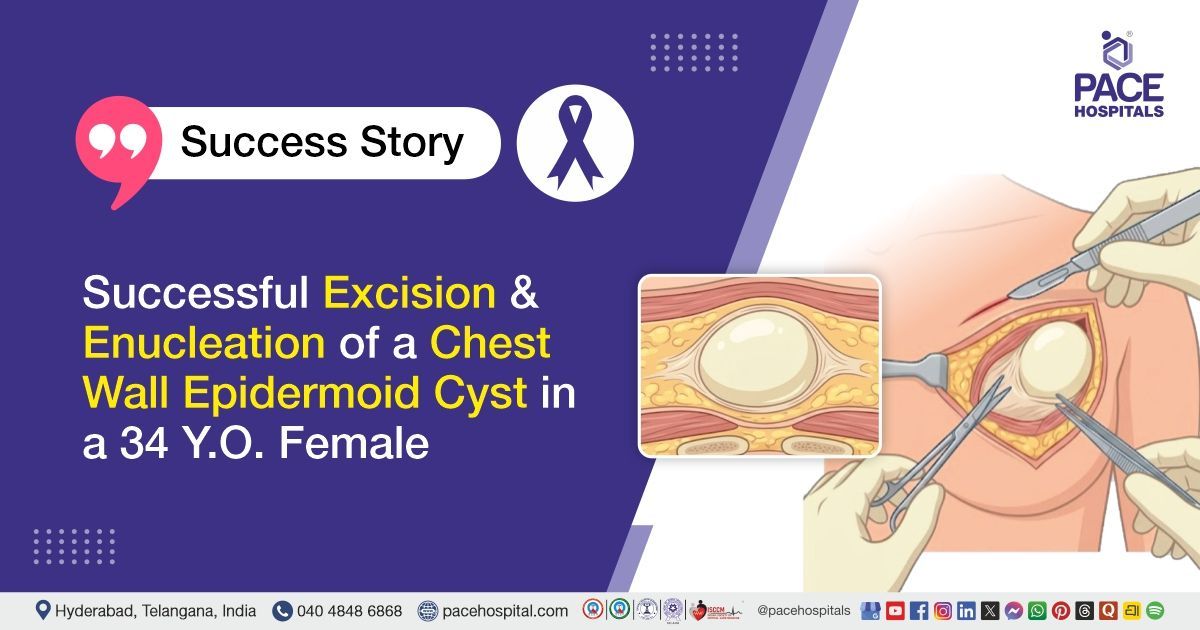
Successful Excision and Enucleation of a Chest Wall Epidermoid Cyst
PACE Hospitals
PACE Hospitals' expert Oncology team successfully performed an Excision Enucleation in a 34-year-old female patient diagnosed with an epidermoid cyst of the chest wall. The procedure was carried out with the aim of completely removing the cyst and its capsule, preventing recurrence, relieving symptoms, and preserving the surrounding healthy tissues for optimal functional and cosmetic outcomes.
Chief Complaints
A 34-year-old female patient with a body mass index of 20 presented to the Oncology Department at PACE Hospitals, Hitech City, Hyderabad, with a complaint of a swelling over the central chest wall.
Past Medical History
The patient had no known comorbidities, including diabetes mellitus, hypertension, cardiovascular disease, or tuberculosis. There was no significant past surgical history, and no prior chest wall swelling or trauma was reported.
On Examination
On examination, the patient was conscious, coherent, and well oriented, with stable vital signs. Local examination revealed a small cystic swelling with a punctum over the intermammary region of the chest wall, slightly to the left of the midline. Per abdominal examination was soft and non-tender, with no other significant systemic abnormalities detected.
Diagnosis
Upon admission to PACE Hospitals, following the clinical assessment, the Oncology team conducted a comprehensive evaluation based on the patient’s complaint of swelling over the central chest wall. A detailed medical history, physical examination, and preoperative assessment were performed to evaluate overall fitness for surgery and to identify associated comorbid conditions.
Baseline investigations, including routine hematological and biochemical parameters, were carried out as part of the preoperative workup, which were within acceptable limits for surgical intervention. Clinical examination revealed a small cystic swelling with a punctum over the intermammary region of the chest wall, slightly to the left of the midline.
Based on the confirmed diagnosis, the patient was advised to undergo
Epidermoid Cyst Treatment in Hyderabad, India, under the expert care of the Oncology Department.
Medical Decision Making (MDM)
After a detailed evaluation by Dr. Ramesh Parimi, Consultant Surgical Oncologist, Dr. M Sudhir, Senior Gastroenterologist and Hepatologist, along with the multidisciplinary team including Dr. Govind Verma, Gastroenterologist, Hepatologist & Therapeutic Endoscopist, Dr. Padma Priya Medical Gastroenterologist, a comprehensive assessment was performed to determine the most appropriate diagnostic and therapeutic approach.
Considering the patient’s history of swelling over the central chest wall and clinical examination findings suggestive of a benign cystic lesion, the case was carefully reviewed. Clinical evaluation and operative assessment were consistent with a diagnosis of epidermoid cyst of the chest wall.
Based on clinical assessment, examination findings, and surgical evaluation, it was determined that Excision Enucleation of the epidermoid cyst was the most appropriate and effective management strategy. This approach was chosen to completely excise the lesion along with its capsule, prevent recurrence, and achieve optimal cosmetic and functional outcomes.
The patient and her family members were counselled regarding the diagnosis, clinical findings, planned surgical procedure, possible risks, postoperative care, and the importance of regular follow-up.
Surgical Procedure
Following the decision, the patient was scheduled for an Excision Enucleation Procedure in Hyderabad at PACE Hospitals, under the expert care and supervision of the Oncology team.
The following steps were carried out during the procedure:
- Patient Preparation and Positioning: The patient was taken to the operating room and placed in a supine position on the operating table. Standard aseptic precautions were followed, and the operative field over the intermammary region of the chest wall was cleaned and draped in a sterile manner.
- Anaesthesia Administration: The procedure was performed under intravenous sedation, followed by local infiltration using 0.5% local anesthetic to achieve adequate anaesthesia over the lesion site. Adequate analgesia was confirmed before proceeding.
- Incision and Exposure: A small elliptical skin incision was made over the lesion in the intermammary region, slightly to the left of the midline, encompassing the punctum. The skin and subcutaneous tissue were carefully dissected to expose the underlying cyst.
- Enucleation of the Cyst: A well-defined cyst measuring approximately 1.5 × 1 cm was identified. Careful blunt and sharp dissection was performed to enucleate the cyst in toto along with its capsule, ensuring complete removal without rupture.
- Hemostasis and Wound Closure: Meticulous hemostasis was achieved. The surgical cavity was irrigated, and the wound was closed in layers using appropriate sutures. A sterile dressing was applied. The procedure was completed uneventfully, and the specimen was sent for histopathological examination.
Postoperative Care
The procedure was uneventful, and the patient tolerated it well. Postoperatively, she showed symptomatic improvement and remained hemodynamically stable following excision and enucleation of the epidermoid cyst. The histopathology report showed an epidermal inclusion (epidermoid) cyst with chronic inflammation and a giant cell reaction, which is benign and non-cancerous. She was managed with appropriate postoperative care and medications and was subsequently discharged in stable condition with the following medical advice.
Discharge Medications
Upon discharge, the patient was advised a short course of medication to prevent postoperative wound infection and to provide relief from postoperative pain, to be taken for a few days and thereafter as needed.
Emergency Care
The patient was informed to contact the emergency ward at PACE Hospitals in case of any emergency or development of symptoms such as fever, chest pain, or vomiting.
Review and Follow-up Notes
The patient was advised to return for follow-up review with the Oncologist in Hyderabad at PACE Hospitals after 7 days. A follow-up visit with the Surgical Gastroenterologist was also advised after 7 days for further postoperative evaluation and assessment.
Conclusion
This case highlights successful management of an epidermoid cyst of the chest wall through excision enucleation. The procedure was uneventful with complete removal of the lesion, leading to symptomatic relief and an uncomplicated postoperative recovery. The patient was discharged in stable condition with appropriate follow-up advised for further evaluation and wound assessment.
Epidermoid Cyst: Understanding a Common Benign Skin Lesion
Epidermoid cysts are common benign skin lesions that develop due to blockage of hair follicles or implantation of epidermal cells beneath the skin, leading to gradual accumulation of keratin material and formation of a slow-growing lump. They are usually painless but can become inflamed, infected, or rupture, resulting in redness, swelling, tenderness, or discharge. Histologically, they are characterized by a cyst lined with keratinizing stratified squamous epithelium and filled with laminated keratin debris and may show a foreign body giant cell reaction when there has been prior rupture or inflammation. These cysts are non-cancerous with an excellent prognosis, and the definitive treatment is complete surgical excision of the cyst along with its wall, which helps prevent recurrence, especially when performed after acute infection has settled. Management is often done in coordination with an oncologist / cancer specialist or a general surgeon, depending on the location and clinical setting.
Frequently Asked Questions (FAQs)
Why was excision done for an epidermoid cyst on the chest wall?
Excision was done to remove the epidermoid cyst completely from the chest wall area. This is usually advised when the swelling is visible, uncomfortable, increasing in size, or likely to recur. Complete removal helps take out both the cyst contents and cyst wall. It also allows the removed tissue to be tested through histopathology.
Is epidermoid cyst excision a major surgery?
Epidermoid cyst excision is usually a minor surgical procedure when the cyst is small and present close to the skin surface. In this case, the cyst was small and was removed under sedation with local numbing. The procedure was uneventful, and the patient was stable after surgery. Same-day discharge is often possible in uncomplicated cases.
Why should the full cyst wall be removed during surgery?
The cyst wall should be removed because it can continue forming cyst material if left behind. If only the inside contents are removed, the swelling may come back later. Complete excision gives better long-term results and lowers recurrence risk. This is why careful removal of the cyst along with its wall is important.
Why was the removed cyst sent for histopathology examination?
The removed cyst was sent for histopathology to confirm the exact nature of the swelling. Many skin and soft tissue lumps can look similar during examination. Histopathology helps confirm whether it is an epidermoid cyst and rules out other causes. This report also helps the doctor decide if any further care is needed.
Can an epidermoid cyst on the chest come back after excision?
An epidermoid cyst is unlikely to recur when it is completely removed along with its entire cyst wall. Recurrence can occur if any part of the cyst lining is left behind or if the cyst was previously ruptured or inflamed. Careful surgical removal and good wound care help minimize this risk. Regular follow-up is useful to ensure proper healing and to identify any early signs of recurrence.
When is same-day discharge possible after cyst excision?
Same-day discharge is possible when the procedure is smooth and the patient remains stable after surgery. Doctors usually check pulse, blood pressure, oxygen level, pain, and wound condition before discharge. In this case, the patient was hemodynamically stable after the procedure. This made day-care discharge suitable.
What care is needed after epidermoid cyst excision?
After epidermoid cyst excision, the wound should be kept clean and dry as advised by the doctor. Dressing care, activity restriction, and follow-up visits should be followed properly. Medicines may be given based on the indication, such as infection prevention and pain control. Fever, wound discharge, increasing pain, or swelling should be reported early.
Is a chest wall epidermoid cyst cancerous?
Most epidermoid cysts are benign and are not cancerous. However, any removed swelling is commonly sent for histopathology to confirm the diagnosis. This is important because some skin lumps may appear similar on examination. The final report gives clarity and helps plan further follow-up if required.
Can an epidermoid cyst be treated without surgery?
Small and painless epidermoid cysts may sometimes be observed if they are not causing problems. Surgery is usually advised when the cyst is painful, repeatedly inflamed, cosmetically concerning, or increasing in size. Simple drainage may give temporary relief but may not remove the cyst wall. Complete excision is preferred when permanent removal is needed.
Why is follow-up important after chest wall cyst excision?
Follow-up is important to check whether the wound is healing properly after cyst excision. It also helps identify infection, bleeding, fluid collection, or delayed healing at an early stage. The histopathology report can also be reviewed during the follow-up visit. In this case, review was advised after 7 days with the treating doctors.
Share on
Request an appointment
Fill in the appointment form or call us instantly to book a confirmed appointment with our super specialist at 04048486868
Appointment request - health articles
Recent Articles