Successful Laparoscopic Radical Prostatectomy for Prostate cancer in a 71 Y.O. Male
PACE Hospitals
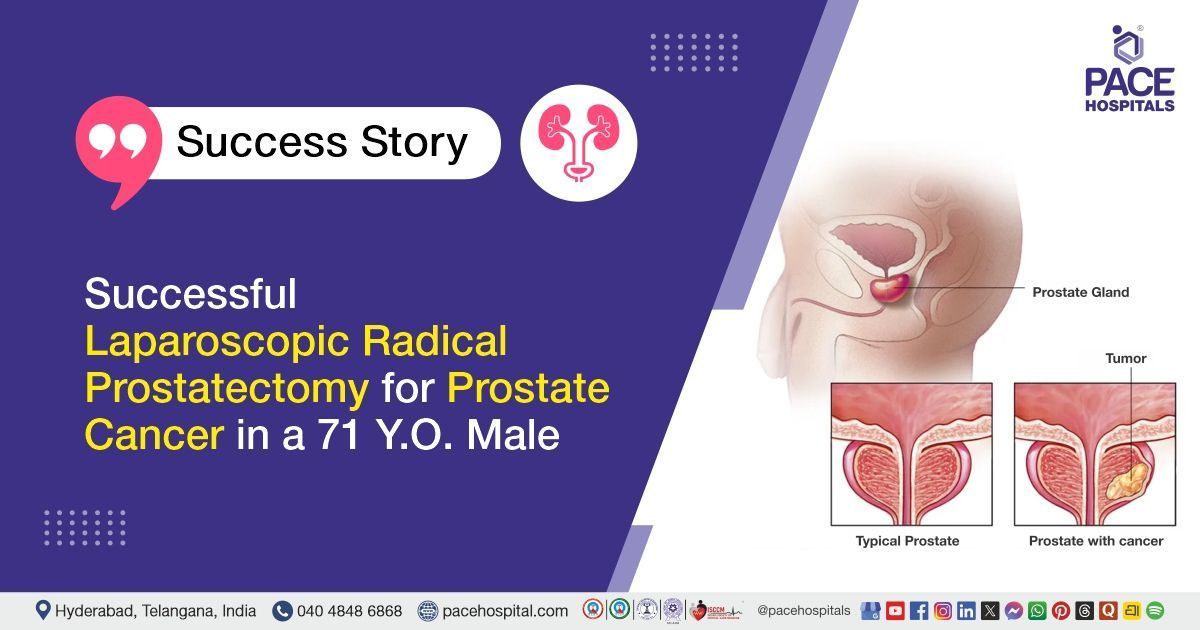
The PACE Hospital's expert Urology team successfully performed a Laparoscopic Radical Prostatectomy on a 71-year-old male patient who was diagnosed with Prostate Adenocarcinoma. The aim of the procedure was to completely remove the diseased prostate gland and relieve urinary obstruction. It was also intended to prevent further progression of the condition and improve the patient’s quality of life.
Chief Complaints
A 71-year-old male patient with a body mass index (BMI) of 18 presented to the Urology Department at PACE Hospitals, Hitech City, Hyderabad, with a poor urine flow and nocturia (excessive urination at night).
Past Medical History
There was no history of other chronic conditions, such as diabetes, hypertension, or liver disease, documented at the time of admission.
On Examination
On examination , the patient was conscious, coherent, and oriented, with stable general condition. Vital parameters were within normal limits. Cardiovascular and respiratory system examinations were normal. Per abdominal examination was soft and non-tender with no palpable organomegaly. On per rectal examination, the prostate was enlarged with hard consistency and irregular surface. No peripheral lymphadenopathy was noted.
Diagnosis
Following the clinical evaluation, the Urology team conducted a comprehensive assessment, including a detailed review of the patient’s medical history and focused evaluation of his lower urinary tract symptoms, particularly poor urine flow and nocturia (excessive urination at night).
To determine the underlying cause, a thorough clinical and systemic examination was performed. On per rectal examination, the prostate was found to be enlarged with hard consistency and irregular surface, raising suspicion of malignancy, while the rest of the systemic examination revealed no significant abnormalities.
Further investigations including serum PSA testing and radiological imaging were carried out to evaluate the prostate gland. In view of suspicious clinical and laboratory findings, a prostate biopsy was performed. Histopathological examination of the biopsy specimen confirmed the diagnosis of adenocarcinoma of the prostate.
Based on the confirmed histopathological diagnosis, the patient was advised to undergo Prostate Cancer Treatment in Hyderabad, India, under the care of the Urology Department to achieve complete oncological clearance and improve long-term outcomes.
Medical Decision Making (MDM)
After a detailed consultation with Dr. Abhik Debnath, Consultant Urologist, a comprehensive evaluation was conducted to determine the most appropriate diagnostic and therapeutic approach for a patient presenting with poor urine flow and nocturia. Based on clinical assessment, imaging, and histopathological confirmation of Adenocarcinoma of the Prostate , surgical intervention was deemed necessary.
It was determined that Laparoscopic radical prostatectomy was identified as the optimal treatment to achieve oncological clearance and improve his quality of life.
The patient and his family members were informed about the diagnosis, the planned surgical procedure, its potential benefits, and associated risks.
Surgical Procedure
Following the diagnosis, The patient was scheduled to undergo Laparoscopic radical prostatectomy Surgery in Hyderabad at PACE Hospitals, under the supervision of the expert Urology Department.
The surgical procedure involved the following steps:
- Port Placement and Initial Access: Under general anesthesia, pneumoperitoneum was established and five laparoscopic ports were placed (three 10 mm and two 5 mm). Proper positioning and visualization were ensured before proceeding with the dissection.
- Posterior Dissection and Seminal Vesicle Mobilization: The vas deferens and seminal vesicles were identified and dissected. Posterior dissection was carried out carefully up to Denonvilliers’ fascia, with safe separation of the prostate from the rectum.
- Anterior Dissection and Prostate Transection: The bladder was dropped to expose the prostate. Dorsal venous complex (DVC) control was secured. Apical dissection was performed, and the prostatic apex was transected. Lymph nodes were sampled as indicated.
- Urethrovesical Anastomosis and Catheter Placement: Following removal of the prostate specimen, urethrovesical anastomosis was completed using continuous 2-0 PDS sutures by the Van Velthoven technique. A 3-way 18 Fr Foley catheter was placed in the bladder, and hemostasis was confirmed. A surgical drain was positioned.
- Specimen Retrieval and Closure: The specimen was extracted by extending one of the 10 mm port incisions. The 10 mm port site rectus sheath was closed using a Carter-Thomason suture passer. Skin incisions were closed with staples.
Postoperative Care
Patient postoperative period was uneventful. Postoperatively, he developed mild abdominal gaseous distension which was managed conservatively. The drain was removed on the third postoperative day. There was mild right lower limb edema; ultrasonography (USG) was performed and deep vein thrombosis was ruled out. Abdominal imaging showed no collections and no hydronephrosis. Throughout his stay, vital parameters and urine output remained stable, and he was discharged in stable condition with catheter in situ.
Discharge Medications
Upon discharge, the patient was advised to prevent postoperative and urinary infections, protect the gastric mucosa, control pain and fever, maintain blood pressure and thyroid hormone levels, support recovery and wound healing, prevent straining, care for wounds and catheter sites, relieve discomfort, reduce inflammation at cannulation sites, improve lung function, strengthen pelvic floor muscles, maintain perineal hygiene, and encourage daily ambulation.
Advice on Discharge
The patient was advised to avoid alternative medications and nephrotoxic drugs, and not to restart antihypertensive medication. He was instructed to maintain adequate hydration with approximately 2.5 liters of oral fluids per day and to follow a low-salt diet.
He was also advised to continue incentive spirometry and deep breathing exercises, perform pelvic floor (Kegel’s) exercises as tolerated, and engage in regular daily walking to aid recovery and prevent postoperative complications.
Emergency Care
The patient was informed to contact the emergency ward at PACE Hospitals in case of any emergency or development of symptoms such as fever, abdominal pain, or decreased urine output.
Review and Follow-Up
The patient was advised to return for a follow-up visit with the Urologist in Hyderabad at PACE Hospitals after 10 days for catheter and stitch removal.
Conclusion
This case highlights successful management of adenocarcinoma prostate with laparoscopic radical prostatectomy. The intraoperative and postoperative course was largely uneventful, with minor complications that were promptly identified and managed conservatively. The patient remained hemodynamically stable throughout the hospital stay. He was discharged in stable condition with advice for follow-up and further review.
Comprehensive Minimally Invasive Management of Localized Prostate Cancer
Minimally invasive radical prostatectomy, performed by an experienced urologist / urology doctor, is an effective treatment for localized prostate cancer, providing optimal oncological clearance with minimal surgical morbidity. Careful anatomical dissection and secure reconstruction by the urology doctor are essential for maintaining functional outcomes.
Early identification and conservative management of postoperative issues help prevent major complications. Vigilant monitoring and thorough evaluation enhance patient safety during recovery. Multidisciplinary perioperative care, medication optimization, and structured rehabilitation support stable recovery. Comprehensive discharge planning and timely follow-up under the guidance of a urologist contribute to favorable long-term results.
Share on
Request an appointment
Fill in the appointment form or call us instantly to book a confirmed appointment with our super specialist at 04048486868
Appointment request - health articles
Recent Articles