Successful Meatoplasty for Meatal Stenosis in a 67 Y.O. Male with Multiple Comorbidities
PACE Hospitals
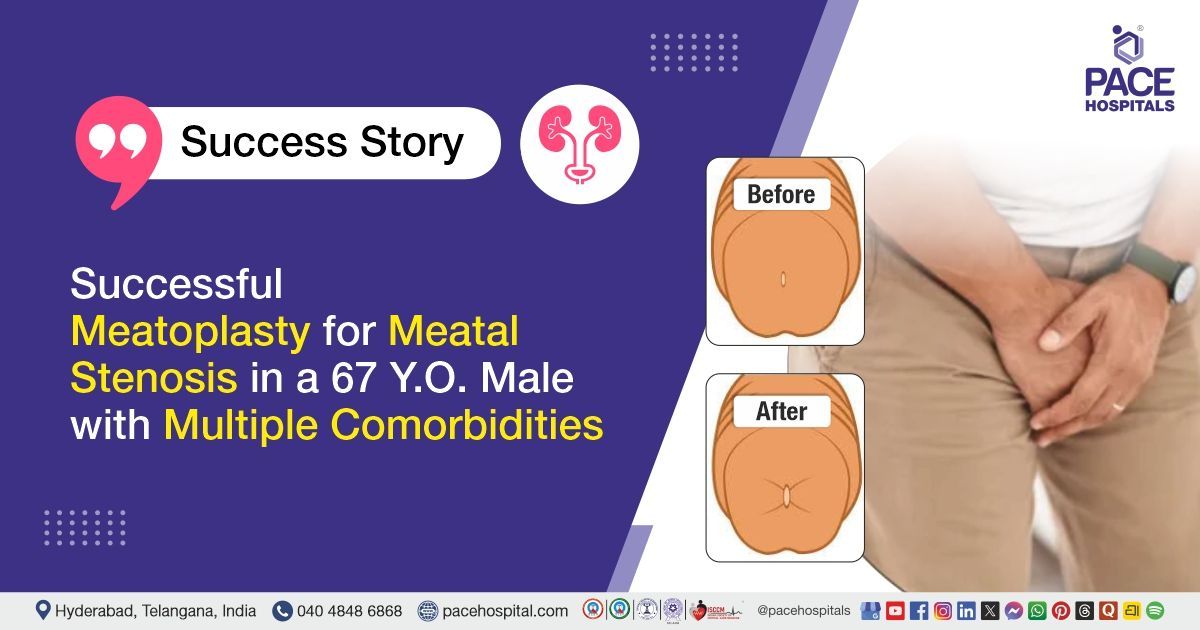
PACE Hospitals’ expert Urology team successfully performed a Meatoplasty on a 67-year-old male patient diagnosed with meatal stenosis, presenting with a weak urinary stream for the past 1 year. The procedure aimed to widen the narrowed urinary opening, improve urine flow, relieve difficulty in urination, and support better urinary function and quality of life.
Chief Complaints
A 67-year-old male patient with a Body Mass Index (BMI) of 20 presented to the Urology Department at PACE Hospitals, Hitech City, Hyderabad, with complaints of weak urinary stream for the past 1 year. The symptom was suggestive of narrowing at the urinary opening, affecting normal urine flow.
Past Medical History
The patient had a past history of partial penectomy done for carcinoma of the penis. He was a known case of coronary artery disease (CAD), diabetes mellitus, hypertension, obstructive sleep apnea, chronic kidney disease, and had a history of smoking. He was on regular medications for his existing medical conditions.
On Examination
On examination, the patient was conscious, coherent, and oriented, with stable vital signs. General and systemic examination did not reveal any acute abnormalities. Local genital examination revealed narrowing of the external urinary opening, consistent with meatal stenosis.
Diagnosis
Upon admission to PACE Hospitals, the patient was thoroughly evaluated by the Urology team, including a detailed review of his medical history and focused clinical examination. He presented with a weak urinary stream for the past 1 year, raising clinical suspicion of narrowing at the urinary opening.
The patient had a significant past history of partial penectomy for carcinoma of the penis. He was also a known case of coronary artery disease, diabetes mellitus, hypertension, obstructive sleep apnoea, chronic kidney disease, and had a history of smoking. These comorbid conditions were taken into consideration during preoperative evaluation and treatment planning.
Local examination revealed meatal stenosis, confirming narrowing of the external urinary opening as the cause of the patient’s weak urinary stream.
Based on the confirmed diagnosis, the patient was advised to undergo Meatal Stenosis Treatment in Hyderabad, India, under the expert care of the Urology Department.
Medical Decision Making (MDM)
After a detailed consultation a comprehensive urological evaluation was performed for the patient, who presented with a weak urinary stream for the past 1 year. The patient had a significant history of partial penectomy for carcinoma of the penis, along with multiple comorbidities and a smoking history.
On local examination, the patient was found to have meatal stenosis, which means narrowing of the external urinary opening. This finding correlated with his complaint of a weak urinary stream and confirmed the need for urological intervention to improve urinary flow.
Considering the confirmed diagnosis, it was determined that meatoplasty was the most appropriate intervention to widen the narrowed urinary opening, improve urine stream, reduce urinary difficulty, and prevent further complications such as worsening obstruction, urinary discomfort, infection, or retention.
The patient and family were counselled regarding the diagnosis, planned procedure, expected benefits, and informed consent was obtained for the procedure.
Surgical Procedure
Following the decision, the patient was scheduled to undergo Meatoplasty Surgery in Hyderabad at PACE Hospitals under the expert care of the Urology Department.
The procedure involved the following steps:
- Patient Preparation and Anaesthesia: The patient was taken to the operating room after completing the necessary preoperative evaluation and investigations. Standard aseptic preparation and draping were performed. Anaesthesia was administered as per the anaesthesia team’s assessment, and the patient was positioned appropriately for the procedure.
- Local Examination and Surgical Planning: The narrowed external urinary opening was identified and assessed. The surgical site was carefully evaluated, especially considering the patient’s previous history of partial penectomy for carcinoma penis.
- Meatal Widening: A meatoplasty was performed to widen the narrowed urinary opening. The stenosed meatus was surgically released and reshaped to improve the urinary outlet and allow better passage of urine.
- Hemostasis and Wound Care: Bleeding points were controlled, and the surgical area was cleaned. The wound edges were appropriately adjusted to maintain a wider meatal opening and reduce the chance of recurrent narrowing.
- Catheter Placement and Completion: A urinary catheter was maintained postoperatively to support urine drainage and healing of the operated area.
Postoperative Care
Postoperatively, the patient was monitored for hemodynamic stability, urine output, pain control, catheter care, and immediate surgical recovery. The procedure was uneventful, and the patient remained stable throughout the postoperative period. During the hospital stay, the patient was managed with medications to prevent infection, medications for pain relief, gastric protection, and continuation of regular medications for his existing medical conditions.
Discharge Medications
Upon discharge, the patient was prescribed medications to prevent infection, control pain, and protect the gastric lining for a short duration. He was also advised to continue his regular medications for diabetes mellitus, hypertension, coronary artery disease, and other existing medical conditions as instructed by the treating team. Proper catheter care was advised to support healing and prevent urinary complications.
Advice on discharge
The patient was advised to follow a low-salt and low-meat diet, considering his existing medical conditions. He was instructed to take all prescribed medications regularly, maintain proper catheter care, and follow the urologist’s postoperative instructions for smooth recovery.
Emergency Care
The patient was instructed to contact the emergency ward at PACE Hospitals in the event of an emergency or development of symptoms such as fever, blood in urine, burning urination, catheter blockage, severe pain, reduced urine output, or worsening urinary symptoms.
Review and Follow-up Notes
The patient was advised to return for follow-up with the Urologist in Hyderabad at PACE Hospitals after 5 days for catheter removal and further urological assessment.
Conclusion
This case highlights a meatal stenosis with a weak urinary stream for 1 year, with a past history of partial penectomy for carcinoma penis and multiple comorbidities. He underwent successful meatoplasty under the Urology Department. The procedure was uneventful, and he was discharged in stable condition with catheter care advice, dietary instructions, and follow-up for catheter removal.
Surgical Correction of Meatal Stenosis for Better Urinary Function
Meatal stenosis is a narrowing of the external urinary opening that can cause symptoms such as weak urine stream, difficulty passing urine, straining, or incomplete bladder emptying. In symptomatic patients, especially when the narrowing affects daily urinary function, surgical correction by a urologist/urology doctor may be required. Meatoplasty helps widen the narrowed urinary opening, allowing urine to pass more freely and comfortably. In this case, the patient had a weak urinary stream for one year and was successfully managed with meatoplasty. Careful postoperative catheter care, infection prevention, medication adherence, and timely follow-up are important to support healing and reduce the risk of recurrence or urinary complications.
Frequently Asked Questions (FAQs)
What is meatoplasty?
Meatoplasty is a minor urological procedure performed to widen a narrowed urinary opening. It helps improve urine flow and reduces difficulty while passing urine. The procedure is commonly advised when meatal stenosis causes a weak or obstructed urine stream.
Why was a catheter used after meatoplasty?
A catheter was placed to allow smooth urine drainage while the operated area heals. It helps protect the newly widened urinary opening during the early recovery period. Proper catheter care reduces the risk of blockage, irritation, and infection.
What warning symptoms should not be ignored after meatoplasty?
Warning symptoms like fever, severe pain, blood in urine, burning urination, catheter blockage, or reduced urine output should not be ignored. These symptoms may indicate infection, bleeding, or urinary obstruction. The patient should seek medical attention immediately if any of these occur. Early care helps prevent complications.
Why was meatoplasty needed for this patient?
The patient had meatal stenosis, which means narrowing of the urinary opening. This has caused a weak urine stream for the past 1 year. Meatoplasty was advised to widen the opening and improve urine flow. The goal was to reduce urinary difficulty and support better urinary function.
Is weak urine stream always due to meatal stenosis?
No, weak urine stream can occur due to several causes, including prostate enlargement, urethral stricture, bladder problems, or narrowing of the urinary opening. In this case, local examination confirmed meatal stenosis. A urologist can identify the exact cause after proper evaluation.
Why is diabetes important in meatoplasty recovery?
Diabetes can slow wound healing and increase the risk of infection after surgery. Good blood sugar control is important for safe recovery. The patient should take medicines regularly and follow the advised diet. Proper wound and catheter care also helps reduce complications.
Why is meatal stenosis important after partial penectomy?
After a partial penectomy, scar tissue or tissue changes may sometimes narrow the urinary opening. This can lead to weak urine flow, straining, or urinary discomfort. In such cases, evaluation is important. Meatoplasty may be advised to improve urine passage.
What diet was advised after discharge and why?
The patient was advised to follow a low-salt and low-meat diet. This was important because he had associated conditions such as hypertension, diabetes, heart disease, and chronic kidney disease. Diet control supports better overall recovery and long-term health.
Can meatal stenosis come back after meatoplasty?
Meatal stenosis can recur in some patients due to scarring, infection, or poor wound healing. Previous penile surgery may also increase the risk of recurrence. Regular follow-up is important to monitor healing. Proper catheter care and postoperative instructions help reduce this risk.
What does blood in urine after meatoplasty surgery indicate?
Mild blood staining may occur after meatoplasty procedures or catheter use. However, heavy bleeding, clots, severe pain, or difficulty passing urine should not be ignored. These may indicate irritation, infection, bleeding, or catheter-related issues. The patient should contact the doctor immediately if symptoms worsen.
Share on
Request an appointment
Fill in the appointment form or call us instantly to book a confirmed appointment with our super specialist at 04048486868
Appointment request - health articles
Recent Articles