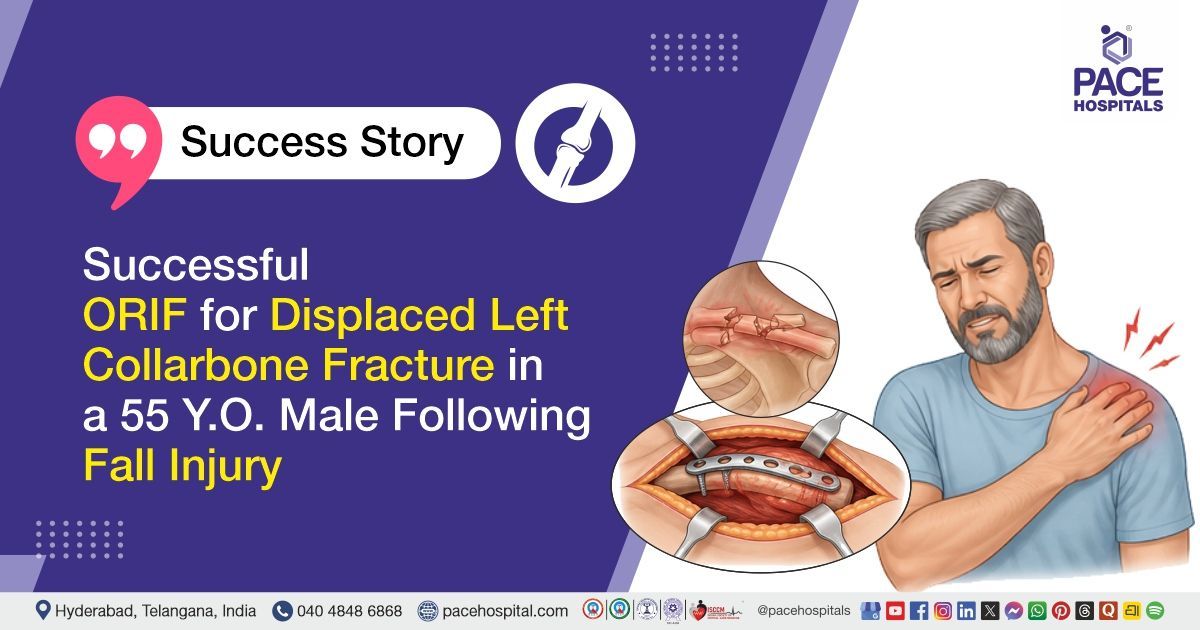
Successful ORIF for Displaced Left Collarbone Fracture in a 55 Y.O. Male
PACE Hospitals
PACE Hospitals’ expert Orthopaedic team successfully performed an Open Reduction and Internal Fixation (ORIF) using a titanium plate and screws on a 55-year-old male patient diagnosed with a comminuted, displaced long oblique fracture of the middle third of the left clavicle. The aim of the procedure was to accurately realign the fractured bone segments, restore the normal anatomy of the clavicle, ensure stable fixation for proper healing, and enable early recovery of shoulder function.
Chief Complaints
A 55-year-old male patient with a body mass index (BMI) of 21 presented to the Orthopaedic Department at PACE Hospitals, Hitech City, Hyderabad, with complaints of pain over the left collarbone region, associated with difficulty in movements of the left shoulder joint. He reported a history of a fall on an outstretched left hand. There was no history of loss of consciousness (LOC), ear, nose, or throat (ENT) bleeding, or vomiting following the injury, and he denied any known drug allergies or chronic illnesses.
Past Medical History
The patient had no known history of chronic medical illnesses such as diabetes mellitus, hypertension, cardiovascular disease, or respiratory disorders. There was no history of prior similar trauma or previous surgeries. He also denied any known drug allergies and had no significant past hospitalizations.
On Examination
The patient was conscious, coherent, and oriented. He was afebrile, with an abnormal pulse rate, elevated blood pressure, and increased respiratory rate. On local examination, deformity and swelling were noted over the left clavicle region, with tenderness over the middle third and palpable crepitus. The range of movements of the left shoulder was grossly restricted and painful. No distal neurovascular deficit was noted.
Diagnosis
Following the clinical evaluation, the Orthopaedic team at PACE Hospitals conducted a detailed assessment of the patient’s complaints of left shoulder pain associated with difficulty in performing daily activities such as shoulder movements and lifting the arm.
A thorough clinical and systemic examination was performed. The examination revealed deformity, swelling, and tenderness over the middle third of the left clavicle, with palpable crepitus. The range of movements of the left shoulder was grossly restricted and painful. No distal neurovascular deficit was noted, and systemic examination findings were within normal limits. X-ray of the left clavicle revealed a comminuted, displaced fracture involving the middle third of the clavicle.
Based on these findings, the patient was advised to undergo
Comminuted and Displaced Collarbone Fracture Treatment in Hyderabad, India, under the care of the Orthopaedic Department to achieve anatomical reduction, stable fixation, pain relief, restoration of shoulder function, and prevention of long-term functional impairment.
Medical Decision Making (MDM)
After a detailed evaluation by Dr. Anand Agroya, Senior Orthopaedic Consultant, the patient was assessed for left shoulder pain following a history of trauma due to a fall on an outstretched hand, associated with significant difficulty in performing daily activities such as lifting the arm and shoulder movements. Clinical examination revealed deformity, swelling, tenderness over the middle third of the left clavicle, palpable crepitus, and gross restriction of left shoulder movements. Radiological assessment confirmed a comminuted, displaced long oblique fracture of the middle third of the left clavicle.
Based on the clinical and radiological findings, it was determined that Open Reduction and Internal Fixation (ORIF) with a titanium plate and screws was the most appropriate surgical intervention. This decision was made with the intent to achieve anatomical reduction of the fracture, provide stable fixation, relieve pain, restore shoulder function, and facilitate early mobilization while preventing malunion or long-term functional impairment.
The patient and his family members were counselled regarding the diagnosis, the planned surgical procedure, potential risks and benefits, postoperative care including immobilization and rehabilitation, expected recovery course, and the importance of regular follow-up for optimal functional outcomes.
Surgical Procedure
Following the diagnosis, the patient was scheduled for Open Reduction and Internal Fixation (ORIF) of the Left Clavicle Surgery in Hyderabad at PACE Hospitals, with a titanium plate and screws under the expert supervision of the orthopaedic Department.
The surgical procedure involved the following steps:
- Preoperative Preparation and Anaesthesia: After proper preoperative work-up and fitness assessment, the patient was taken up for surgery under general anaesthesia. Standard aseptic precautions and surgical draping were performed.
- Surgical Exposure: A standard incision was made over the left clavicle region, and soft tissues were carefully dissected to expose the fracture site while preserving surrounding neurovascular structures.
- Fracture Identification and Reduction: Intraoperatively, a comminuted, displaced, long oblique fracture of the middle third of the clavicle was identified. The fracture fragments were carefully mobilized and anatomically reduced to restore clavicular alignment.
- Fixation with Implant: Stable internal fixation was achieved using a 3.5 system titanium plate with screws (PDL system), ensuring proper alignment, stability, and compression of the fracture fragments.
- Wound Closure and Postoperative Care: Haemostasis was secured, and the wound was closed in layers with subcuticular suturing. A sterile dressing was applied, and an arm pouch was provided for support and immobilization. The procedure was completed uneventfully.
Postoperative Care
Postoperatively, the patient was monitored in the Intensive Care Unit (ICU) for a few hours and later shifted to the room on the same day of surgery. On the first postoperative day, the dressing was changed, and the wound was found to be healthy with no active discharge. Postoperative X-ray demonstrated satisfactory reduction with the implant in situ. The patient was continued on intravenous medications for prevention of infection, pain control, and supportive care during the hospital stay.
On the second postoperative day, discharge planning was initiated after clinical assessment. The patient remained hemodynamically stable throughout the hospital course and showed satisfactory postoperative recovery. He was discharged in stable condition with appropriate postoperative care instructions and advised regular follow-up.
Discharge Medications
Upon discharge, the patient was prescribed a short course of oral medications aimed at preventing postoperative infection, controlling pain and inflammation, providing gastric protection, and managing severe pain on an as-needed basis. He was also advised to continue his regular antihypertensive medications as per the physician’s advice for blood pressure control.
Advice on Discharge
The patient was advised to continue using the arm pouch until further instruction. He was instructed to keep the surgical dressing clean and dry and avoid wetting it. Chest physiotherapy was advised as per protocol to aid recovery and maintain respiratory function.
Emergency Care
The patient was advised to contact the emergency ward at PACE Hospitals immediately in case of any emergency or if symptoms such as fever, increasing pain at the surgical site or shoulder region, swelling, redness, wound discharge, or any other unusual or worsening symptoms.
Review and Follow-up Notes
The patient was advised to return for follow-up with the Orthopaedic Doctor in Hyderabad at PACE Hospitals after 3 days for dressing review, followed by a second follow-up after 3 weeks for clinical and radiological assessment, and a third follow-up after 5 weeks for evaluation of fracture healing and functional recovery of the left shoulder.
Conclusion
This case highlights a displaced comminuted long oblique fracture of the left mid-clavicle managed successfully with Open Reduction and Internal Fixation using a titanium plate and screws. The patient had an uneventful postoperative recovery with stable implant positioning and satisfactory fracture reduction. He was discharged in a hemodynamically stable condition with appropriate postoperative care instructions and scheduled follow-up to ensure optimal functional recovery of the left shoulder.
Role of Surgical Fixation in Complex Orthopaedic Fractures
Operative management is often indicated in displaced and comminuted fractures to restore anatomical alignment and ensure stable fixation when conservative treatment may not provide optimal outcomes, as decided by the Orthopaedic Doctor/Orthopaedic Surgeon. Internal fixation techniques provide rigid stability, maintain bone length and orientation, and support proper biomechanical function during healing. Early postoperative mobilization under guided rehabilitation helps reduce stiffness and improve functional recovery. With appropriate surgical planning and technique, reliable bone union and good functional outcomes can be achieved while minimizing the risk of malalignment and long-term disability.
Additionally, surgical intervention allows precise reduction of fracture fragments, which is particularly important in load-bearing or functionally critical bones, and helps reduce prolonged immobilization, thereby decreasing the risk of muscle wasting and joint stiffness. Overall, timely intervention and structured rehabilitation remain key factors in achieving successful orthopaedic outcomes.
Frequently Asked Questions (FAQs)
How long does recovery take after clavicle fracture surgery with plate fixation?
Recovery usually takes a few weeks to a couple of months. Rest is needed in the early stage so the bone can heal properly. Movement improves slowly with time and gentle exercises. Daily activities can be restarted step by step as pain decreases. Full recovery depends on proper healing and following the doctor’s advice.
When can arm movement be started after this type of surgery?
Arm movement is not started immediately after surgery. Initially, the arm is kept supported to avoid strain on the healing bone. Gentle movements may be allowed after some time, based on the doctor’s advice. Full movement is introduced step by step. Starting too early can affect healing.
Why is an arm pouch given after clavicle surgery, and how long should it be used?
An arm pouch helps keep the shoulder in a stable position and reduces pain. It prevents unnecessary movement during the early healing phase. It is usually used for a few weeks, depending on recovery. The exact duration is decided during follow-up visits. Using it properly supports better healing.
What care should be taken at home after discharge?
The surgical dressing should be kept dry and clean at all times. Sudden movements and lifting heavy objects should be avoided. Proper rest and following instructions are important. Any exercises should be done only as advised. Regular follow-up visits should not be missed.
Are titanium plates and screws safe inside the body?
Titanium implants are commonly used and are generally safe. They are designed to stay inside the body without causing harm. Most people do not feel any problem after healing. In rare cases, some discomfort may occur. Removal is only needed if there is a specific issue.
When can normal daily activities be resumed?
Light activities can be started once the pain starts to ease. More demanding tasks should wait until the shoulder has healed further. Getting back to the normal routine depends on how well the recovery is going. It’s important not to rush the process. A doctor usually advises when it is safe to resume activities.
How to know if the bone is healing well after surgery?
As healing continues, pain and swelling slowly go down. Shoulder movement improves little by little over time. Follow-up X-rays are used to check that the bone is healing properly. The wound should stay clean and not show any discharge. Regular doctor visits help make sure the recovery is on track.
Is physiotherapy required after clavicle fracture surgery?
Physiotherapy helps in regaining shoulder movement and strength. It is usually started after the initial healing period. Exercises are given in a gradual manner. Skipping physiotherapy can lead to stiffness. Proper rehabilitation supports better recovery.
What warning signs should be noticed after surgery?
If pain, swelling, or redness around the wound gets worse, it should be checked. Any discharge or fever should not be ignored. If there is more difficulty than expected in moving the arm, it may need medical attention. Getting checked early can help prevent problems. Any unusual changes should be reported to a doctor.
Will the shoulder return to normal after this surgery?
In most cases, the shoulder recovers well with proper care. Strength and movement improve gradually over time. Following advice and doing exercises regularly helps with recovery. Some mild stiffness may be present initially. Overall function usually becomes near normal with time.
Share on
Request an appointment
Fill in the appointment form or call us instantly to book a confirmed appointment with our super specialist at 04048486868
Appointment request - health articles
Recent Articles