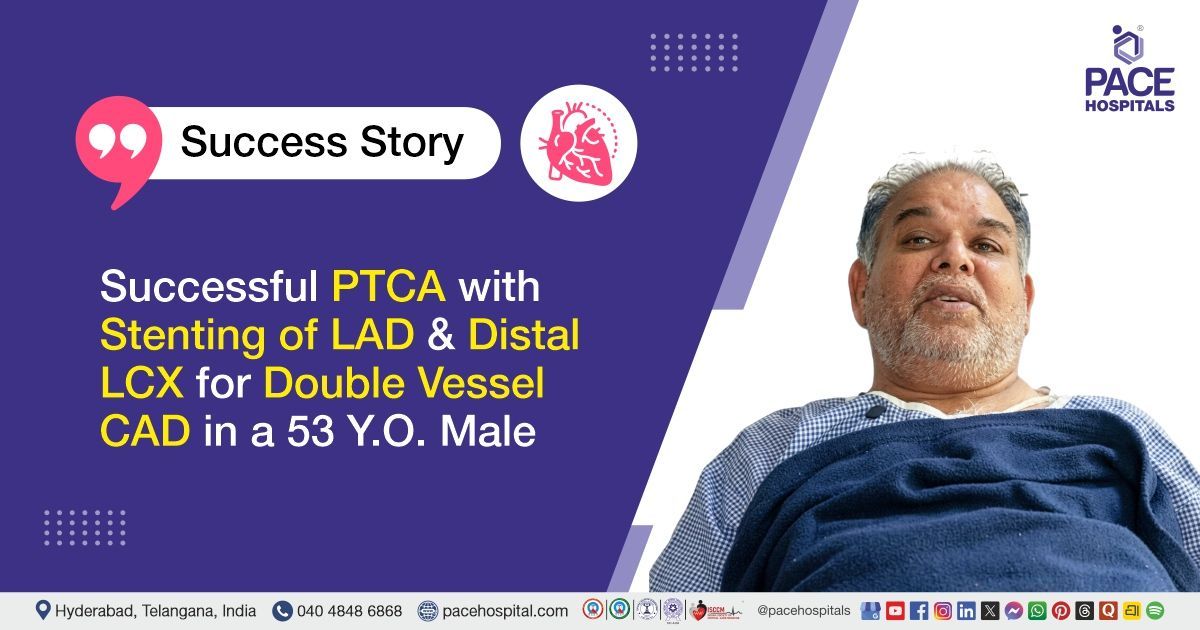
Successful PTCA with Stenting of LAD and Distal LCX for Double Vessel CAD in a 53 Y.O. Male
PACE Hospitals
PACE Hospitals’ expert cardiology team successfully performed a Percutaneous Transluminal Coronary Angioplasty (PTCA) of the Left Anterior Descending (LAD) artery and Left Circumflex artery (LCX) in a 53-year-old male patient diagnosed with Coronary Artery Disease (CAD), along with Hypertension (HTN) and Suspected Obstructive Sleep Apnea (OSA). The procedure was undertaken to restore adequate coronary blood flow, alleviate symptoms such as chest pain and breathlessness, and reduce the risk of future adverse cardiac events, including myocardial infarction.
Chief Complaints
A 53-year-old male patient with a body mass index (BMI) of 21 presented to the Cardiology Department at PACE Hospitals, Hitech City, Hyderabad, with complaints of chest pain and breathlessness on exertion, without associated symptoms such as palpitations, sweating, or orthopnea.
Past Medical History
The patient had a known history of Hypertension (HTN), and there was a suspected history of Obstructive Sleep Apnea (OSA).
On Examination
On examination, the patient was conscious, cooperative, and oriented. There was no pallor, icterus, cyanosis, or pedal edema. Vital signs were stable except for blood pressure. Cardiovascular examination showed normal heart sounds with no added murmurs. Respiratory examination revealed bilateral air entry with no added sounds. The abdomen was soft and non-tender with no organomegaly. Neurological examination was grossly normal, with no focal neurological deficits noted.
Diagnosis
Upon admission to PACE Hospitals, the patient was evaluated by the Cardiology team, which included a detailed review of his medical history and a comprehensive clinical examination. The patient presented with complaints of chest pain on exertion and shortness of breath on exertion, while orthopnea, palpitations, and sweating were absent. The patient was hemodynamically stable at the time of assessment.
Coronary angiography (CAG) revealed double vessel disease (DVD) involving the left anterior descending (LAD) artery and the distal left circumflex (LCX) artery. Laboratory investigations, including complete blood picture (CBP) and renal function tests (RFT), were largely within normal limits. Echocardiographic evaluation showed good left ventricular systolic function with preserved ejection fraction, along with associated hypertension and suspected obstructive sleep apnea (OSA).
Based on these confirmed findings, the patient was advised to undergo
Coronary Artery Disease Treatment in Hyderabad, India, under the expert care of the Cardiology Department.
Medical Decision Making
After a detailed consultation with Dr. Seshi Vardhan Janjirala, Consultant Interventional Cardiologist, a comprehensive evaluation was conducted focusing on the patient’s coronary artery disease (CAD) with double vessel involvement involving the left anterior descending (LAD) artery and the distal left circumflex (LCX) artery. Clinical presentation with exertional chest pain and shortness of breath, along with diagnostic coronary angiography, confirmed significant coronary artery disease requiring intervention.
It was determined that Percutaneous Transluminal Coronary Angioplasty (PTCA) with drug-eluting stent (DES) placement in the LAD and distal LCX arteries under fractional flow reserve (RFR) and ultrasound guidance was identified as the most appropriate management strategy to restore adequate coronary blood flow, relieve symptoms, and prevent future ischemic cardiac events. The procedure was successfully performed with optimal stent deployment in both vessels.
The patient and his family members were informed about his diagnosis, the planned procedure, associated risks, and expected benefits aimed at preserving heart function and enhancing his overall prognosis.
Surgical Procedure
Following the diagnosis, the patient was scheduled for a Percutaneous Transluminal Coronary Angioplasty (PTCA) Procedure in Hyderabad at PACE Hospitals, with stent placement to the left anterior descending (LAD) and Left Circumflex (LCX) arteries under the expert supervision of the Cardiology Department, ensuring optimal care and a smooth recovery process.
The procedure involved the following steps:
- Vascular Access and Preparation: The patient was taken to the cardiac catheterization laboratory under sterile conditions. Local anesthesia was administered, and vascular access was obtained through the appropriate arterial route (radial/femoral). A sheath was inserted to allow passage of diagnostic and interventional catheters.
- Coronary Angiographic Assessment: Coronary angiography (CAG) was performed, which confirmed double vessel disease involving the LAD and distal LCX arteries. Fractional flow reserve (RFR) assessment was used to determine the hemodynamic significance of the lesions before intervention.
- Lesion Crossing and Pre-Dilatation: A guidewire was carefully advanced across the stenotic segments of the LAD and LCX arteries. Balloon pre-dilatation was performed to prepare the lesion site and improve vessel compliance for stent placement.
- Stent Deployment: Drug-eluting stents (XIENCE) were deployed in both the LAD and distal LCX arteries under fluoroscopic and ultrasound guidance. Proper positioning and full expansion of stents were ensured for optimal coronary blood flow restoration.
- Post-Procedure Assessment and Completion: Final angiographic images confirmed successful stent placement with good distal flow and no residual stenosis or complications. Hemostasis was achieved at the access site, and the patient was shifted to the ICU for post-procedure monitoring and stabilization.
Postoperative Care
The procedure and post-procedure course were uneventful. During his hospital stay, he received antiplatelet therapy and supportive therapy to optimise cardiac function and prevent complications following coronary angioplasty with stent placement in two coronary vessels. The vascular access site was monitored regularly for any issues. After achieving stable recovery, the patient was discharged in good condition with detailed instructions on strict medication adherence, lifestyle modifications, and follow-up care.
Discharge Medications
Upon discharge, the patient was prescribed medications for prevention of clot formation within the coronary stents, reduction of platelet aggregation, control of lipid levels to slow progression of atherosclerosis, management of blood pressure and reduction of cardiac workload, improvement of overall cardiovascular protection, and prevention of future cardiac events. Additionally, supportive therapy was provided to reduce inflammation and improve cardiac stability.
Emergency Care
The patient was informed to contact the emergency ward at PACE Hospitals in case of any emergency or development of symptoms such as chest pain, shortness of breath, abdominal pain, or vomiting.
Review and Follow-up Notes
The patient was advised to return for a follow-up visit with the Cardiologist in Hyderabad at PACE Hospitals after 1 week to review his condition.
Conclusion
This case highlights coronary artery disease with double vessel involvement managed successfully with PTCA and drug-eluting stent placement in the LAD and distal LCX. The patient had preserved left ventricular function and showed good symptomatic improvement after the procedure. Post-procedure recovery was uneventful with a stable clinical status. The patient was discharged in stable condition with advice for regular follow-up and secondary prevention.
Physiology-guided PCI in double vessel CAD with preserved LV function
Physiology-guided percutaneous coronary intervention improves outcomes in multivessel coronary artery disease by enabling accurate identification of hemodynamically significant lesions and guiding optimal revascularization. Early invasive evaluation with adjunctive physiological and imaging techniques enhances procedural precision, reduces unnecessary stenting, and ensures appropriate lesion treatment. This approach supports better symptom relief, improved stent optimization, and long-term vessel patency. Preserved ventricular function along with effective risk factor control contributes to a favorable prognosis.
Comprehensive post-procedural medical therapy and regular follow-up remain essential for secondary prevention and reduction of recurrent cardiovascular events. It also helps in individualized treatment planning based on functional significance rather than angiographic appearance alone. Overall, it improves safety and long-term clinical outcomes in complex coronary artery disease managed under the care of a Cardiologist / Heart specialist.
Frequently Asked Questions (FAQs)
When is angioplasty (PTCA) usually advised in heart blockages?
Angioplasty (PTCA) is usually done when the heart’s blood vessels are badly narrowed and the person has symptoms like chest pain during activity. Tests like angiography are used to check if blood flow to the heart is reduced. When two blood vessels are blocked, treatment becomes more important. Opening these blocked arteries helps improve blood flow to the heart and lowers the risk of a heart attack.
What does double vessel disease (DVD) indicate in this condition?
Double vessel disease means that two major heart arteries have blockages. This can limit blood flow to the heart, particularly during physical activity. It may result in symptoms such as chest discomfort or shortness of breath. Treating both vessels improves circulation and helps reduce future heart-related risks.
Why are drug-eluting stents commonly used in some cases?
Drug-eluting stents are used because they slowly release medicine that helps prevent the artery from narrowing again. This makes them more effective over the long term compared to older types of stents. They are especially helpful in important arteries like the LAD. Their use lowers the chances of needing another procedure later.
How does normal heart pumping function affect recovery?
A normal pumping function means the heart is still working well despite the blockage. This is a positive sign and supports a smoother recovery after the procedure. It also lowers the risk of complications like heart failure. Patients with good heart function usually return to normal activities faster.
Why are advanced techniques like RFR and imaging used during angioplasty?
Techniques like RFR help identify which blockages actually need treatment. This avoids unnecessary procedures. Imaging guidance helps place the stent accurately inside the artery. Together, these methods improve the success of the procedure and reduce the chances of complications.
Why are several medicines given after stent placement?
Different medicines are needed because each one has a specific role. Some prevent blood clots inside the stent, while others control blood pressure and heart workload. A combination of these medicines helps protect the heart in the long run. Taking them regularly is important for preventing future problems.
What lifestyle changes are important after this procedure?
Healthy lifestyle habits play a major role after angioplasty. A balanced diet, regular walking, and avoiding smoking help keep the arteries healthy. Managing stress and controlling blood pressure are also important. These changes support the treatment and help prevent new blockages.
What does Grade II diastolic dysfunction mean?
Grade II diastolic dysfunction means the heart does not relax properly while filling with blood. This can sometimes cause breathlessness, especially during activity. Even though the pumping function is normal, this condition needs monitoring. Proper treatment and lifestyle changes help manage it effectively.
Why is follow-up needed after angioplasty?
Follow-up visits help check how well the heart is recovering after the procedure. They also allow doctors to adjust medicines if needed. Regular check-ups help in controlling risk factors like high blood pressure. This reduces the chances of future heart issues.
Which symptoms after discharge should not be ignored?
Symptoms like new or increasing chest pain, severe shortness of breath(SOB), or fainting should not be ignored. Persistent vomiting, fever, or unusual swelling also needs attention. These could be signs of complications after the procedure. Early medical care helps prevent serious problems.
Share on
Request an appointment
Fill in the appointment form or call us instantly to book a confirmed appointment with our super specialist at 04048486868
Appointment request - health articles
Recent Articles