Endoscopic Spine Surgery: Guide to Minimally Invasive Spine Treatment
PACE Hospitals
Back pain and pain travelling down the leg can make even simple activities such as walking, sitting, sleeping or working difficult. When tests show a slipped or herniated disc pressing on a spinal nerve, surgery may sometimes be considered if symptoms do not improve with appropriate non-surgical treatment.
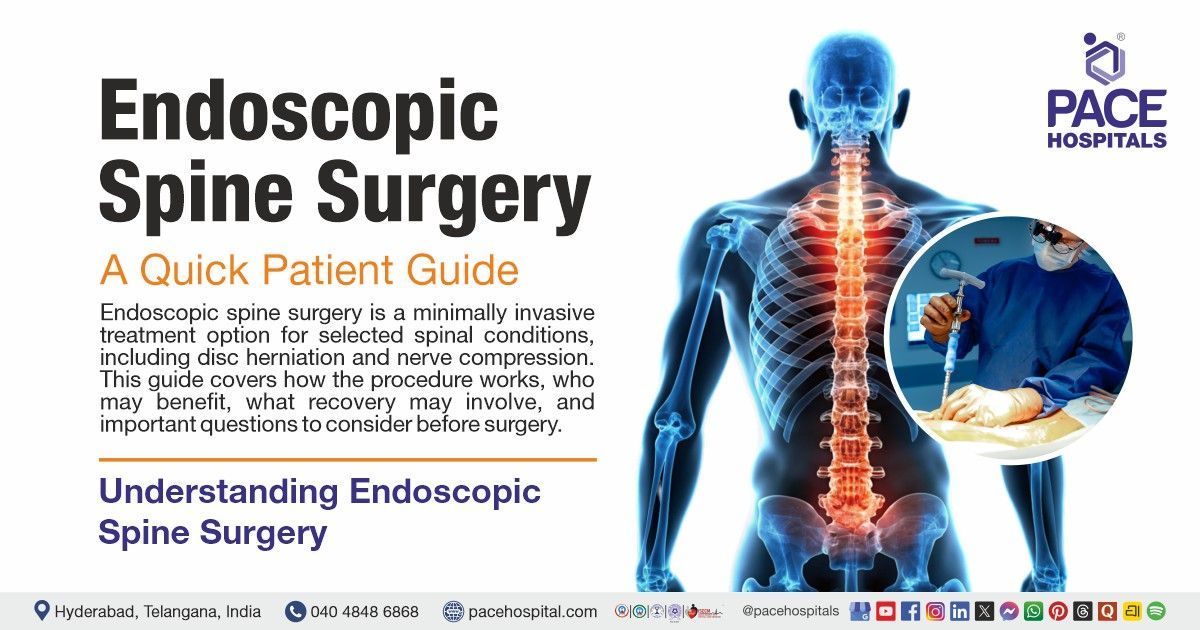
Endoscopic spine surgery is a minimally invasive technique used to treat certain spinal conditions through a small working pathway. It allows the spine surgeon to see the affected area using a specialised camera and use fine instruments to relieve pressure on the affected nerve.
However, endoscopic spine surgery is not required for every disc problem, and it is not suitable for every patient. The decision depends on the patient's symptoms, neurological examination, imaging findings and the underlying spinal condition.
This guide explains how endoscopic spine surgery works, when it may be considered, what patients can expect during recovery, and what to discuss with a spine specialist before deciding on surgery.
What Is Endoscopic Spine Surgery?
Endoscopic spine surgery is a minimally invasive surgical technique used to access and treat selected problems affecting the spine and spinal nerves.
Instead of using a larger surgical exposure, the spine surgeon creates a small access pathway through which a specialised endoscope is introduced. The endoscope has a camera that provides a magnified view of the surgical area. Small instruments can then be passed through the working channel to remove or treat the tissue causing nerve compression.
For example, when a herniated disc is pressing on a nerve, the purpose of the procedure may be to remove the problematic disc fragment and decompress the affected nerve.
The aim is not simply to make the incision as small as possible. The important goal is to relieve the problem safely while avoiding unnecessary disruption to the surrounding tissues.
How Does Endoscopic Spine Surgery Work?
Before recommending surgery, the spine specialist evaluates the patient's symptoms, neurological examination and imaging studies. This helps determine whether the abnormality seen on a Magnetic Resonance Imaging (MRI) or or CT scan is actually responsible for the patient's symptoms.
During the Endoscopic Spine Surgery procedure, imaging guidance may be used to identify the appropriate spinal level. The spine surgeon and the orthopaedic surgical team then establish a suitable working pathway and introduce the endoscopic system.
The camera provides a clear view of the affected area, while specialised instruments are used to reach and decompress the nerve or remove the tissue responsible for the compression.
The exact approach, anaesthesia, procedure time and surgical technique can vary depending on the spinal condition and the individual patient.
What Are the Main Types of Endoscopic Spine Surgery?
The type of endoscopic spine surgery recommended depends on the spinal condition, the level of nerve compression, imaging findings, and the patient’s symptoms. The commonly performed procedures include:
- Endoscopic Discectomy: This procedure is used to remove the part of a slipped or herniated disc that is pressing on a spinal nerve. It may help relieve radiating leg pain, numbness, tingling, or weakness caused by nerve compression.
- Endoscopic Foraminotomy: It helps widen the foramen, the natural opening through which spinal nerves exit the spine. This may be considered when narrowing due to bone spurs, disc bulge, or degenerative changes is causing nerve irritation.
- Endoscopic Decompression: This technique creates more space for compressed spinal nerves by carefully removing the tissue, thickened ligament, or small portions of bone responsible for the narrowing. It may be advised for selected cases of spinal stenosis.
- Endoscopic Laminotomy: In this procedure, a small part of the lamina—the bone at the back of the vertebra—is removed to access and relieve pressure on the affected nerve structures while preserving surrounding tissues as much as possible.
- Endoscopic Rhizotomy: This procedure may be considered for selected patients with persistent facet-joint-related back pain. It targets small sensory nerve branches that carry pain signals from the facet joints after the pain source has been clinically assessed.
- Endoscopic-Assisted Spinal Fusion: In selected cases involving spinal instability or advanced degenerative changes, minimally invasive or endoscopic-assisted techniques may be combined with spinal fusion to stabilise the affected spinal segment.
What Are the Common Surgical Approaches in Endoscopic Spine Surgery?
Endoscopic spine surgery may be performed through different access routes. The surgeon selects the approach based on the spinal level involved, the position of the disc problem or nerve compression, the patient’s anatomy, and MRI findings.
- Transforaminal Approach: The surgeon accesses the spine through the side of the back, using the natural opening called the intervertebral foramen, where a spinal nerve exits. It is commonly used for selected disc herniations and nerve compression affecting the foraminal or extraforaminal region.
- Interlaminar Approach: The surgeon reaches the affected area through the space between two adjacent laminae—the bony structures at the back of the spine. This approach may be useful for selected central or lateral-recess nerve compression and is often considered for suitable lower-lumbar conditions, including some L5–S1 disc herniations.
When Is Endoscopic Spine Surgery Recommended?
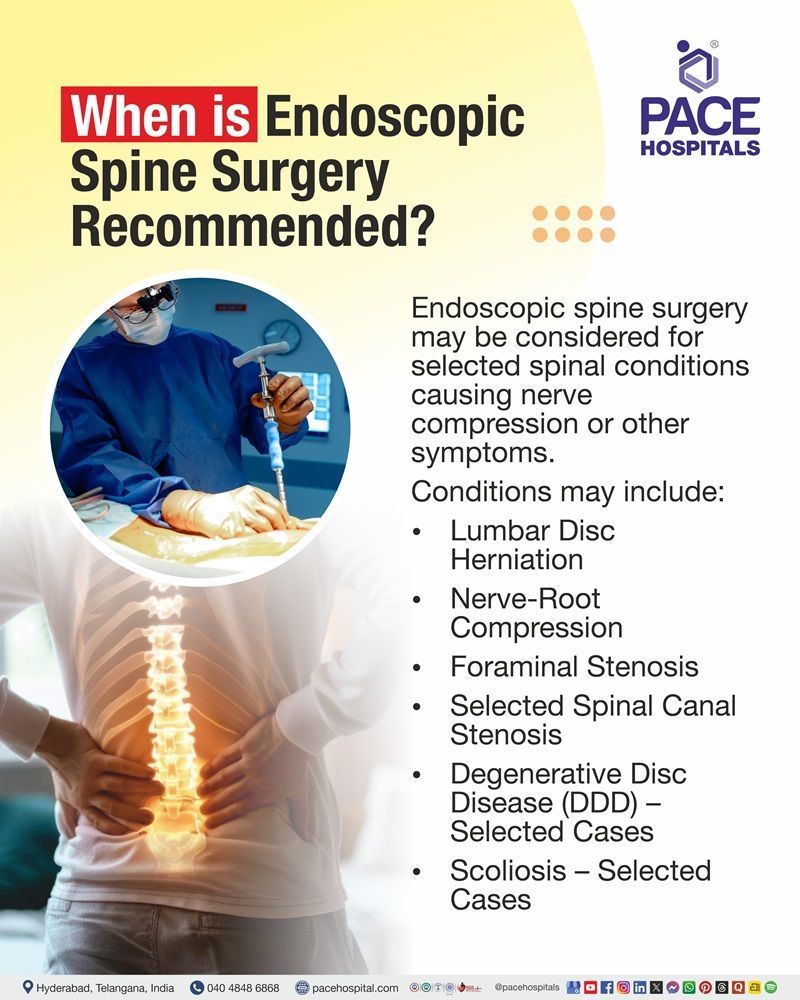
Endoscopic spine surgery may be considered when a specific spinal problem is causing symptoms that can be appropriately treated through an endoscopic approach.
Depending on the individual case, endoscopic techniques may be used for conditions such as:
- Lumbar disc herniation (Herniated Discs)
- Nerve-root compression
- Foraminal stenosis
- Selected cases of spinal canal stenosis
- Degenerative disc disease (DDD) in selected cases
- Scoliosis
Surgery may also be considered when significant symptoms continue despite appropriate non-surgical treatment, particularly when pain is interfering with sleep, walking, work or everyday activities. Progressive numbness or muscle weakness can also influence the decision to consider surgical treatment.
A disc bulge on Magnetic Resonance Imaging (MRI) does not necessarily necessitate endoscopic spine surgery. Endoscopic Spinal surgery should be appropriate for the patient's symptoms.
When Do Symptoms Suggest that Endoscopic Spine Surgery May Be Needed?
Endoscopic spine surgery may be considered when symptoms are caused by a spinal condition that can be treated effectively through an endoscopic approach. The decision is usually based on the combination of symptoms, physical examination, MRI findings and response to non-surgical treatment.
Surgery may be considered when persistent back or leg pain continues despite appropriate treatment and starts affecting sleep, walking, work or daily activities. Progressive numbness or muscle weakness may also indicate significant nerve compression and require surgical evaluation.
However, having a disc bulge or other abnormality on an MRI does not automatically mean that surgery is necessary. Some spinal changes may be present without causing symptoms. For this reason, the MRI findings need to match the patient's symptoms and clinical examination before endoscopic spine surgery is recommended.
How Does Endoscopic Spine Surgery Treat Nerve Compression?
When a herniated disc or other spinal tissue presses on a nerve, it can cause pain, numbness, tingling or weakness. Endoscopic spine surgery uses a small working pathway to reach the affected area and remove or release the tissue causing the pressure. This helps create space around the nerve and relieve the compression.
Why Does a Slipped Disc Cause Leg Pain?
The spine consists of a series of vertebrae separated by discs. These discs act as cushions between the bones and help the spine absorb loads during everyday movement.
When part of a disc protrudes or herniates, it can irritate or compress a nearby spinal nerve. The resulting symptoms may extend beyond the lower back. A person may experience pain travelling from the back into the buttock, thigh, calf or foot. This type of nerve-related pain is commonly known as sciatica.
Depending on the severity and location of nerve compression, symptoms can also include:
- Burning or electric-shock-like pain
- Tingling or pins-and-needles
- Numbness
- Muscle weakness
- Difficulty lifting the foot or standing on the toes
This is why doctors do not look at the Magnetic Resonance Imaging (MRI) alone when assessing a slipped disc. The imaging finding needs to correspond with the patient's symptoms and clinical examination.
Who May Be a Candidate for Endoscopic Spine Surgery (Indications)?
Endoscopic spine surgery may be considered when a patient has a clearly identified spinal problem that can be safely treated using an endoscopic minimally invasive approach. The decision is not based on the Magnetic Resonance Imaging (MRI) report alone.
A spine specialist and Endoscopic Spine Surgeon will usually consider:
- Whether the patient's symptoms match the findings on the MRI or other imaging
- Whether a specific nerve or spinal structure is being compressed
- Whether appropriate non-surgical treatment has been tried and has not provided sufficient relief
- Whether there is a neurological problem, such as progressive numbness or weakness
- Whether endoscopic surgery can adequately and safely address the underlying problem
Two patients may have the same-looking disk prolapse on Magnetic Resonance Imaging (MRI), yet they require different therapies. The location of the disk, the direction in which it has shifted, the nerve affected, any concomitant constriction or instability, and any previous spine surgery can all have an impact on treatment.
As a result, being told that a patient has a slipped disk does not necessarily entail that the patient requires endoscopic spine surgery. The minimally invasive surgical technique should only be recommended if it is appropriate for the patient's condition.
Who May Not Be Suitable for Endoscopic Spine Surgery?
Endoscopic spine surgery is not the right option for every patient or every spinal condition. Some problems may require a different surgical approach to achieve adequate treatment.
A simple endoscopic procedure may not be suitable in situations involving:
- Significant spinal instability
- Major spinal deformity
- Severe multilevel spinal disease
- Certain types of fractures
- Certain spinal tumours or infections
- Conditions requiring spinal reconstruction, stabilisation or fusion
The important consideration is whether the chosen procedure can safely and adequately treat the underlying problem. A smaller incision is not necessarily better if it cannot address the actual cause of the patient's symptoms.
What Happens During Endoscopic Spine Surgery?
Before the procedure, the spine surgeon evaluates the symptoms, physical examination findings and imaging results to identify the exact cause of the problem. The general health and suitability for anaesthesia are also assessed for the patient.
- During the procedure, a small working pathway is created to reach the affected part of the spine. A specialised endoscope with a camera is then inserted through this pathway, allowing the surgeon to view the surgical area on a monitor.
- Fine surgical instruments are passed through the endoscope to treat the problem. For example, when a herniated disc is pressing on a nerve, the surgeon may remove the disc fragment responsible for the compression and relieve pressure on the affected nerve.
- After adequate decompression is achieved, the instruments are removed and the incision is closed. The exact technique and approach can vary depending on the spinal level, location of the problem and the patient's individual anatomy.
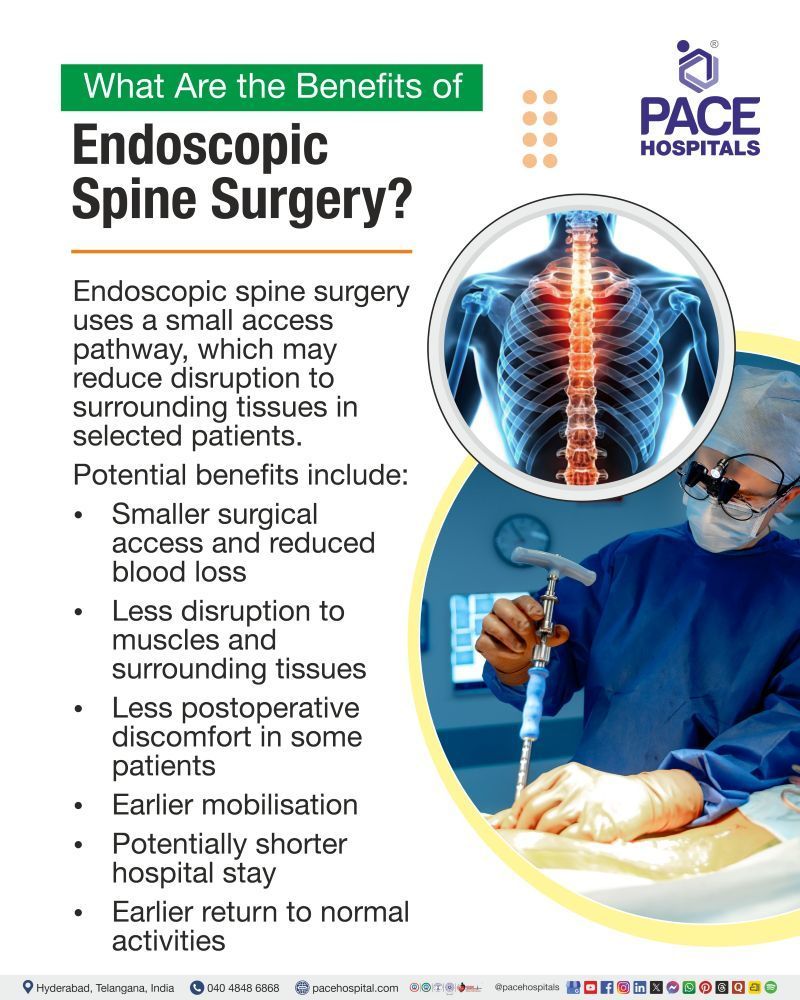
What Are the Benefits of Endoscopic Spine Surgery?
Because endoscopic spine surgery uses a small access pathway, it can limit the amount of muscle and soft-tissue disruption involved in reaching the affected area. For patients who are suitable for this approach, this may offer several potential benefits.
These may include:
- Smaller surgical access and reduced blood loss
- Less disruption to the surrounding muscles and tissues compared to open surgery
- Less postoperative discomfort in some patients
- Earlier mobilisation after the procedure
- Potentially shorter hospital stay
- Earlier return to normal activities in appropriately selected patients
The actual recovery and benefits can vary from one person to another. They depend on the spinal condition being treated, the surgical technique used and the patient's overall health. Endoscopic surgery should therefore be considered based on whether it is appropriate for the particular spinal problem, rather than on the size of the incision alone.
Endoscopic Spine Surgery vs Traditional Spine Surgery: What Is the Difference?
Endoscopic and traditional spine surgery use different ways of reaching and treating problems in the spine. The choice between them depends on the condition being treated and the type of surgery required.
- Endoscopic surgery uses a small working pathway to reach selected spinal problems while limiting disruption to the surrounding tissues. Traditional surgery may involve a larger surgical exposure when wider access is needed.
- For some patients, endoscopic surgery may offer advantages such as less tissue disruption, reduced postoperative discomfort and earlier mobilisation. However, these benefits are not the same for everyone.
- Some spinal disorders may be best addressed with traditional surgery or another minimally invasive method. As a result, rather than selecting the technique with the shortest incision, the decision should be made based on which strategy can address the patient's individual problem safely and efficiently.
Does Endoscopic Spine Surgery Require Screws?
Many patients worry that spine surgery automatically means having screws or other implants placed in the spine. This is not always the case.
In a straightforward endoscopic discectomy, where the main problem is a disc fragment pressing on a nerve, screws may not be necessary. The procedure is focused on relieving the pressure on the affected nerve.
However, some patients may need stabilisation or fusion in addition to decompression. This can be considered when there is spinal instability, deformity, certain fractures, recurrent problems or other structural changes that cannot be adequately treated with decompression alone.
If screws or fusion have been recommended, it is reasonable to ask a spine surgeon why they are needed in a particular case. The choice depends on the underlying spinal problem and the treatment required, rather than simply on whether the surgery is endoscopic or conventional.
Endoscopic Spine Surgery Recovery Time: What to Expect?
Recovery after endoscopic spine surgery can vary depending on the spinal condition treated, the type of procedure performed and the patient's overall health. Some patients may be able to start walking relatively soon after surgery, depending on their condition and the advice of their medical team.
Improvement in symptoms may also happen at different rates. Leg pain caused by nerve compression may improve earlier, while numbness can take longer to settle. If there is muscle weakness, recovery may take more time because the affected nerve needs time to regain its function.
Even if a person feel better soon after surgery, the spine still needs time to recover. Activities such as heavy lifting, repeated bending and strenuous exercise should not be resumed immediately. A surgeon will guide a patient on gradually returning to normal activities and work. Following the recommended rehabilitation and activity guidelines can help support a safe recovery.
What Are the Risks and Possible Complications of Endoscopic Spine Surgery?
Endoscopic spine surgery is minimally invasive, but like any surgical procedure, it can have risks. The possible complications depend on the type of procedure, the spinal condition being treated and the patient's individual health.
Possible risks may include:
- Infection
- Bleeding
- Nerve injury
- Dural injury or cerebrospinal fluid (CSF) leak
- Persistent symptoms
- Incomplete decompression of the affected nerve
- Recurrence of a disc herniation
- Need for further surgery in some cases
- Anaesthesia-related complications
Having a small incision does not mean that the procedure is completely risk-free. A spine surgeon can explain the risks that are relevant to your particular condition and procedure before surgery.
Can a Disc Prolapse Come Back After Surgery?
Yes, a disc herniation can recur even after successful spine surgery. Removing the disc fragment causing nerve compression does not completely eliminate the possibility of another disc herniation in the future.
The risk of recurrence can occur regardless of whether the disc problem is treated through an endoscopic, microscopic or conventional surgical approach.
After recovery, long-term spine care remains important. Maintaining a healthy body weight, building core and back strength, staying physically active, using proper lifting techniques and avoiding smoking may help support overall spinal health.
A gradual return to strenuous activities is generally recommended, based on the advice provided by the treating medical team.
What Questions Should Patients Ask Their Spine Surgeon Before Surgery?
A detailed discussion with the spine surgeon can help patients understand the reason for surgery, the available treatment options and what to expect from the procedure and recovery.
Important questions may include:
- What is causing the symptoms?
- Does the imaging finding explain the symptoms?
- Can the condition improve without surgery?
- Why is surgery being recommended at this stage?
- Is endoscopic spine surgery suitable for the condition?
- Is decompression alone sufficient, or is stabilisation or fusion also needed?
- What are the available alternatives?
- What are the possible risks and complications?
- What may happen if surgery is delayed?
- What level of improvement can realistically be expected after surgery?
Understanding these points can help patients and their families make an informed decision based on the individual spinal condition and treatment options.
Frequently Asked Questions (FAQs) on Endoscopic Spine Surgery
Is endoscopic spine surgery suitable for every patient?
No. Endoscopic spine surgery is considered for selected spinal conditions where the problem can be safely and adequately treated using an endoscopic approach. The decision depends on the symptoms, neurological examination, imaging findings and the nature of the spinal problem.
Is endoscopic spine surgery completely painless?
No surgery can be guaranteed to be completely painless. Some patients may experience less postoperative discomfort because the technique can involve less disruption of surrounding tissues, but pain and recovery vary between individuals.
How soon can a patient walk after endoscopic spine surgery?e or Question
Depending on the procedure and the patient's condition, walking may begin relatively early after surgery. However, early walking does not mean that the spine has completely healed. Activities should be increased gradually according to medical advice.
How quickly does leg pain improve after endoscopic spine surgery?
When leg pain is mainly caused by nerve compression and the nerve is successfully decompressed, improvement may occur relatively early in some patients. The recovery time varies depending on the severity and duration of nerve compression.
What is the endoscopic spine surgery cost at PACE Hospitals, Hyderabad, India?
The endoscopic spine surgery cost at PACE Hospitals varies based on the diagnosis, overall health, medical history, imaging findings and the type and complexity of the procedure required. A spine specialist first assesses whether endoscopic surgery is suitable for the individual condition, after which the treating team can provide an appropriate cost estimate.
Can L4-L5 or L5-S1 disc problems be treated with endoscopic surgery?
Endoscopic techniques can be used for suitable disc herniations at levels such as L4-L5 and L5-S1. However, the spinal level alone does not determine whether the procedure is appropriate. The location and size of the disc fragment, its migration, the affected nerve, associated stenosis, spinal stability and previous surgery are also considered.
Can a disc prolapse recur after surgery?
Yes. Disc herniation can recur after surgery, and the risk is not completely eliminated by an endoscopic procedure. Appropriate long-term spine care remains important after recovery.
Is endoscopic spine surgery the same as keyhole spine surgery?
Yes. Endoscopic spine surgery is often described as keyhole spine surgery because the procedure is performed through a small access pathway rather than a larger surgical opening.
What conditions can be treated with endoscopic spine surgery?
Depending on the individual case, endoscopic techniques may be used for lumbar disc herniation, nerve-root compression, foraminal stenosis and selected cases of spinal canal stenosis.
Does every slipped or herniated disc require surgery?
No. Many patients with disc problems improve with non-surgical treatment. The decision about surgery depends on symptoms, neurological examination and imaging findings rather than the MRI report alone.
When is spine surgery considered for a herniated disc?
Surgery may be considered when significant symptoms continue despite appropriate non-surgical treatment, when pain substantially affects daily activities, or when progressive numbness or weakness develops.
Does endoscopic spine surgery remove the entire disc?
Not usually. In a routine endoscopic discectomy, the aim is generally to remove the disc fragment causing nerve compression and relieve pressure on the affected nerve. The exact amount of tissue removed depends on the individual condition.
Is endoscopic spine surgery better than traditional spine surgery?
There is no single surgical approach that is suitable for every spinal condition. Endoscopic surgery may provide advantages for appropriately selected patients, while conventional or other minimally invasive procedures may be more appropriate for certain conditions.
How soon can a patient walk after endoscopic spine surgery?
Walking may begin relatively early in selected patients, depending on the procedure and overall condition. Early mobilisation does not mean that the spine has completely healed, so activity should be increased gradually.
What is the endoscopic spine surgery success rate at PACE Hospitals, Hyderabad, India?
The endoscopic spine surgery success rate can vary depending on the condition being treated, severity of nerve compression and individual patient factors. At PACE Hospitals, more than 90% of patients report less pain and improved mobility after endoscopic spine surgery. The expected outcome can vary between patients and is best discussed with a spine specialist after evaluation of the symptoms, clinical findings and imaging.
Share on
Request an appointment
Fill in the appointment form or call us instantly to book a confirmed appointment with our super specialist at 04048486868
Appointment request - health articles
Recent Articles